CM Sai Honours Teejan Bai With Folk Award, Art Village
Synopsis
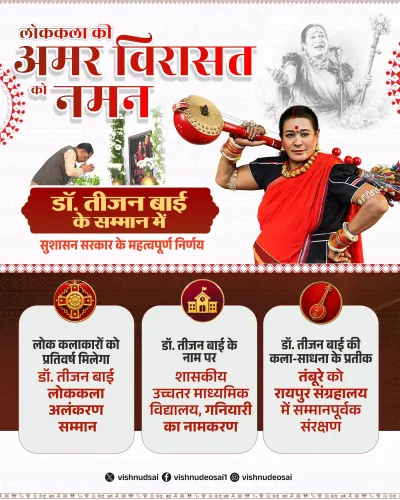
The Chhattisgarh government under CM Vishnu Deo Sai announces the Teejan Bai Lokkala Alankaran folk-arts award, to be given from 2026, and plans to develop Pandavani legend Teejan Bai's native village Ganiyari into a Kala Gram to preserve the state's folk heritage.
Key Takeaways
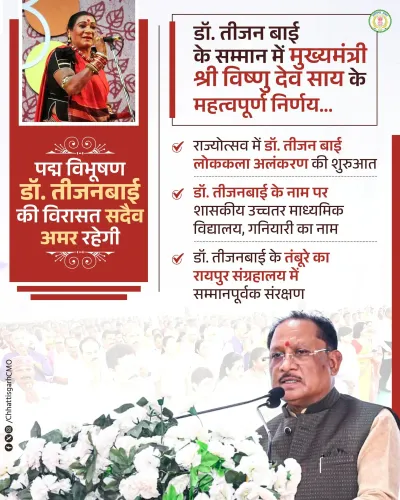
The Chhattisgarh CMO announced on October 25, 2026 two new cultural initiatives honouring Padma Vibhushan late Teejan Bai .
A new folk-arts honour, the Lokkala Alankaran , will be awarded in Teejan Bai's name starting in 2026 itself .
Ganiyari , Teejan Bai's native village, will be developed into a Kala Gram (Art Village).
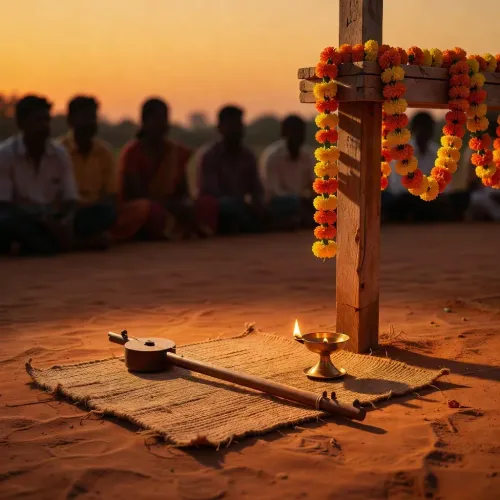
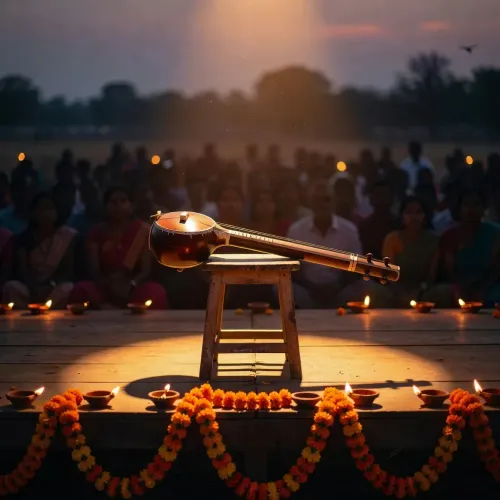
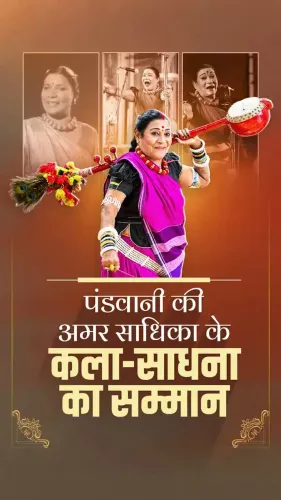
Teejan Bai was the foremost exponent of Pandavani , a Chhattisgarhi oral folk tradition based on the Mahabharata, and held the Padma Vibhushan .
The initiatives are framed as a step to safeguard Chhattisgarh's folk tradition and pass it to future generations.
The first recipients of the Teejan Bai Lokkala Alankaran and the Ganiyari project blueprint are the immediate milestones to watch.
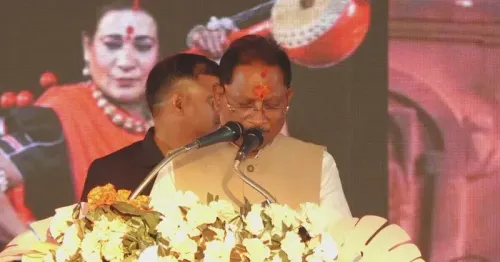
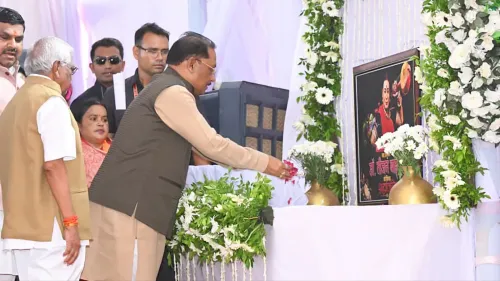
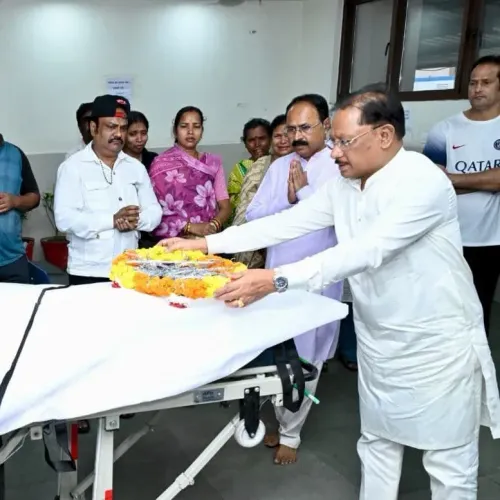
A legend's life ends, but a state's memory need not. The Chief Minister's Office of Chhattisgarh announced on Sunday, October 25, 2026 that the government of Chief Minister Vishnu Deo Sai will institute a dedicated folk-arts honour in the name of Padma Vibhushan late Teejan Bai — starting this very year — and will develop her native village Ganiyari into a full-fledged Kala Gram (Art Village) to preserve the Chhattisgarhi performing-arts tradition for generations ahead.
The CMO's post in Hindi framed the twin moves as 'a significant step in the direction of safeguarding Chhattisgarh's glorious folk-art tradition and passing it on to coming generations' — language that signals a deliberate state policy shift from passive acknowledgement to active institutionalisation of Pandavani, the oral epic tradition Teejan Bai made world-famous.
Who Was Teejan Bai — and Why Pandavani Matters
Teejan Bai was the most celebrated exponent of Pandavani, a folk performance form from Chhattisgarh in which a single artist narrates and enacts episodes from the Mahabharata, holding audiences with voice, percussion, and storytelling alone. Her mastery earned her successive national recognition, culminating in the Padma Vibhushan — India's second-highest civilian honour — cementing her status as the living face of Chhattisgarhi culture. Her passing has left a generational vacuum that the state is now moving to fill institutionally.
The Lokkala Alankaran: A Named Award From This Year
The government's announcement of the Lokkala Alankaran — a folk-arts decoration bearing Teejan Bai's name — to be awarded starting in 2026 itself, signals urgency. Named awards of this kind, conferred by state governments in the wake of a legendary practitioner's death, serve a dual purpose: they keep the master's name in public circulation and create a recurring incentive structure for working folk artists who might otherwise receive no official recognition. The first recipients of the Teejan Bai Lokkala Alankaran are now the immediate thing to watch — their selection will signal how broadly or narrowly the state defines the folk-arts community it means to honour.
Ganiyari's Transformation Into a Kala Gram
Equally significant is the plan to develop Ganiyari — a village in Chhattisgarh where Teejan Bai was born and raised — as a Kala Gram. The concept of a dedicated art village, where performance, craft, documentation, and training co-exist in a single living space, has precedent across India as a mechanism to keep traditional forms from becoming museum pieces. For Ganiyari, the proposal holds real economic promise too: a well-executed Kala Gram draws cultural tourists, creates livelihoods for local artists, and anchors the community's identity around its most famous daughter. The detailed project blueprint and timeline remain to be announced.
Sai Government's Cultural Signal
Since Chhattisgarh's formation as a separate state, successive governments have recognised that the region's folk wealth — Pandavani, Raut Nacha, Karma dance, Panthi — is both a cultural asset and a source of soft identity that distinguishes the young state on the national stage. The Vishnu Deo Sai government's moves today fit a broader pattern: converting individual greatness into durable institutions before memory fades. The test will be in execution — whether the award carries prestige and prize money that genuinely elevates folk artists, and whether Ganiyari's Kala Gram gets the infrastructure investment to match the vision.
Teejan Bai gave Chhattisgarh the world's ear. The state has now committed, in writing and in policy, to making sure the world keeps listening.
Point of View
A relatively young state, gains symbolic cohesion by elevating its indigenous folk forms to the level of state ceremony. The challenge, as with many such announcements, lies entirely in the quality of follow-through — specifically, whether the Lokkala Alankaran carries real prestige and resources, and whether Ganiyari gets substantive investment or merely a designation on paper.
NationPress
25 Oct 2026
Frequently Asked Questions
Who was Teejan Bai and what is Pandavani?
Teejan Bai was Chhattisgarh's most celebrated folk artist and the foremost exponent of Pandavani — a solo performance tradition in which the artist narrates and enacts episodes from the Mahabharata using voice, percussion and movement. She received the Padma Vibhushan, India's second-highest civilian honour, for her contributions.
What is the Teejan Bai Lokkala Alankaran?
The Lokkala Alankaran is a new folk-arts honour announced by the Chhattisgarh government in Teejan Bai's name. The CM's office confirmed it will be awarded starting in 2026 itself, though details of the selection process and prize structure are yet to be made public.
What is the Ganiyari Kala Gram project?
The Chhattisgarh government plans to develop Ganiyari — Teejan Bai's native village — into a Kala Gram, or Art Village. The concept involves creating a space where folk performance, craft, documentation, and artist training coexist, preserving the state's traditional arts while also generating cultural-tourism activity.
Which government announced these cultural initiatives?
The government of Chhattisgarh under Chief Minister Vishnu Deo Sai announced both the Lokkala Alankaran award and the Ganiyari Kala Gram project on October 25, 2026.
Why is Chhattisgarh launching these folk-culture schemes?
The CMO framed the initiatives as a step to preserve Chhattisgarh's 'glorious folk-art tradition' and pass it to future generations. Named awards and designated heritage sites are a common mechanism Indian state governments use to institutionalise recognition of traditional performing arts, particularly after the passing of a leading practitioner.