CM Yogi Calls Disaster Vigilance a Daily Civic Duty
Synopsis
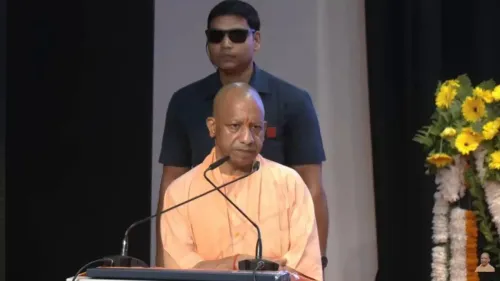
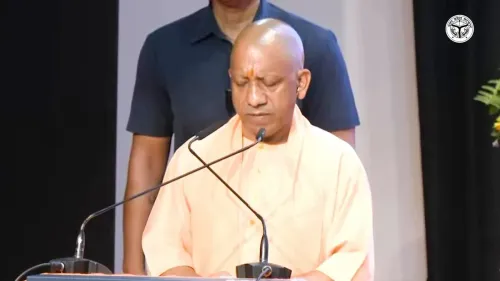
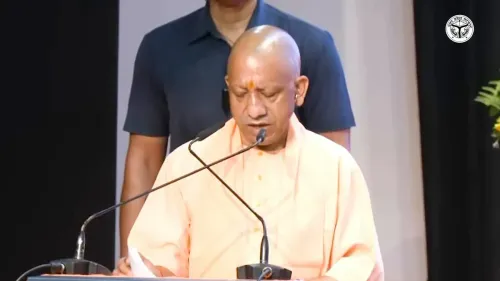
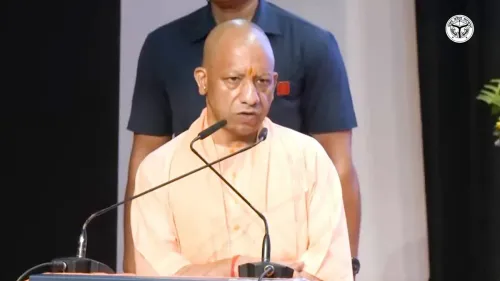
The Chief Minister's Office of Uttar Pradesh quoted CM Yogi Adityanath on 19 July 2026 stressing that vigilance, preparedness, and awareness towards disasters must become part of every citizen's daily routine — framing resilience as a civic duty, not just a state function.
Key Takeaways
The Chief Minister's Office of Uttar Pradesh posted the statement on 19 July 2026 , quoting CM Yogi Adityanath directly.
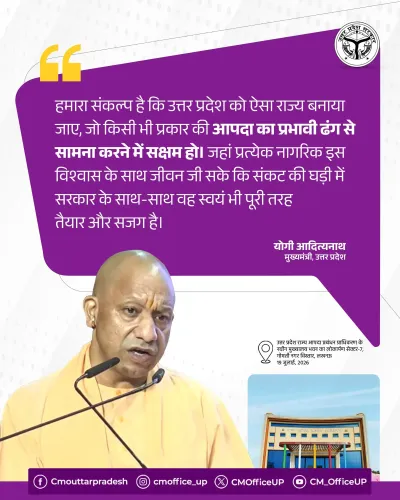
CM Yogi stated that 'vigilance, preparedness, and awareness' are the only tools to minimise loss of life and property in disasters.
He called disaster readiness 'an inseparable part of all our daily lives,' shifting the frame from crisis response to everyday civic duty.
Uttar Pradesh's 75 districts are covered by the UP State Disaster Management Authority , which revises its disaster plan periodically after major flood events.
The state's eastern and Terai districts face recurrent Ganga basin flooding every monsoon, making community-level awareness especially critical.
India's disaster governance aligns with the 2015 Sendai Framework , which prioritises preparedness over post-event relief — the same philosophy underpinning CM Yogi's statement.
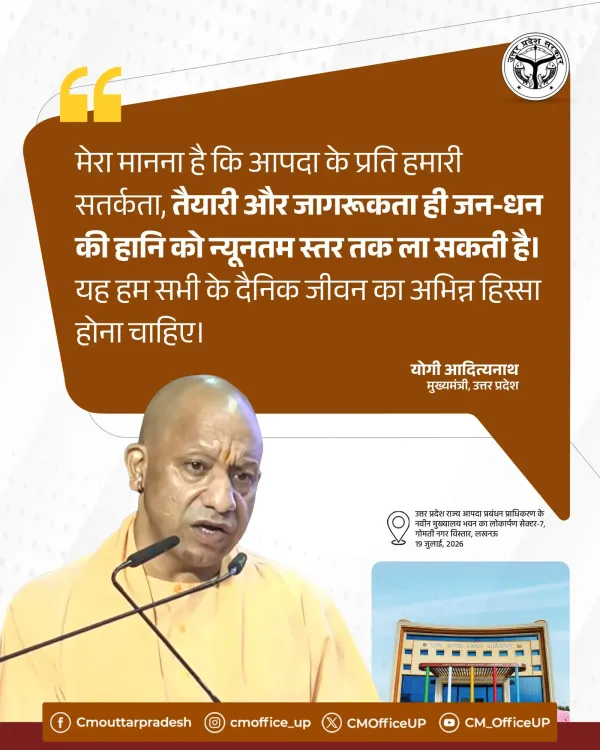
The Chief Minister's Office of Uttar Pradesh, citing Chief Minister Yogi Adityanath, on Sunday, 19 July 2026, underscored that public alertness, preparedness, and awareness are the only effective tools to minimise loss of life and property in disasters — and that these must become part of every citizen's daily routine.
Context
The statement, posted in Hindi, quotes CM Yogi Adityanath directly: 'मेरा मानना है कि आपदा के प्रति हमारी सतर्कता, तैयारी और जागरूकता ही जन-धन की हानि को न्यूनतम स्तर तक ला सकती है।' ('I believe that our vigilance, preparedness, and awareness towards disaster alone can bring the loss of lives and property to a minimum level.') He added that this must be 'an inseparable part of all our daily lives.' The message frames disaster readiness not as a crisis-time response but as a standing civic obligation.
Policy Backdrop
Uttar Pradesh operates under the framework of the National Disaster Management Act, 2005, which mandated the creation of state-level disaster management authorities across India. The Uttar Pradesh State Disaster Management Authority (UP SDMA) serves as the nodal agency for preparing annual disaster management plans and coordinating monsoon and flood response across the state's 75 districts. The State Disaster Management Plan has been revised multiple times following major flood seasons, including those of 2013 and 2021, with increasing emphasis on community-level early-warning systems.
India's disaster governance architecture is also shaped by the 2015 Sendai Framework for Disaster Risk Reduction, a global accord that explicitly prioritises preparedness and risk reduction over post-event relief — precisely the philosophy CM Yogi's statement echoes. Integrating this framework into routine state governance has been a stated goal of central and state disaster bodies alike.
Stakeholders and Impact
Uttar Pradesh is among India's most disaster-exposed states. Its eastern districts and the Terai belt along the Nepal border face recurrent Ganga basin flooding every monsoon season, affecting millions of residents, agricultural land, and rural infrastructure. District administrations and State Disaster Response Force (SDRF) personnel are the primary first responders, but the Chief Minister's framing places equal weight on community-level awareness as a force multiplier for official preparedness machinery.
For ordinary citizens — particularly in flood-prone rural areas — the call to embed disaster awareness into daily life signals a governance push toward decentralised, bottom-up resilience rather than reliance solely on state machinery. Urban residents in cities such as Lucknow, Varanasi, and Prayagraj, which face both flooding and seismic risk, are equally within the scope of such messaging.
What's Next
The annual pre-monsoon review meetings of the UP SDMA are the immediate institutional forum where such directives translate into operational orders — covering stockpiling of relief material, deployment of SDRF teams, and activation of early-warning communication channels. Any revision to the State Disaster Management Plan ahead of the 2027 rainy season will be a concrete indicator of whether this public statement is followed by structural policy action. Citizens and civil society groups in high-risk districts will be watching for district-level preparedness drills and community awareness campaigns that operationalise the Chief Minister's call.
Point of View
Embedding preparedness into daily governance messaging serves both a practical and a political function: it distributes moral responsibility to citizens while reinforcing the administration's image as forward-looking. The timing, mid-July, squarely within the monsoon window, suggests the statement is also an operational signal to district administrations and SDRF units to maintain high alert. Whether this translates into measurable institutional action — drills, updated district plans, community early-warning networks — will determine its policy legacy beyond the news cycle.
NationPress
19 Jul 2026
Frequently Asked Questions
What did CM Yogi Adityanath say about disaster preparedness?
CM Yogi Adityanath stated that vigilance, preparedness, and awareness towards disasters are the only means to minimise loss of life and property, and that these must become an inseparable part of every citizen's daily life.
Which agency manages disaster response in Uttar Pradesh?
The Uttar Pradesh State Disaster Management Authority (UP SDMA) is the nodal state agency responsible for preparing disaster management plans and coordinating flood and monsoon response across UP's 75 districts.
Why is Uttar Pradesh particularly vulnerable to disasters?
Uttar Pradesh faces recurrent Ganga basin flooding every monsoon, especially in its eastern districts and the Terai belt along the Nepal border, and also has pockets of seismic risk, making it one of India's most disaster-exposed states.
What is the Sendai Framework and how does it relate to UP's disaster policy?
The Sendai Framework for Disaster Risk Reduction, adopted in 2015, is a global accord that prioritises preparedness and risk reduction over post-event relief. India, including Uttar Pradesh, aligns its state-level disaster governance with this framework.
What should citizens expect after CM Yogi's disaster awareness statement?
Citizens in high-risk districts can watch for pre-monsoon review meetings of the UP SDMA, community awareness campaigns, SDRF deployment updates, and possible revisions to the State Disaster Management Plan ahead of the 2027 rainy season.