CM Yogi credits Modi's 12-year rule for welfare reach across all sections
Synopsis
Uttar Pradesh CM Yogi Adityanath credited PM Narendra Modi's 12-year leadership for delivering welfare scheme benefits to every section of Indian society without discrimination, reinforcing the BJP's 'Sabka Saath, Sabka Vikas' governance narrative.
Key Takeaways
CM Yogi Adityanath posted on X on 30 September 2026 praising PM Modi's 12-year governance record .
He stated that welfare scheme benefits have reached every section of society across India 'without discrimination.' The statement aligns with the BJP's 'Sabka Saath, Sabka Vikas' framework introduced when the NDA came to power in 2014 .
Uttar Pradesh , India's most populous state, has been a key implementation ground for central welfare schemes.
The post included a video , suggesting it is part of a broader governance milestone communication effort.
The 'without discrimination' framing is a pointed political signal in India's diverse and contested welfare landscape.
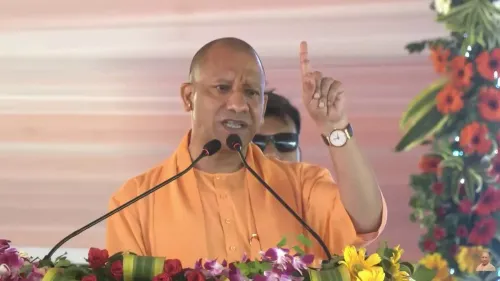
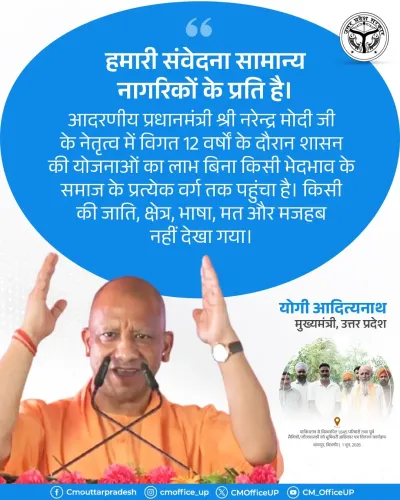
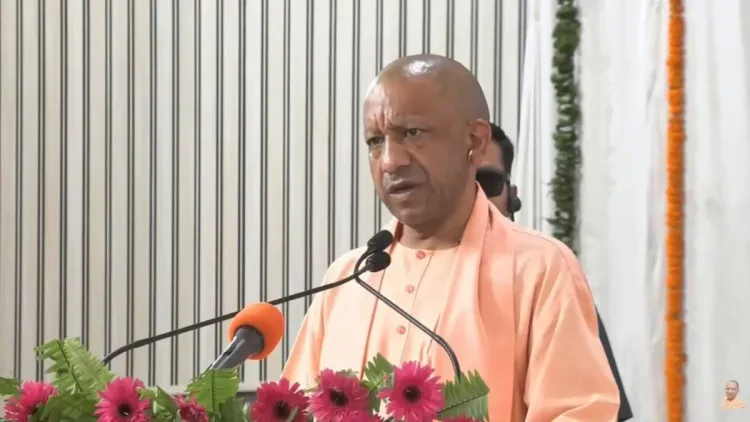
Twelve years of governance, one consistent promise — no one left behind. Uttar Pradesh Chief Minister Yogi Adityanath took to X on Wednesday, 30 September 2026, to credit Prime Minister Narendra Modi's leadership for delivering welfare scheme benefits to every section of society without discrimination over the past twelve years.
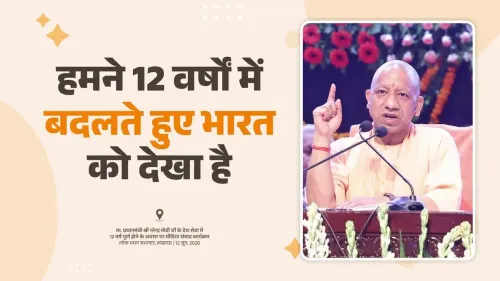
In his post, CM Yogi wrote: 'आदरणीय प्रधानमंत्री श्री @narendramodi जी के नेतृत्व में पिछले 12 वर्षों में पूरे देश के अंदर बिना भेदभाव के शासन की योजनाओं का लाभ समाज के हर तबके तक पहुंचाया गया है' — translated: 'Under the leadership of respected Prime Minister Shri Narendra Modi, over the last 12 years, the benefits of governance schemes have been delivered to every section of society across the entire country without discrimination.'
The 'Sabka Saath, Sabka Vikas' arc: twelve years in the making
When the BJP-led NDA government came to power in 2014, it anchored its welfare philosophy on the slogan 'Sabka Saath, Sabka Vikas' — 'Together with all, development for all'. That framework became the stated organising principle behind a wide range of central schemes covering housing, sanitation, cooking gas access, direct benefit transfers, and health insurance, among others. CM Yogi's statement is a pointed reaffirmation of that twelve-year arc.
State chief ministers aligned with the BJP have consistently amplified this message, and Uttar Pradesh — India's most populous state — has been a high-stakes testing ground for central scheme delivery. Yogi Adityanath, who also heads the Gorakhnath Math, has repeatedly framed inclusive outreach as both a governance imperative and a moral one.
Why the 'without discrimination' framing carries political weight
The phrase 'without discrimination' is not incidental. In a state as socially diverse as Uttar Pradesh — and in a national political landscape where welfare delivery along caste and community lines has long been a flashpoint — the explicit emphasis on non-discriminatory access is a deliberate signal. It positions the Modi government's record as a counter-narrative to the charge that welfare has historically been routed through vote-bank calculations.
The post arrives with a video attachment, suggesting the statement may be part of a larger outreach or campaign communication around the twelve-year governance milestone. Whether it ties to a specific scheme anniversary or a broader political messaging cycle, the framing is unmistakably retrospective — a ledger being read aloud.
Twelve years is a long time to make a promise. The question now is whether the ground-level data on scheme saturation matches the political claim — and that answer will be written in the next election cycle.
Point of View
A state that delivered decisive mandates in both 2017 and 2022, this kind of retrospective crediting of central leadership also reinforces the Modi-Yogi political tandem as an indivisible brand. Watch for similar statements from BJP chief ministers in other large states as the party builds its twelve-year legacy pitch.
NationPress
30 Sept 2026
Frequently Asked Questions
What did CM Yogi Adityanath say about PM Modi's governance?
CM Yogi Adityanath said that under PM Modi's leadership over the last 12 years, the benefits of governance schemes have been delivered to every section of society across India without discrimination.
What is the 'Sabka Saath, Sabka Vikas' slogan?
'Sabka Saath, Sabka Vikas' means 'Together with all, development for all' and has been the central welfare philosophy of the BJP-led NDA government since it came to power in 2014.
How long has the Modi government been in power?
The BJP-led NDA government under Prime Minister Narendra Modi first came to power in 2014, completing 12 years in office by the time of CM Yogi's post in September 2026.
Why does CM Yogi emphasise 'without discrimination' in welfare delivery?
The phrase is a deliberate political signal positioning the Modi government's welfare record as non-partisan and inclusive, countering the charge that benefits have historically been distributed along caste or community lines.
What is CM Yogi Adityanath's role beyond being Uttar Pradesh Chief Minister?
Beyond his role as Uttar Pradesh Chief Minister and senior BJP leader, Yogi Adityanath is also the head of the Gorakhnath Math, a prominent Hindu religious institution in Gorakhpur.