CM Yogi Hails 12 Years of Modi's Infrastructure Push

Synopsis
Uttar Pradesh Chief Minister Yogi Adityanath marked 12 years of the Modi government by crediting it with historic infrastructure gains, spotlighting the Chenab Bridge, the Bairabi-Sairang rail link connecting Mizoram, FASTag rollout, and the Dedicated Freight Corridors as milestones of inclusive national development.
Key Takeaways
CM Yogi Adityanath posted on June 16, 2026 praising PM Modi 's infrastructure record under the #12YearsOfNayaBharatNirman campaign.
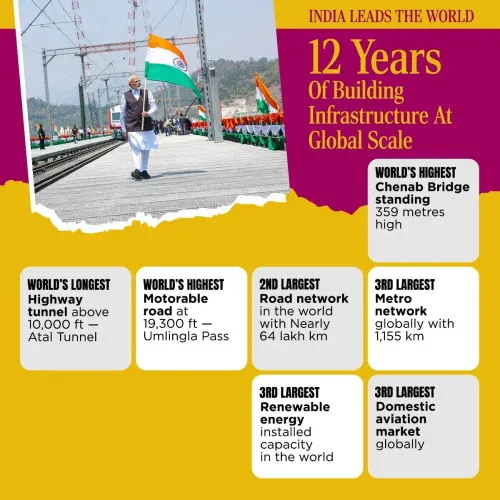
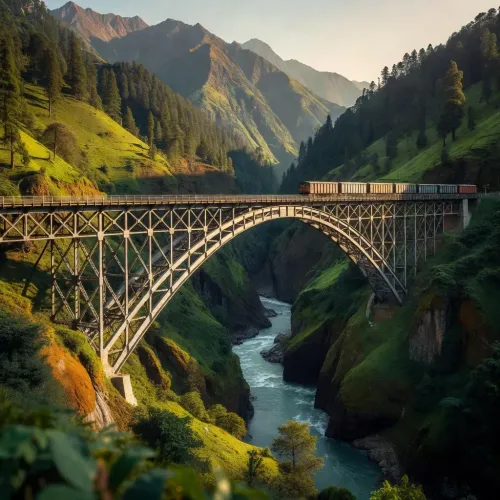
The Chenab Bridge in Jammu and Kashmir , the world's highest railway bridge, was cited as a landmark engineering achievement.
The Bairabi-Sairang rail project has connected Mizoram to the national rail network, extending services to the Northeast.
FASTag , mandatory since December 2019 , has enabled cashless, faster toll collection on national highways.
The Eastern and Western Dedicated Freight Corridors have improved logistics efficiency by separating freight from passenger rail lines.
The Bharatmala Pariyojana , launched in 2015 , has driven significant expansion of the national highway network.
Uttar Pradesh Chief Minister Yogi Adityanath on Tuesday, June 16, 2026, took to X to credit Prime Minister Narendra Modi's decade-plus tenure with transforming India's transport infrastructure, citing landmark projects from the Chenab Bridge in Jammu and Kashmir to the Bairabi-Sairang rail project in Mizoram as proof that development has reached the country's remotest corners.
Context
The post, tagged #12YearsOfNayaBharatNirman, marks twelve years since the BJP-led government under Narendra Modi assumed office in May 2014. CM Yogi wrote — 'आधुनिक अवसंरचना किसी भी विकसित राष्ट्र की पहचान होती है' ['Modern infrastructure is the hallmark of any developed nation'] — framing the anniversary as a milestone in India's journey toward becoming a developed economy. He extended gratitude to the Prime Minister for translating the vision of inclusive development into ground-level reality.
The post singles out two engineering achievements: the Chenab Bridge, described as a benchmark of engineering excellence, and the Bairabi-Sairang rail project, credited with linking Mizoram to the national rail map. Both are positioned as evidence that infrastructure investment is no longer confined to India's urban heartland.
Policy Backdrop
The infrastructure push referenced by CM Yogi spans multiple flagship initiatives. The Bharatmala Pariyojana, launched in 2015, set an ambitious target for national highway construction and corridor development, significantly expanding the country's road network. FASTag, made mandatory on national highways from December 2019, introduced seamless electronic toll collection, cutting congestion at toll plazas and reducing travel time for millions of commuters.
On the rail side, the Eastern and Western Dedicated Freight Corridors have progressively come online since 2014, separating freight movement from passenger lines to improve logistics efficiency and reduce costs for industry. The Chenab Bridge, part of the Udhampur-Srinagar-Baramulla Rail Link (USBRL), stands as the world's highest railway bridge and represents one of the most challenging engineering feats undertaken on Indian soil. The Bairabi-Sairang line extends rail connectivity into Mizoram, a state that remained outside the national rail network for decades.
CM Yogi also highlighted record investment in the railway sector and the operational rollout of Dedicated Freight Corridors as twin pillars reshaping India's freight and passenger mobility.
Stakeholders and Impact
The beneficiaries of this infrastructure expansion are varied. Residents of Northeast India and border states such as Jammu and Kashmir and Mizoram gain direct access to rail connectivity that was previously absent or severely limited, opening new economic and social pathways. The logistics and freight sector stands to gain from the Dedicated Freight Corridors, which promise faster transit times and lower per-unit transport costs.
Highway users across the country benefit from FASTag's cashless toll infrastructure, while the broader economy gains from improved supply-chain efficiency. The emphasis on last-mile connectivity in difficult terrain — high-altitude zones, dense northeastern forests — signals a deliberate policy to reduce regional disparities in physical infrastructure.
What's Next
Attention will now turn to the completion of remaining sections of the Udhampur-Srinagar-Baramulla Rail Link and additional northeastern rail corridors still under construction. Budget allocations for highway and rail projects in the next Union Budget will be closely watched as indicators of whether the pace of infrastructure spending is sustained. For CM Yogi and the BJP, the #12YearsOfNayaBharatNirman campaign serves as a political stock-taking exercise ahead of state and national electoral cycles, anchoring the party's governance narrative firmly around visible, large-scale public works.
Point of View
Using the 12-year milestone to consolidate the BJP's governance narrative around infrastructure as a proxy for national progress. By invoking geographically distant projects — from Jammu and Kashmir to Mizoram — he underscores a deliberate messaging strategy that frames the party's reach as truly pan-Indian rather than limited to its traditional strongholds. The hashtag campaign signals a coordinated party-wide communication exercise, likely designed to build momentum ahead of electoral cycles. Sustaining this narrative will depend on how quickly remaining flagship projects — particularly the full USBRL completion — are delivered and communicated to voters.
NationPress
15 Sept 2026
Frequently Asked Questions
What is the Chenab Bridge and why is it significant?
The Chenab Bridge is the world's highest railway bridge, located in Jammu and Kashmir, and forms a critical section of the Udhampur-Srinagar-Baramulla Rail Link that aims to connect the Kashmir Valley to the national rail network.
What is the Bairabi-Sairang rail project?
The Bairabi-Sairang rail project is a railway line that connects Mizoram to India's national rail network, extending rail services to a northeastern state that was previously underserved by rail connectivity.
What is the Dedicated Freight Corridor in India?
The Dedicated Freight Corridor is a network of special rail lines built exclusively for freight movement, separating goods trains from passenger services to reduce congestion and improve logistics efficiency across India.
What is FASTag and when did it become mandatory?
FASTag is an electronic toll collection system using RFID technology that enables cashless payment at highway toll plazas. It was made mandatory on national highways from December 2019.
What is the Bharatmala Pariyojana?
Bharatmala Pariyojana is a national highway development programme launched in 2015 aimed at accelerating road construction, improving connectivity across states, and building economic corridors throughout India.