CM Yogi invokes Ram Rajya vision at Deepotsav 2026
Synopsis
At Deepotsav 2026 in Ayodhya, Chief Minister Yogi Adityanath linked five welfare pillars — free food grain, youth employment, farmer dignity, labour wages, and women's safety — to the ideal of Ram Rajya, marking a decade of the state-organised festival of lights.
Key Takeaways
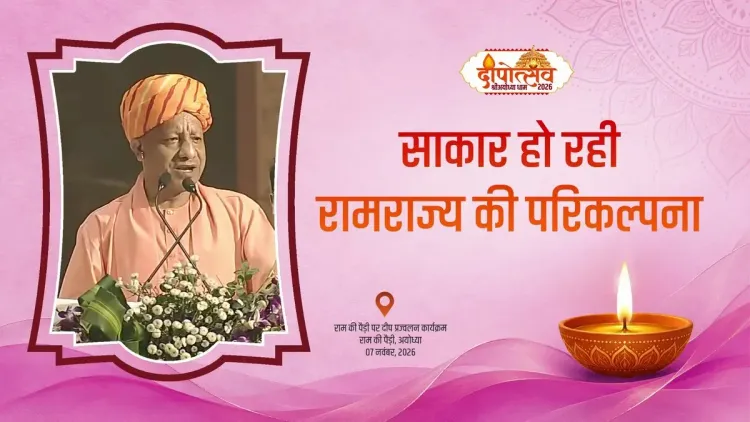
CM Yogi Adityanath delivered the Ram Rajya statement at Deepotsav 2026 in Ayodhya on 7 November 2026 .
He cited five welfare categories: free food grain, youth employment, farmer dignity, fair labour wages, and women's safety.
Deepotsav has been held annually in Ayodhya since 2017 ; the 2026 edition marks roughly a decade of the event.
The free food-grain reference aligns with the central PM Garib Kalyan Anna Yojana , active since 2020 .
The statement frames measurable welfare delivery within the cultural and religious ideal of Ram Rajya , a recurring BJP-UP government communications strategy.
Ayodhya has undergone significant infrastructure development, and Deepotsav serves as the annual showcase for the city's transformation.
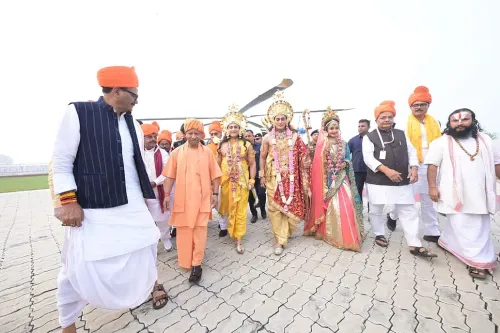
Free grain for the hungry, jobs for the young, dignity for the farmer, fair wages for the labourer, and safe passage for women — Chief Minister Yogi Adityanath distilled his government's welfare agenda into a single, striking image at Deepotsav 2026 in Ayodhya on 7 November 2026, calling it the living realisation of Ram Rajya — the ancient ideal of a just and benevolent kingdom.
What CM Yogi said — and what he meant
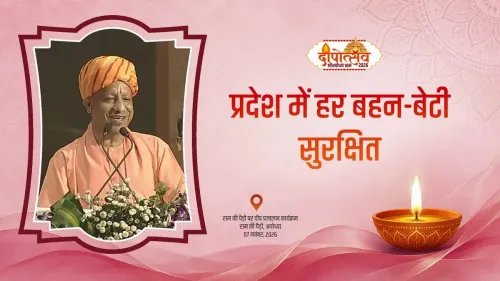
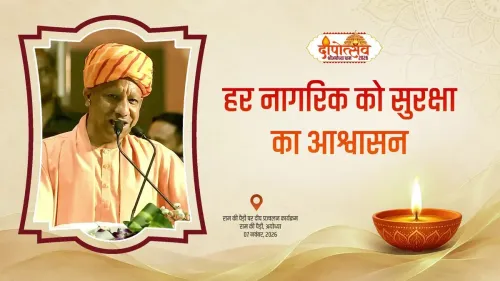
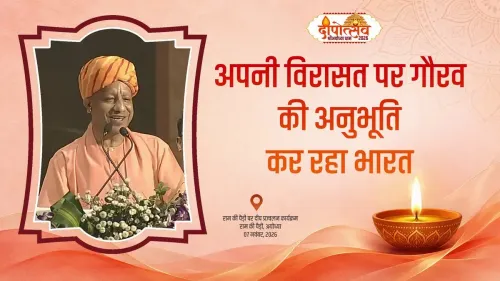
Speaking at the state-organised festival of lights, the Chief Minister's Office quoted him as saying: 'When the poor benefit from the free food-grain scheme, when a young person finds employment, when the toiling farmer's labour is honoured, when a worker receives fair wages, when a woman is assured of safety and travels fearlessly to her destination — that is when the vision of Ram Rajya truly appears to be taking shape.'
The statement is a deliberate weaving together of five distinct welfare categories — food security, employment, agrarian dignity, labour rights, and women's safety — under one cultural umbrella. It is a rhetorical move the Bharatiya Janata Party-led Uttar Pradesh government has refined over nearly a decade in power.
Deepotsav's decade: from ceremony to state signature
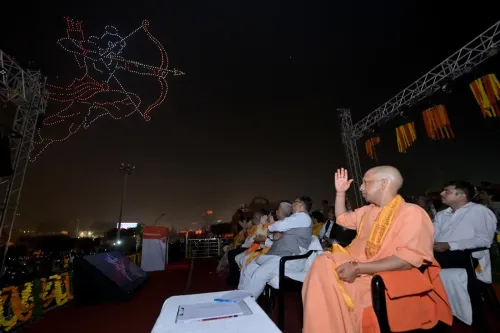
Deepotsav began as an annual Diwali celebration in Ayodhya in 2017, the year Yogi Adityanath first took office. Over successive editions it has grown into one of the largest state-sponsored cultural events in India, drawing pilgrims, tourists, and television audiences. The 2026 edition — marked by the hashtag #deepostav1dasak (a decade of Deepotsav) — signals that the government is framing this milestone as proof of sustained institutional commitment to Ayodhya's revival.
The city itself has been at the centre of a massive infrastructure push since the consecration of the Ram Mandir, and Deepotsav serves as the annual showcase for that transformation. Culture, connectivity, and welfare delivery are presented as a single narrative arc.
The welfare planks behind the rhetoric
The free food-grain reference points directly to the PM Garib Kalyan Anna Yojana, which the central government launched in 2020 and which Uttar Pradesh — home to the country's largest beneficiary base — has consistently highlighted. Yogi Adityanath's government has also run state-level employment and farmer-support schemes that it credits with reducing agrarian distress in the country's most populous state.
Women's safety, the fifth pillar in his statement, has been a recurring political theme for the UP government, which has pointed to improved crime-response infrastructure and anti-rowdy drives as evidence of a safer public environment for women.
Ram Rajya as political grammar
The invocation of Ram Rajya is not incidental. For the BJP-led government in Lucknow, linking measurable welfare outcomes — ration cards issued, jobs created, MSP paid — to a scriptural ideal of righteous governance is a core communications strategy. It allows the administration to speak simultaneously to a devout base and to a development-minded electorate. At a festival held in the birthplace of Lord Ram, the framing lands with maximum symbolic force.
A decade into Deepotsav, the state is betting that the image of Ayodhya's illuminated ghats and the promise of a just state can reinforce each other — and that voters will read both as evidence of delivery, not just aspiration.
Point of View
The statement signals that the Uttar Pradesh government views Ayodhya not just as a religious site but as a living proof-of-concept for its political model. The enumeration of five distinct beneficiary groups — poor, youth, farmers, labourers, women — is also a broad-spectrum electoral message ahead of future assembly cycles. Whether the welfare outcomes match the rhetorical ambition remains the central question any opposition will press.
NationPress
7 Nov 2026
Frequently Asked Questions
What is Ram Rajya and why does CM Yogi use the term?
Ram Rajya refers to the ideal of a just, prosperous, and benevolent kingdom associated with Lord Ram in Hindu tradition. CM Yogi Adityanath uses the term to frame his government's welfare and law-and-order agenda as the fulfilment of a timeless moral ideal, particularly powerful when spoken in Ayodhya, the city regarded as Lord Ram's birthplace.
What is Deepotsav and when did it start?
Deepotsav is an annual festival of lights organised by the Uttar Pradesh government in Ayodhya during Diwali. It began in 2017, the year Yogi Adityanath took office, and has grown into one of India's largest state-sponsored cultural events. The 2026 edition marks approximately a decade of the celebration.
What is the PM Garib Kalyan Anna Yojana that CM Yogi referenced?
The PM Garib Kalyan Anna Yojana is a central government scheme that provides free food grain to eligible beneficiaries. Launched in 2020, it covers a large share of India's population, with Uttar Pradesh — the most populous state — accounting for one of the largest beneficiary bases in the country.
What welfare schemes did CM Yogi mention at Deepotsav 2026?
CM Yogi referenced five areas: free food-grain distribution for the poor, employment for youth, recognition of farmers' labour, fair wages for workers, and safety for women enabling them to travel without fear. He presented all five as evidence of Ram Rajya becoming a reality.
Why is Ayodhya significant to the Uttar Pradesh government?
Ayodhya is regarded as the birthplace of Lord Ram and has been the site of major infrastructure investment and the consecration of the Ram Mandir. The UP government has used the city as a centrepiece of its cultural, tourism, and governance narrative, with Deepotsav serving as the annual flagship event.