Delhi CM Rekha Gupta Reaffirms Child Rights on Anti-Child Labour Day
Synopsis
On World Day Against Child Labour, Delhi Chief Minister Rekha Gupta reiterated the government's resolve to protect every child's right to a safe childhood and quality education, stating that children belong in schools, not in labour — a commitment backed by India's legislative and constitutional framework.
Key Takeaways
Delhi Chief Minister Rekha Gupta posted on 12 June 2026 to mark World Day Against Child Labour , reaffirming children's right to safe childhood and education.
She stated that children's rightful place is in schools , not in labour, and that a strong nation is built through quality education for the young.
World Day Against Child Labour has been observed globally on 12 June every year since 2002 , promoted by the ILO .
India's 2016 amendment to the Child Labour Act banned all employment of children under 14 years and hazardous work under 18 years .
India ratified ILO Conventions No.
182 in 2017 , cementing its international commitment against child labour.
The National Child Labour Project (NCLP) remains the central rehabilitation mechanism for withdrawing children from labour and enrolling them in education.
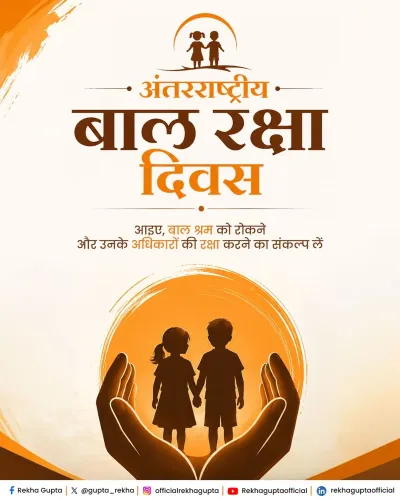
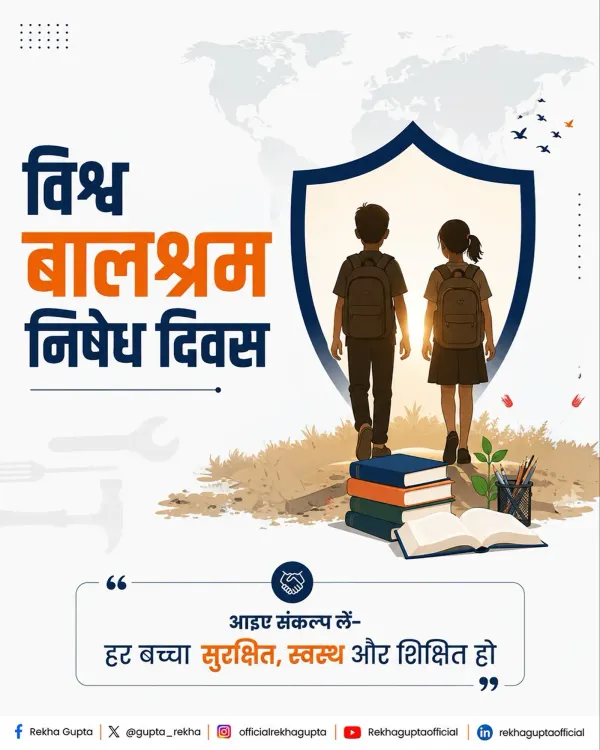
Delhi Chief Minister Rekha Gupta on Friday, 12 June marked World Day Against Child Labour by reaffirming the government's commitment to every child's right to a safe childhood and quality education, urging that children belong in classrooms, not workplaces.
In a post on X, Rekha Gupta wrote: 'विश्व बाल श्रम निषेध दिवस पर हम हर बच्चे के सुरक्षित बचपन और शिक्षा के अधिकार के प्रति अपने संकल्प को दोहराते हैं' — 'On World Day Against Child Labour, we reiterate our resolve for every child's safe childhood and right to education.' She added that children's rightful place is in schools, not in labour, and that building a strong nation is possible only by providing the young with a better future and quality education.
Context
World Day Against Child Labour is observed every year on 12 June, an annual global observance initiated by the International Labour Organization (ILO) in 2002 to spotlight and eliminate child labour worldwide. The day draws statements from governments, civil society, and international bodies renewing their commitment to protecting children from economic exploitation. Delhi, as the national capital, has been a visible platform for such commitments by successive administrations.
Policy Backdrop
India's legislative framework against child labour has been built over decades. The Child Labour (Prohibition and Regulation) Act, 1986 first banned child work in listed hazardous occupations, and a landmark 2016 amendment extended the prohibition to all employment of children under 14 years and hazardous work under 18 years. In 2017, India ratified two key ILO conventions — the Minimum Age Convention (No. 138) and the Worst Forms of Child Labour Convention (No. 182) — signalling its international commitment.
At the constitutional level, Articles 21A and 24 of the Indian Constitution guarantee the right to free and compulsory education for children up to 14 years and prohibit their employment in factories and hazardous settings. The National Child Labour Project (NCLP), a central government scheme, supports identification, withdrawal, and rehabilitation of child labourers through education and skill training. India's approach also aligns with Sustainable Development Goal (SDG) target 8.7, which calls for ending all forms of child labour.
Stakeholders and Impact
The statement from Rekha Gupta speaks directly to two groups: the millions of school-going children whose access to education must be protected, and the working children who remain outside the schooling system. According to policy researchers, child labour persists most in informal sectors, agriculture, and domestic work — areas where enforcement remains a challenge.
For Delhi, a densely populated urban territory with significant migrant labour communities, the issue carries particular weight. Children of migrant workers are among the most vulnerable to being pulled into labour rather than enrolled in school. State-level implementation of the NCLP and coordination with municipal bodies and NGOs are critical to translating such public commitments into on-ground outcomes.
What's Next
Observers and child rights advocates will watch for concrete follow-through — including state-level action plans, inspection drives, and enrolment campaigns — that translate the 12 June reaffirmation into measurable results. Periodic surveys on child labour prevalence and implementation reports under the National Child Labour Project will be key indicators of progress. The broader push to achieve SDG 8.7 means that annual observances like this carry increasing accountability weight for state governments across India.
Point of View
The emphasis on education as the foundation of a 'strong nation' echoes the broader national narrative linking human capital development with India's growth ambitions. The real test, however, lies in state-level enforcement data and enrolment figures, which will determine whether the reaffirmation moves beyond symbolism. Analysts will watch whether Delhi pairs this statement with specific programme announcements or inspection drives in the months ahead.
NationPress
21 Sept 2026
Frequently Asked Questions
What did Delhi CM Rekha Gupta say on World Day Against Child Labour?
Delhi CM Rekha Gupta reaffirmed on 12 June that every child has the right to a safe childhood and quality education, stating that children belong in schools, not in labour, and that a strong nation is built by giving children a better future.
When is World Day Against Child Labour observed?
World Day Against Child Labour is observed every year on 12 June . It was initiated by the International Labour Organization (ILO) in 2002 to raise awareness and action against child labour globally.
What is India's law on child labour?
The Child Labour (Prohibition and Regulation) Act, 1986 , as amended in 2016 , bans all employment of children under 14 years and prohibits hazardous work for those under 18 years . India also ratified two key ILO conventions on child labour in 2017 .
What is the National Child Labour Project?
The National Child Labour Project (NCLP) is a central government scheme designed to identify, withdraw, and rehabilitate child labourers by providing them access to education and skill training.
How does India's Constitution protect children from labour?
Article 21A of the Indian Constitution guarantees free and compulsory education for children up to 14 years , while Article 24 prohibits employment of children in factories and hazardous occupations.