CM Sukhu calls child labour a barrier to social progress
Synopsis
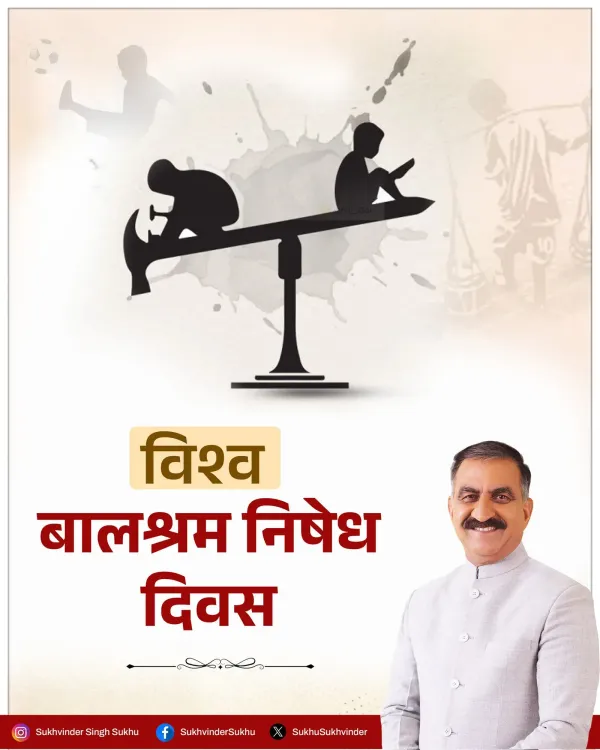
On World Day Against Child Labour, Himachal Pradesh CM Sukhvinder Singh Sukhu declared every child's right to a safe childhood and called child labour a grave social challenge, urging collective resolve for its eradication across the state and nation.
Key Takeaways
CM Sukhvinder Singh Sukhu posted on 12 June 2026 , World Day Against Child Labour , calling for collective resolve to end child labour.
He described child labour as a 'serious challenge to humanity' and a barrier to social progress.
India ratified ILO Convention 182 on the worst forms of child labour in 2017 .
The Child Labour (Prohibition and Regulation) Act, 1986 was amended in 2016 to ban child employment in all occupations for those below 14 years .
Himachal Pradesh has seen persistent, low-level child labour in agriculture and domestic work despite high literacy rates.
Next steps to watch include new state enforcement orders and updated HP child labour survey data.
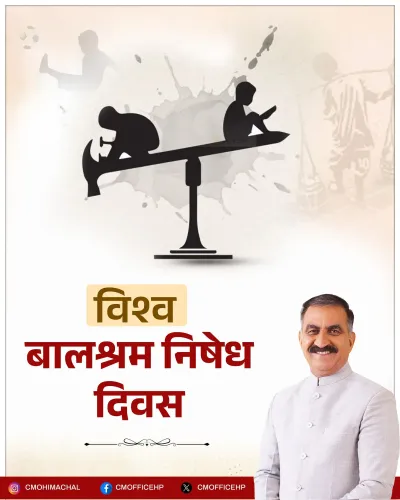
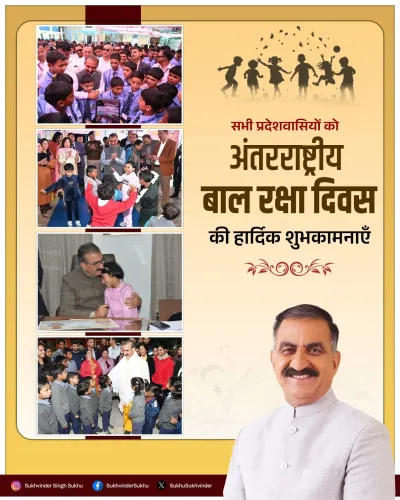
Himachal Pradesh Chief Minister Sukhvinder Singh Sukhu on Friday, 12 June 2026 — World Day Against Child Labour — called for collective resolve to eliminate child labour, describing it as a grave challenge to humanity and an obstacle on the path of social progress.
Posting in Hindi on X, CM Sukhu wrote: 'हर बच्चे का अधिकार है कि उसका बचपन सुरक्षित और सम्मानजनक हो' ['Every child has the right to a safe and dignified childhood']. He added that as a compassionate society, the eradication of child labour is a collective responsibility, and called on citizens to pledge continuous effort toward that goal and toward building a bright future for every child.
Context
June 12 is observed globally as World Day Against Child Labour, an annual occasion anchored by the International Labour Organization (ILO) to focus attention on the millions of children worldwide still engaged in exploitative or hazardous work. CM Sukhu's post aligns with the spirit of ILO Conventions 138 and 182, both ratified by India — Convention 182 as recently as 2017 — which set binding standards on minimum working age and the elimination of the worst forms of child labour.
Policy Backdrop
India's foundational statute on the issue, the Child Labour (Prohibition and Regulation) Act, 1986, was substantially strengthened by amendments in 2016 that extended prohibitions to all occupations for children below 14 years of age. Complementing the legislation, the National Child Labour Project Scheme, operational since 1988, focuses on withdrawing children from work and mainstreaming them into formal education — a goal reinforced by the Right to Education Act, 2009.
Himachal Pradesh, despite its historically high literacy rates, has reported low but persistent child labour in agriculture, domestic work, and small-scale industry. The state has periodically conducted enforcement drives in coordination with district labour departments to identify and rehabilitate at-risk children.
Stakeholders and Impact
The most direct beneficiaries of stronger enforcement and rehabilitation efforts are Himachal Pradesh's school-age children, particularly those in rural and semi-urban pockets vulnerable to being pulled into informal labour markets. State labour departments, district administrations, and civil society organisations play a front-line role in identifying violations and linking rescued children to education and welfare schemes.
For families in poverty, the economic pressure that drives child labour remains a structural challenge. Effective elimination requires not only legal enforcement but convergence with social protection programmes that reduce households' dependence on children's earnings.
What's Next
Observers will watch whether CM Sukhu's statement is followed by concrete state-level directives — such as fresh enforcement orders, expansion of rehabilitation centres, or targeted surveys to update Himachal Pradesh's child labour data. The next round of state child labour survey results, once released, will offer a clearer picture of ground-level progress. Sustained political signalling from the chief ministerial level, aligned with World Day Against Child Labour, can translate into renewed administrative momentum if backed by budgetary and institutional follow-through.
Point of View
Expanded rehabilitation infrastructure, or updated child labour data — all areas where Himachal Pradesh has room to move. Sustained follow-through would distinguish this as policy intent rather than calendar-driven messaging.
NationPress
29 Jul 2026
Frequently Asked Questions
What did Himachal Pradesh CM Sukhu say on World Day Against Child Labour 2026?
CM Sukhvinder Singh Sukhu said every child has the right to a safe and dignified childhood, called child labour a serious challenge to humanity, and urged collective resolve to eliminate it and secure a bright future for every child.
When is World Day Against Child Labour observed?
World Day Against Child Labour is observed every year on 12 June , as designated by the International Labour Organization.
What is India's law against child labour?
The Child Labour (Prohibition and Regulation) Act, 1986 , amended in 2016 , prohibits the employment of children below 14 years in all occupations and processes in India.
Has India ratified ILO conventions on child labour?
Yes. India ratified ILO Convention 182 on the worst forms of child labour in 2017 , and is also a signatory to Convention 138 on minimum age for employment.
What is the child labour situation in Himachal Pradesh?
Himachal Pradesh has historically high literacy rates but reports low yet persistent child labour, particularly in agriculture, domestic work, and small-scale industry, prompting periodic state enforcement drives.