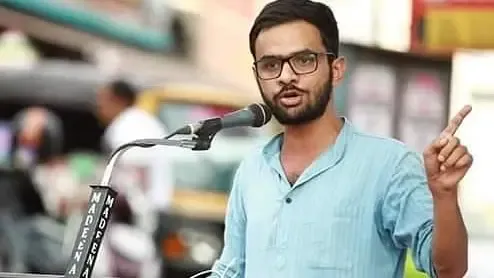
Delhi court restores Umar Khalid's two weekly video calls with family
Synopsis
A Delhi court has ruled that jailed activist Umar Khalid must be allowed two video calls with his family each week — a facility reduced without cause in May 2026 after six years of uninterrupted compliance. The order is a narrow procedural win; his bail pleas remain dismissed and the broader UAPA question of whether prolonged incarceration can override bail restrictions is now headed to a larger Supreme Court bench.
Key Takeaways
Additional Sessions Judge Sameer Bajpai of Karkardooma Courts ordered restoration of two e-mulakats per week for Umar Khalid on 15 July .
The facility had been curtailed to one e-mulakat per week from May 2026 , despite no recorded violation of the Delhi Prison Rules .
The court noted Khalid had availed two weekly video meetings for six years without breaching any prison rule.
Bail pleas of Khalid and co-accused Sharjeel Imam remain dismissed; the trial court is bound by the Supreme Court's 5 January order.
The Supreme Court has referred to a larger bench the question of whether prolonged incarceration can justify bail under Section 43D(5) of the UAPA .
Tasleem Ahmed and Khalid Saifi were granted six months' interim bail by the apex court while the larger bench question is pending.
A Delhi court has directed jail authorities to restore two e-mulakats (video meetings) per week for jailed student activist Umar Khalid, allowing him to speak with his mother and other family members. Additional Sessions Judge Sameer Bajpai of the Karkardooma Courts passed the order on 15 July, noting that Khalid had availed the facility without breaching any prison rule for the past six years.
Background to the Application
Khalid, an accused in the larger conspiracy case linked to the February 2020 northeast Delhi riots, had approached the court after the frequency of his e-mulakats was reduced from two to one per week starting May 2026. His counsel argued the curtailment was imposed despite no recorded violation of the Delhi Prison Rules on his part.
Jail authorities contested the plea, submitting that under applicable rules, Khalid was entitled to only one e-mulakat per week, and that the earlier practice of permitting two had accordingly been discontinued.
What the Court Held
After hearing both sides, the court held that Khalid had availed two e-mulakats every week for six years without breaching any provision of the Delhi Prison Rules. It directed that he be permitted two e-mulakats per week to speak with his mother and family, and ordered a copy of its order to be sent to the Superintendent of the concerned Central Jail.
'The applicant has been using two e-mulakats a week for the last six years and has not violated any rule of the Delhi Prisons Rules,' the court said, adding that Khalid was accordingly 'allowed to have two e-mulakats per week for the purpose of talking to his mother and other family members.'
Bail Pleas Remain Dismissed
Earlier this month, the same court dismissed the regular bail pleas of Khalid and co-accused Sharjeel Imam in the larger conspiracy case, holding it was bound by the Supreme Court's earlier order declining bail. The trial court observed it had 'no option but to follow' the apex court's ruling, which permitted the accused to renew their bail prayer only after the examination of protected witnesses or on the expiry of one year from the Supreme Court's 5 January order, whichever occurred earlier.
Broader UAPA Legal Questions
Khalid and Imam are among several accused booked under the Unlawful Activities (Prevention) Act (UAPA) and other penal provisions in connection with the communal violence that broke out in northeast Delhi in February 2020. Earlier this year, the Supreme Court dismissed their bail pleas, holding that prosecution material disclosed prima facie grounds attracting the statutory embargo under Section 43D(5) of the UAPA. At the same time, the apex court granted bail to five other accused — Gulfisha Fatima, Meeran Haider, Shifa Ur Rehman, Mohd Saleem Khan, and Shadab Ahmed.
More recently, the Supreme Court granted six months' interim bail to Tasleem Ahmed and Khalid Saifi, while referring to a larger bench the question of whether prolonged incarceration and trial delay can justify bail despite Section 43D(5) restrictions. A bench of Justices Aravind Kumar and Prasanna B. Varale directed the registry to place the matter before the Chief Justice of India for constituting an appropriate bench, noting divergent views across Supreme Court benches on the interpretation of the ruling in Union of India vs K.A. Najeeb.
The apex court also took note of the subsequent judgment in Syed Iftikhar Andrabi vs National Investigation Agency (NIA), where a coordinate bench expressed reservations over aspects of the ruling that had denied bail to Khalid and Imam while granting relief to five co-accused. As the larger bench question awaits a hearing, the trial in the northeast Delhi riots conspiracy case is not expected to conclude in the near future.
Point of View
With jail authorities citing rules that had evidently not been enforced for the better part of a decade. The court's intervention is less a victory than a correction of an unexplained administrative reversal. Meanwhile, the larger legal question — whether indefinite pre-trial detention under UAPA can be sustained regardless of trial timelines — remains unresolved and is now before a larger Supreme Court bench. The interim bail granted to Ahmed and Saifi signals judicial unease, but Khalid and Imam remain in custody with no clear end date for a trial that has dragged on since 2020. The gap between the law's intent and its operational reality in UAPA cases is precisely what the larger bench must now confront.
NationPress
14 Oct 2026
Frequently Asked Questions
Why did the Delhi court restore Umar Khalid's two weekly video meetings?
The court restored the two weekly e-mulakats because Khalid had availed the facility for six years without violating any provision of the Delhi Prison Rules. Additional Sessions Judge Sameer Bajpai found no justification for the curtailment to one meeting per week that jail authorities had imposed from May 2026.
What is the current status of Umar Khalid's bail plea?
Khalid's regular bail plea remains dismissed. The trial court ruled it was bound by the Supreme Court's earlier order, which allows the accused to renew their bail application only after protected witnesses are examined or one year from the Supreme Court's 5 January order elapses, whichever comes first.
What is the UAPA case against Umar Khalid about?
Khalid is among several accused booked under the Unlawful Activities (Prevention) Act (UAPA) and other penal provisions in connection with an alleged larger conspiracy behind the communal violence that broke out in northeast Delhi in February 2020. The case is being tried at Karkardooma Courts in Delhi.
What is the larger UAPA bail question before the Supreme Court?
A Supreme Court bench of Justices Aravind Kumar and Prasanna B. Varale has referred to a larger bench the question of whether prolonged incarceration and delay in trial can justify bail despite the restrictions in Section 43D(5) of the UAPA. The matter arose from divergent views across Supreme Court benches on the K.A. Najeeb ruling.
Which co-accused in the Delhi riots case have been granted bail?
Five accused — Gulfisha Fatima, Meeran Haider, Shifa Ur Rehman, Mohd Saleem Khan, and Shadab Ahmed — were granted bail by the Supreme Court earlier this year. More recently, Tasleem Ahmed and Khalid Saifi received six months' interim bail from the apex court while the larger UAPA bail question is pending before a larger bench.