Dr. Jitendra Singh Launches 3rd DAKSH Batch for CPSE Leaders
Synopsis
Union Minister Dr. Jitendra Singh launched the 3rd batch of DAKSH, a year-long leadership programme for senior CPSE executives, on 3 July 2026, calling for cross-institutional synergy and invoking the Modi government's evolution toward a Whole-of-Government and Whole-of-Nation governance framework over 12 years.
Key Takeaways
Jitendra Singh launched and addressed the 3rd batch of DAKSH on 3 July 2026 , a year-long leadership development programme for senior CPSE executives.
DAKSH stands for Development of Aspiration, Knowledge, Succession and Harmony .
The minister called for capacity building that creates synergy across institutions , not just individual competency enhancement.
He invoked the Whole of Government and Whole of Nation framework as the evolved governance philosophy of the Narendra Modi government over the last 12 years .
The programme aligns with the broader Mission Karmayogi and Capacity Building Commission architecture established in 2021 .
Scaling DAKSH to additional CPSE cohorts and parliamentary or CAG reviews of CPSE performance remain key developments to watch.
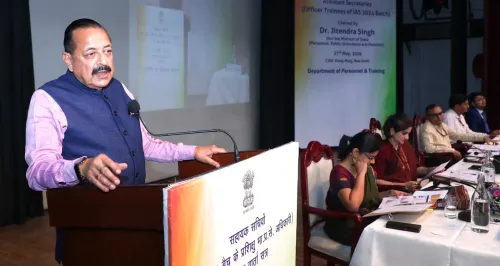
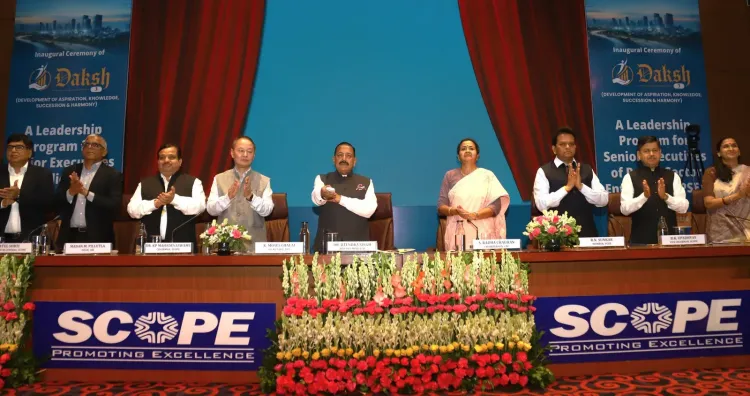
Union Minister of State (Independent Charge) for Science and Technology and Earth Sciences Dr. Jitendra Singh on Friday, 3 July 2026 launched and addressed the third batch of DAKSH (Development of Aspiration, Knowledge, Succession and Harmony), a year-long leadership development programme designed for senior executives of Central Public Sector Enterprises (CPSEs).
Context
Addressing the third cohort, Dr. Jitendra Singh articulated a shift in how the government conceptualises capacity building. 'Capacity building is no longer confined to enhancing individual competencies but must also create synergy across institutions to develop governance systems capable of meeting the aspirations of common citizens,' he said. The remark signals that CPSE leadership training is being reoriented from individual skill upgradation toward a broader institutional convergence model.
The minister also underscored the 'Whole of Government' principle, stating that it 'calls for convergence of diverse individual and institutional capacities, where institutions and professionals contribute their respective strengths and expertise towards common national goals.' This framing positions CPSE executives not merely as corporate managers but as participants in national policy delivery.
Policy Backdrop
DAKSH sits within a wider post-2014 administrative reform architecture. The Mission Karmayogi national programme, launched in 2021, established a standardised capacity-building framework for civil services through the iGOT digital platform, and the Capacity Building Commission was constituted the same year to set competency standards across government institutions. Extending a structured, year-long leadership module to CPSE senior executives reflects the next logical step: bringing public sector enterprise leadership into the same reform orbit as the civil services.
Dr. Jitendra Singh noted that over the last 12 years, the Narendra Modi government's governance philosophy has 'evolved from a Whole-of-Government approach towards a broader Whole-of-Government and Whole-of-Nation framework.' The distinction is significant — the latter explicitly incorporates societal actors and institutions beyond the formal government apparatus into policy implementation.
Stakeholders and Impact
Central Public Sector Enterprises collectively employ hundreds of thousands of personnel and operate across critical sectors including energy, manufacturing, and infrastructure. Their senior leadership directly influences capital allocation, project execution, and service delivery at scale. A structured year-long programme targeting this cohort aims to align CPSE decision-making with the outcome-oriented governance priorities that the central government has championed since 2014.
The programme's design — emphasising synergy across institutions rather than siloed individual training — also reflects lessons from implementation gaps identified in earlier reform cycles, where inter-departmental coordination remained a persistent challenge. CPSE executives who complete DAKSH are expected to carry cross-institutional thinking back into their respective enterprises.
What's Next
With the third batch now underway, attention will turn to whether the government scales DAKSH to additional cohorts or extends similar modules to mid-level CPSE executives. Parliamentary standing committees and the Comptroller and Auditor General periodically review CPSE performance metrics, and outcomes from DAKSH participants could feature in future assessments of governance quality within public sector enterprises. The evolution toward a 'Whole-of-Nation' framework also raises the question of how private sector and civil society actors may eventually be drawn into complementary capacity-building initiatives.
Point of View
Not merely corporate administrators. This rhetorical and programmatic shift carries political weight ahead of a period when CPSE performance will face heightened scrutiny on infrastructure delivery and energy transition targets. Whether the programme produces measurable governance outcomes, or remains an aspirational training exercise, will determine its long-term policy credibility.
NationPress
3 Jul 2026
Frequently Asked Questions
What is the DAKSH programme for CPSE executives?
DAKSH stands for Development of Aspiration, Knowledge, Succession and Harmony. It is a year-long leadership development programme for senior executives of Central Public Sector Enterprises, aimed at building cross-institutional synergy and aligning CPSE leadership with national governance goals.
Who launched the 3rd batch of DAKSH in 2026?
Union Minister of State (Independent Charge) for Science and Technology and Earth Sciences Dr. Jitendra Singh launched and addressed the 3rd batch of DAKSH on 3 July 2026.
What is the Whole of Government and Whole of Nation framework?
The Whole-of-Government approach calls for convergence of capacities across government institutions toward common goals. The broader Whole-of-Nation framework, as described by Dr. Jitendra Singh, extends this to include wider societal actors and institutions beyond the formal government apparatus.
How does DAKSH relate to Mission Karmayogi?
Both programmes are part of India's post-2014 administrative reform architecture. Mission Karmayogi, launched in 2021, established a capacity-building framework for civil servants via the iGOT platform. DAKSH extends a similar structured, outcome-oriented leadership training model to senior CPSE executives.
Which ministry oversees Central Public Sector Enterprise governance training?
The Ministry of Personnel, Public Grievances and Pensions, where Dr. Jitendra Singh also serves as Minister of State, plays a key role in civil services and public sector capacity-building policy alongside the Capacity Building Commission constituted in 2021.