Delhi stubble burning 2026: Haryana fires down 53%, but smog threat looms
Synopsis
India has spent ₹4,266 crore since 2018 trying to stop farmers from burning paddy straw — and this October, Haryana is down 53% and UP down 32% in fire incidents. But Madhya Pradesh and Rajasthan are moving in the wrong direction, political deadlock persists, and Delhi is bracing for another smog winter. The machinery is in place; the question is whether it finally holds.
Key Takeaways
Stubble-burning incidents in Haryana fell by 53.3% and in Uttar Pradesh by approximately 32% between 15 September and 12 October 2026 compared to the same period last year.
Madhya Pradesh and Rajasthan recorded higher stubble-burning incidents, prompting concern at the Union Agriculture Ministry .
The Centre has released ₹4,266.47 crore under the Crop Residue Management scheme since 2018-19 , with Punjab receiving the largest share at ₹2,056.50 crore .
Burning one tonne of paddy straw releases an estimated 1,460 kg of carbon dioxide and 3 kg of particulate matter, according to government guidelines.
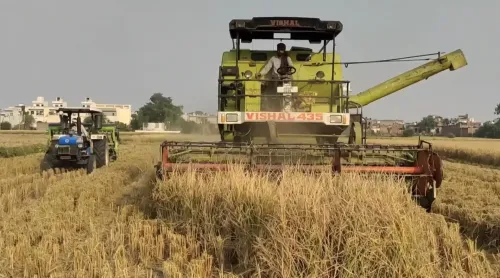
Over 3.23 lakh CRM machines and 41,900+ Custom Hiring Centres have been established since the scheme's launch.
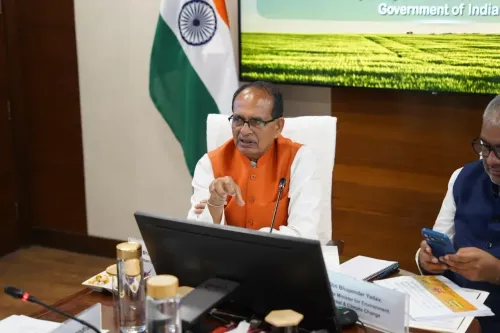
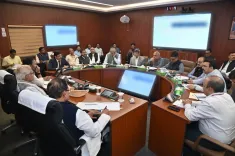
A high-level inter-ministerial review meeting was held on Tuesday with Union and state ministers to oversee the ongoing harvest season response.
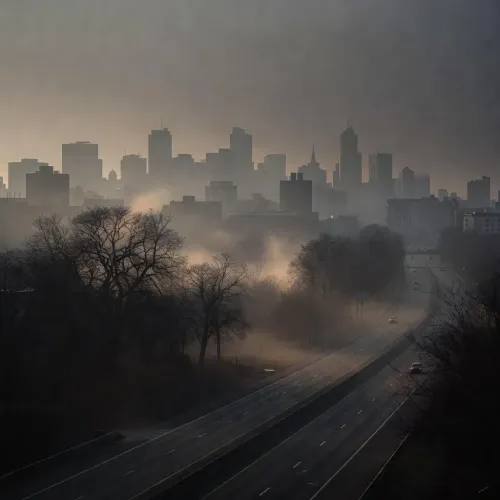
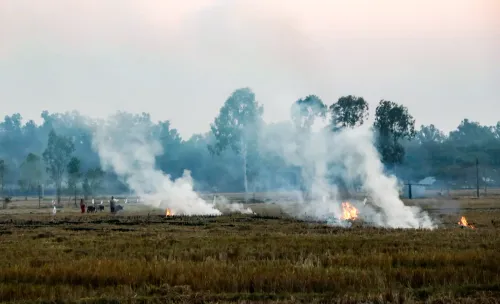
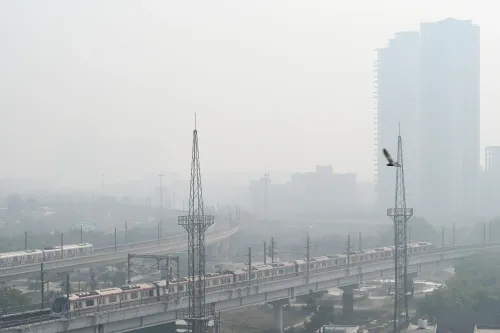
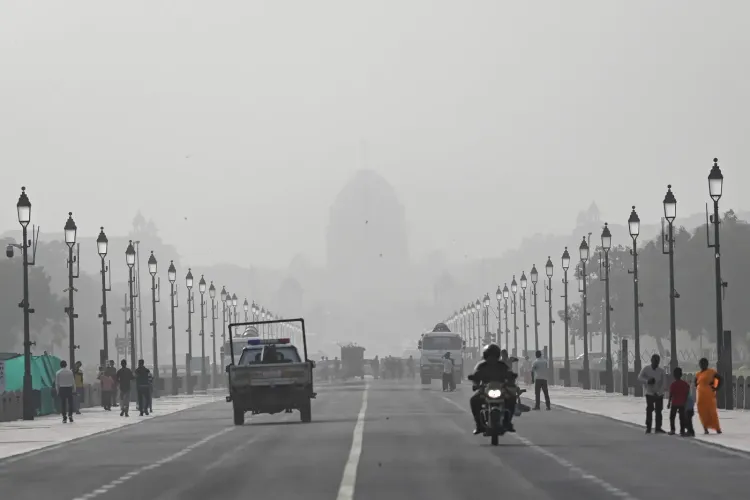
As North India enters the paddy-harvest season in October 2026, authorities are racing to contain stubble burning — the annual agricultural practice that sends a toxic haze across the National Capital Region (NCR) every winter. While early satellite data shows a significant drop in fire incidents in key states, the threat of severe smog in New Delhi remains far from over.
Where Fires Have Fallen — and Where They Have Risen
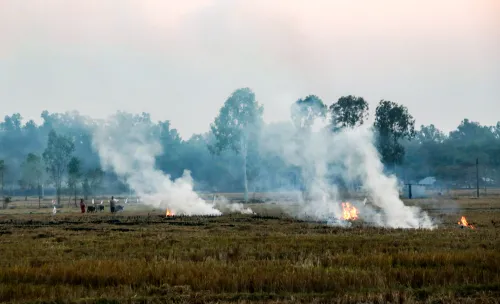
Between 15 September and 12 October, stubble-burning incidents declined sharply compared with the same period last year. Haryana recorded a reduction of 53.3 per cent, while Uttar Pradesh registered a decline of approximately 32 per cent. However, Madhya Pradesh and Rajasthan bucked the trend with higher incident counts, raising concerns within the Union Agriculture Ministry.
Notably, authorities have begun scrutinising not just the number of fires detected by satellites but also the actual area burned — after concerns emerged that fire-count figures may understate the true extent of residue burning on the ground.
Why Farmers Still Burn
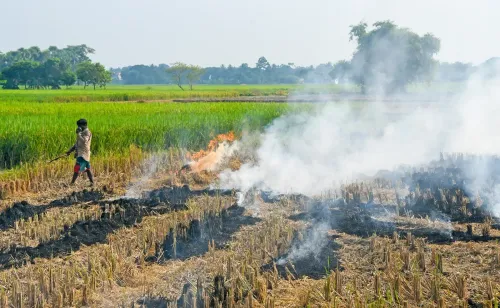
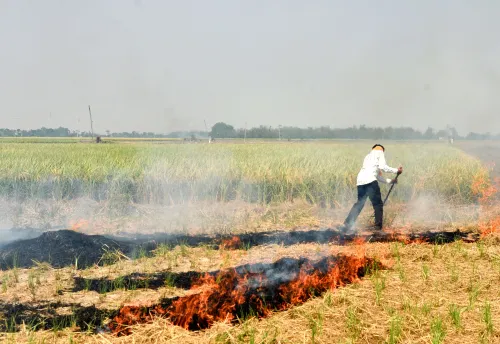
In Punjab, Haryana, and parts of western Uttar Pradesh, paddy is harvested in late September and October. Farmers then have a narrow window — often just two to three weeks — to prepare fields for the wheat sowing season. Burning paddy straw remains the cheapest and fastest way to clear fields, despite its documented environmental cost.
According to the government's Crop Residue Management Operational Guidelines 2026, burning one tonne of paddy straw releases an estimated 3 kg of particulate matter, 60 kg of carbon monoxide, 1,460 kg of carbon dioxide, 199 kg of ash, and 2 kg of sulphur dioxide, in addition to other pollutants. The guidelines also noted substantial loss of soil nutrients and organic matter as a consequence of the practice.
Government Spending: ₹4,266 Crore and Counting
The Centre has run the Crop Residue Management (CRM) scheme since 2018, providing subsidies for machinery and alternative residue-management systems. Between 2018-19 and 2025-26, the Union government released ₹4,266.47 crore to states under the programme — including ₹2,056.50 crore for Punjab, ₹1,171.71 crore for Haryana, ₹868.67 crore for Uttar Pradesh, and ₹59 crore for Madhya Pradesh.
For the current financial year, ₹592.57 crore was earmarked, of which ₹430.87 crore had already been released by mid-October. Slow utilisation of allocated funds, however, remains a persistent concern. More than 3.23 lakh crop-residue management machines and over 41,900 Custom Hiring Centres (CHC) have been established since the scheme's launch. Revised guidelines now allow financial support of up to 65 per cent for projects developing straw supply chains for biomass, biofuel, and pelletisation industries.
Monitoring, Courts, and Political Deadlock
The Commission for Air Quality Management (CAQM) has intensified enforcement, deploying flying squads across Punjab and Haryana during the harvest period, supported by dedicated monitoring cells. Thermal power plants, compressed biogas facilities, and biomass-energy projects are increasingly being positioned as long-term structural solutions that transform agricultural waste into fuel.
The issue, however, remains entangled in state politics. Delhi, governed at various times by parties opposed to those ruling Punjab, Haryana, or the Centre, has repeatedly seen inter-state blame rather than coordinated action. The Supreme Court has intervened on multiple occasions, directing Punjab, Haryana, Uttar Pradesh, and central agencies to act in concert.
A high-level inter-ministerial review meeting was held on Tuesday to oversee crop residue management during the ongoing harvest season, attended by concerned Union and state ministers. This season will test whether the combination of subsidies, alternative technologies, biomass markets, and stricter monitoring can deliver a sustained and measurable reduction in burning.
Point of View
266 crore into the Crop Residue Management scheme, the results are mixed at best — Haryana and UP show real progress, but Madhya Pradesh and Rajasthan are moving backwards, and slow fund utilisation undermines the entire effort. The deeper problem is structural: a two-to-three-week window between paddy harvest and wheat sowing leaves farmers with no economically rational alternative to burning, and no subsidy regime has yet changed that calculus at scale. Delhi's air quality has become a political football precisely because the costs are borne by one state while the burning happens in others — a classic inter-state externality that state-level politics cannot resolve. Until the Centre creates binding, enforceable timelines and links disbursement to verified on-ground outcomes rather than machine procurement figures, each October will bring the same headlines.
NationPress
14 Oct 2026
Frequently Asked Questions
Why does stubble burning cause smog in Delhi every winter?
Stubble burning in Punjab, Haryana, and western Uttar Pradesh during October–November releases large quantities of particulate matter and gases that, combined with calm winter winds and temperature inversions, become trapped close to the ground over the NCR. Scientific studies and government assessments identify it as a significant seasonal contributor to Delhi's severe winter air pollution, though it is not the sole cause.
Has stubble burning reduced in 2026 compared to last year?
Partially. Between 15 September and 12 October 2026, Haryana recorded a 53.3% reduction and Uttar Pradesh a roughly 32% decline in fire incidents versus the same period in 2025. However, Madhya Pradesh and Rajasthan registered higher incidents during the same window, raising concerns at the Union Agriculture Ministry.
How much has the government spent on tackling stubble burning?
The Centre has released ₹4,266.47 crore to states under the Crop Residue Management scheme between 2018-19 and 2025-26. For the current financial year, ₹592.57 crore was earmarked, of which ₹430.87 crore had been released by mid-October. Slow utilisation of funds remains a concern.
What are Custom Hiring Centres and how do they help?
Custom Hiring Centres (CHCs) are government-supported facilities that provide crop-residue management machinery on rent, enabling small and marginal farmers to access equipment they cannot afford to buy outright. More than 41,900 CHCs have been established since 2018 alongside over 3.23 lakh CRM machines deployed across Punjab, Haryana, Uttar Pradesh, and Madhya Pradesh.
What role has the Supreme Court played in addressing stubble burning?
The Supreme Court has intervened multiple times, directing Punjab, Haryana, Uttar Pradesh, and central agencies to coordinate action and seeking explanations from authorities over slow progress. Political disagreements between Delhi and the states where burning occurs have repeatedly hampered implementation, necessitating judicial oversight.