CM Fadnavis: Human Capital Key to Viksit Maharashtra 2047
Synopsis
Chief Minister Devendra Fadnavis has identified human capital as the defining input for Maharashtra's Viksit Maharashtra 2047 vision, echoing the national Viksit Bharat framework. The statement signals a people-first development philosophy from India's largest state economy as it works toward a detailed 2047 action plan.
Key Takeaways
CM Devendra Fadnavis declared human capital the key to achieving Viksit Maharashtra 2047 , the state's long-term development vision.
The statement was issued by the official Chief Minister's Office of Maharashtra on June 12, 2026 .
Viksit Maharashtra 2047 is aligned with the national Viksit Bharat@2047 framework launched by PM Modi in August 2023 .
Maharashtra is India's largest economy by GSDP and is prioritising human-capital upgrades to retain its economic lead.
The state has existing institutional infrastructure for skilling, including the Maharashtra State Skill Development Society established in 2011 .
A detailed Viksit Maharashtra 2047 action plan and budgetary allocations in the 2026-27 budget session are the key deliverables to watch.
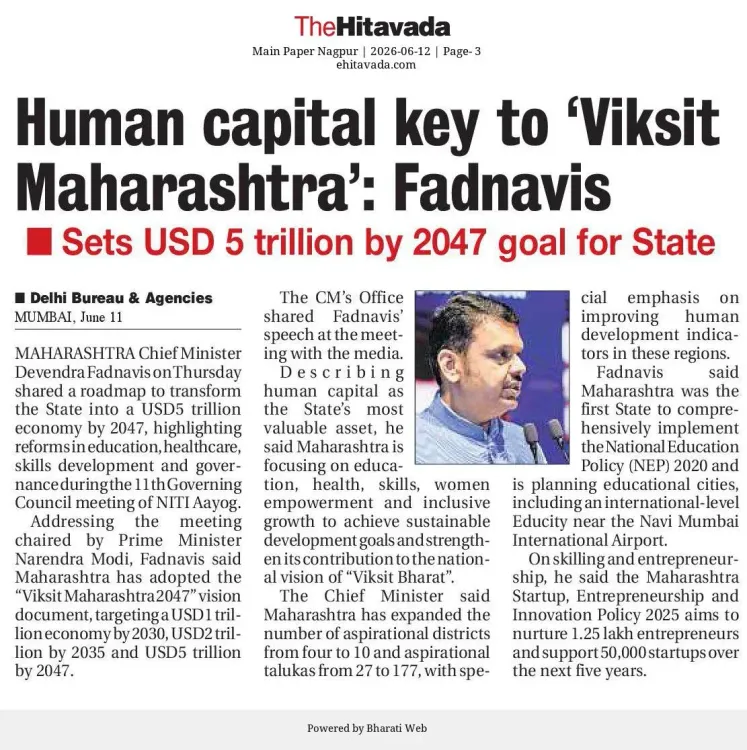
The Chief Minister's Office of Maharashtra, on Friday, June 12, 2026, shared a statement from Chief Minister Devendra Fadnavis underlining that human capital is the cornerstone of the state's long-term development vision, Viksit Maharashtra 2047.
Context
CM Fadnavis framed the development of Maharashtra's workforce, educational institutions, and skill ecosystem as non-negotiable inputs for achieving the state's 2047 growth ambitions. The remark positions people — not just infrastructure or industry — as the primary lever for sustained economic leadership. The statement was shared by the official Chief Minister's Office of Maharashtra handle, signalling institutional weight behind the message.
Policy Backdrop
The Viksit Maharashtra 2047 vision is the state's answer to the national Viksit Bharat@2047 framework formally articulated by Prime Minister Narendra Modi in August 2023, which set a target of transforming India into a developed economy by the centenary of independence. Like several other states, Maharashtra has since been building a matching long-term roadmap that prioritises education, skilling, and health as foundational pillars. The state has institutional precedent in this space: the Maharashtra State Skill Development Society, established in 2011, and a series of skill missions launched after 2014 laid early groundwork for workforce-focused policymaking.
Maharashtra is already India's largest economy by Gross State Domestic Product, and policymakers are acutely aware that retaining that position requires continuous investment in human capital as competition intensifies from southern and western states with aggressive skilling and education agendas of their own.
Stakeholders and Impact
The primary beneficiaries of a human-capital-centred approach would be Maharashtra's youth workforce and its network of educational and vocational training institutions. A sustained policy push in this direction could translate into expanded skilling programmes, higher public investment in higher education, and tighter alignment between industry demand and academic output. For employers — particularly in Mumbai's financial sector and Pune's manufacturing and technology corridors — a better-trained talent pool directly affects competitiveness and productivity.
Civil society groups and student organisations tracking education budgets will watch whether the rhetorical emphasis on human capital is matched by allocations in the 2026-27 budget session. The statement also carries political significance: by anchoring the Viksit Maharashtra narrative in people-first language, CM Fadnavis signals a governance philosophy that goes beyond brick-and-mortar infrastructure projects.
What's Next
Attention will now turn to the release of a detailed Viksit Maharashtra 2047 action plan and the corresponding budgetary allocations for education and skill-development programmes. Observers will scrutinise whether specific targets — such as enrolment rates, skilling throughput numbers, or research and development spending — are attached to the vision. The degree to which the state government translates this human-capital emphasis into measurable policy commitments will determine the long-term credibility of the Viksit Maharashtra 2047 roadmap.
Point of View
CM Fadnavis is doing two things at once: aligning Maharashtra tightly with the ruling dispensation's national vision, and staking a governance identity that is harder to attack than infrastructure-led claims alone. The framing is politically astute — education and skilling are cross-cutting issues that resonate with youth voters, a demographic Fadnavis has consistently courted. However, the statement's real test will come when budget allocations and programme targets are published; vision documents without fiscal muscle have a long history in Indian state politics. If Maharashtra backs this rhetoric with measurable commitments, it could set a benchmark for how large states operationalise the Viksit Bharat framework.
NationPress
29 Jul 2026
Frequently Asked Questions
What is Viksit Maharashtra 2047?
Viksit Maharashtra 2047 is the state government's long-term development vision aimed at making Maharashtra a fully developed economy by 2047 , the centenary of India's independence, in line with the national Viksit Bharat@2047 framework.
What did CM Devendra Fadnavis say about human capital?
CM Devendra Fadnavis stated that human capital is the key to achieving Viksit Maharashtra 2047 , emphasising that investment in people — through education, skilling, and health — is central to the state's development strategy.
What is Viksit Bharat 2047?
Viksit Bharat@2047 is the national vision articulated by Prime Minister Narendra Modi in August 2023 , targeting India's transformation into a developed economy by the 100th anniversary of independence in 2047 .
Why is human capital important for Maharashtra's economy?
Maharashtra is India's largest state economy by GSDP, and sustaining that lead requires a skilled, educated workforce. As competition from other states intensifies, human-capital investment in education and skilling is seen as essential to long-term productivity and growth.
What skilling institutions does Maharashtra already have?
Maharashtra established the Maharashtra State Skill Development Society in 2011 and has since launched multiple skill missions, providing an institutional base for the human-capital push envisioned under Viksit Maharashtra 2047 .