Textiles Minister Giriraj Singh cites 38% fall in TB deaths
Synopsis
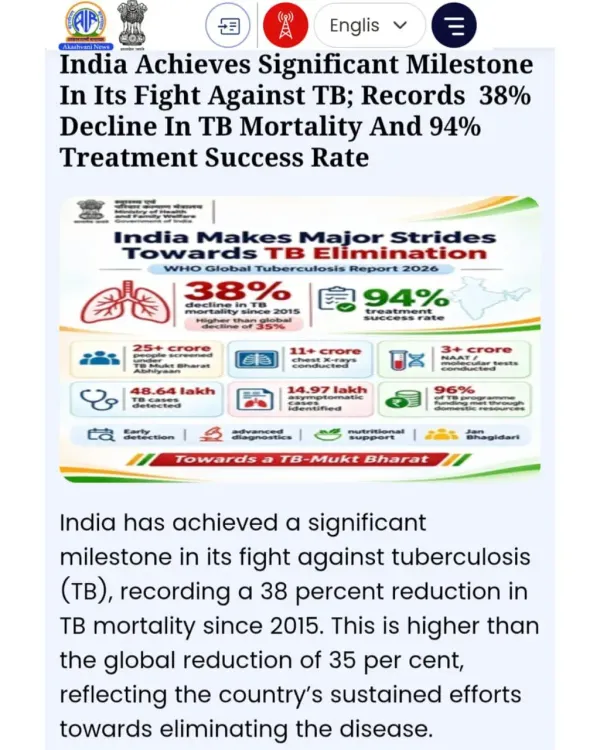
India is beating the global decline in tuberculosis deaths, Union Textiles Minister Giriraj Singh said, putting the fall at 38 percent against 35 percent worldwide and treatment success at 94 percent. He credited Prime Minister Narendra Modi's push on early detection, diagnostics, nutrition and public participation, and restated the BJP government's pledge to a TB-free India.
Key Takeaways
Union Textiles Minister Giriraj Singh on 25 November 2026 said India is advancing toward a TB-free country.
He cited a 38 percent fall in TB deaths, which he said exceeds the 35 percent global decline, and a 94 percent treatment success rate.
He credited Prime Minister Narendra Modi for pushing early identification, modern testing, nutrition support and public participation.
India’s National Strategic Plan for TB Elimination 2017-2025 targets ending TB by 2025 , five years ahead of the SDG timeline.
Nikshay Poshan Yojana (2018) provides monthly nutrition support to notified TB patients via direct benefit transfer.
The Nikshay portal digitally tracks TB cases, treatment and nutrition payments across states.
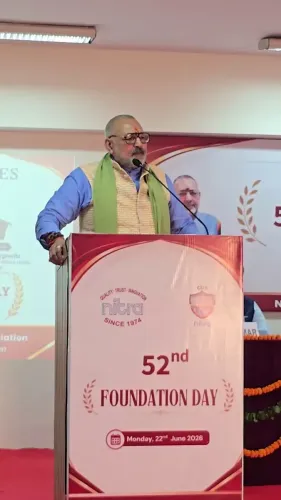
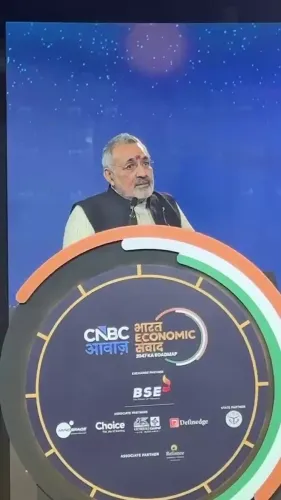
Union Textiles Minister Giriraj Singh on 25 November 2026 said India is steadily closing in on a TB-free nation, putting the fall in tuberculosis deaths above the global average. Posting on X, he cited a 38 percent drop in TB mortality against a 35 percent worldwide decline, and a treatment success rate of 94 percent.
Singh wrote that the country is moving continuously toward the resolve of a TB mukt Bharat (TB-free India). The fall in deaths, he said, is larger than the global decline, and the 94 percent treatment success rate is the result of collective effort. Under Prime Minister Narendra Modi, he added, the campaign is being given new momentum through early identification, modern testing, nutrition support and janbhagidari (public participation). ‘The BJP government is committed to realizing the goal of a TB-free India,’ he said.
The 38 percent claim and the 94 percent success rate
Those two figures are the political core of the post. Singh did not name the dataset behind the 38 percent mortality cut or the 94 percent treatment success rate. They sit, however, inside a programme architecture New Delhi has built since the late 2010s.
India’s National Strategic Plan for TB Elimination 2017-2025 set a deadline of ending TB by 2025 — five years ahead of the Sustainable Development Goal target. The vehicle is the National TB Elimination Programme, which leans on active case-finding, digital notification and community mobilisation rather than waiting for patients to walk into clinics.
Nikshay Poshan Yojana and the nutrition lever
Nutrition is not a side note in this campaign. The Nikshay Poshan Yojana, launched in 2018, sends monthly nutrition support to notified TB patients through direct benefit transfer. The companion Nikshay portal is the digital spine: it tracks cases, treatment and payments so that state health departments and the Centre can see the same patient journey.
Singh’s emphasis on public participation tracks that design. Community workers, families and local volunteers are treated as part of the detection-and-adherence chain, not as spectators. For patients, the difference is concrete: a notified diagnosis, a molecular test, a monthly nutrition credit, and a follow-up that is supposed to stay on a screen in Nikshay.
An accelerated clock against the global End TB Strategy
India has pursued a faster elimination timeline than the World Health Organization’s End TB Strategy. That choice raises the stakes of every mortality and treatment-success figure ministers put on record. State health departments remain the operational layer: they run the microscopy and molecular testing, enrol patients, and push the last-mile nutrition transfers.
The next test of the story Singh told is documentary, not rhetorical. The forthcoming India TB Report, read against the WHO Global Tuberculosis Report, is the ledger that matters. That comparison, not a social-media post, will show whether the elimination clock is still running in India’s favour.
Point of View
Not the health minister, puts TB mortality and treatment-success rates on X, it is whole-of-government political signalling. The National Strategic Plan’s 2025 end-TB deadline was always more aggressive than the global SDG clock; citing a 38 percent mortality cut and 94 percent treatment success is an attempt to show that accelerated timeline is holding. Nutrition transfers under Nikshay Poshan Yojana and digital tracking on the Nikshay portal are the operational proof points behind the rhetoric. The next India TB Report will decide whether those percentages survive contact with the official tables.
NationPress
25 Nov 2026
Frequently Asked Questions
What did Giriraj Singh say about TB in India?
Union Textiles Minister Giriraj Singh said India is moving toward a TB-free nation, with TB deaths down 38 percent — more than the 35 percent global decline he cited — and a 94 percent treatment success rate. He credited Prime Minister Narendra Modi’s focus on early identification, modern testing, nutrition support and public participation.
What is the National TB Elimination Programme?
It is the central scheme through which India pursues TB-free status, with a focus on detection, treatment and nutrition support. It sits under the National Strategic Plan for TB Elimination 2017-2025.
What is Nikshay Poshan Yojana?
Nikshay Poshan Yojana is a 2018 direct-benefit-transfer scheme that provides monthly nutrition support to notified tuberculosis patients. It is paired with the Nikshay portal, which digitally tracks cases and payments.
What is India’s target year for ending TB?
India’s National Strategic Plan for TB Elimination 2017-2025 set the goal of ending TB by 2025. That is five years ahead of the Sustainable Development Goal timeline.
Who is Giriraj Singh?
Giriraj Singh is the Union Minister of Textiles, a senior BJP leader and Lok Sabha MP from Begusarai, Bihar. On 25 November 2026 he restated the government’s pledge to a TB-free India.