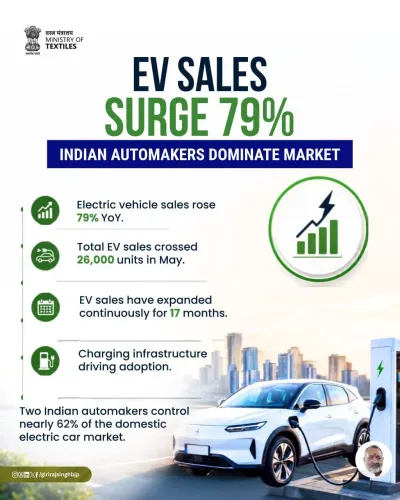
Giriraj Singh flags 4-6% PV sales growth forecast for FY27
Synopsis
Union Textiles Minister Giriraj Singh on 22 June 2026 amplified a report projecting 4-6 per cent growth in India's passenger vehicle sales in FY27 via the NaMo App, spotlighting the sector's post-pandemic recovery and the government's PLI-backed manufacturing push.
Key Takeaways
Union Textiles Minister Giriraj Singh shared the forecast on 22 June 2026 via the NaMo App .
India's passenger vehicle sales are projected to grow 4-6 per cent in FY27 .
India is currently the fifth-largest passenger vehicle market in the world.
The government's PLI Scheme for Automobiles , approved in 2021 with an outlay of Rs 26,058 crore , underpins the sector's manufacturing expansion.
Industry body SIAM 's full-year FY26 data will serve as the key baseline for assessing FY27 growth.
Stakeholders including auto manufacturers, component suppliers and vehicle buyers are all positioned to benefit from sustained volume growth.
Union Textiles Minister Giriraj Singh on Monday, 22 June 2026 shared a report projecting 4 to 6 per cent growth in India's passenger vehicle sales in FY27, amplifying the forecast through the NaMo App to highlight the country's automotive momentum.
Context
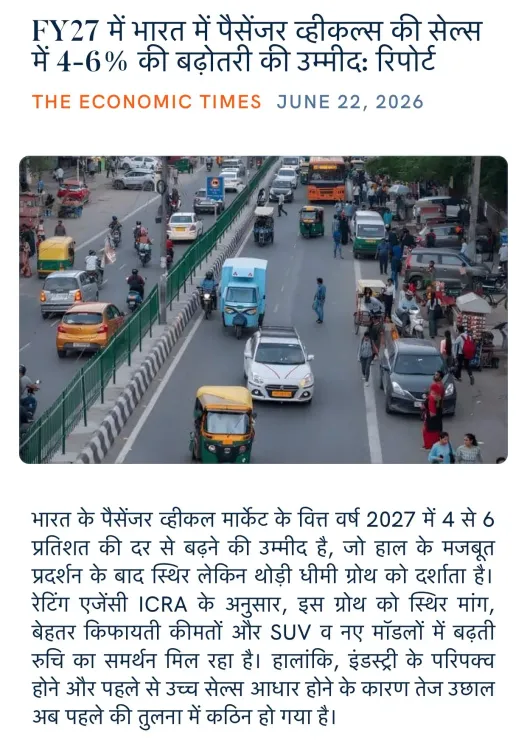
The minister shared the forecast — originally published in a financial daily — with the caption: 'FY27 mein Bharat mein passenger vehicles ki sales mein 4-6% ki badhotari ki ummeed: Report' ('India's passenger vehicle sales expected to grow 4-6% in FY27: Report'). The share signals the ruling dispensation's intent to draw attention to positive economic indicators in the auto sector, even as the minister's own portfolio covers textiles.
India is currently the fifth-largest passenger vehicle market globally, and domestic retail numbers are closely watched as a barometer of consumer demand and manufacturing health. A projected 4-6 per cent expansion in FY27 would build on the sector's post-pandemic recovery trajectory.
Policy Backdrop
The government has deployed a layered set of incentives to strengthen the automotive value chain. The Production Linked Incentive (PLI) Scheme for Automobiles and Auto Components, approved in 2021 with an outlay of Rs 26,058 crore, was designed to boost domestic manufacturing, exports, and component localisation.
Earlier, the FAME India scheme, launched in 2015, accelerated adoption of electric and hybrid vehicles through demand-side incentives. Both schemes sit within the broader Make in India and Atmanirbhar Bharat frameworks, which have consistently positioned the auto sector as a pillar of industrial self-reliance.
Successive Union Budgets have reinforced this thrust through infrastructure spending and rationalisation of import duties on components, providing original equipment manufacturers with a more predictable cost environment.
Stakeholders and Impact
Auto manufacturers and component suppliers stand to benefit most directly from sustained volume growth, as higher throughput improves capacity utilisation and justifies fresh capital expenditure. For vehicle buyers, a competitive and growing market typically translates into wider choice and more aggressive pricing.
The forecast, if realised, would also support employment across the automotive value chain, which spans assembly plants, tier-1 and tier-2 suppliers, and dealership networks spread across states such as Maharashtra, Gujarat, Tamil Nadu and Haryana. Industry body SIAM is expected to publish full-year FY26 sales data that will serve as the baseline against which FY27 performance is measured.
What's Next
The release of final FY26 retail and wholesale data by SIAM will sharpen the growth baseline and allow analysts to calibrate whether the 4-6 per cent FY27 projection is conservative or optimistic. Any fresh auto-sector incentives announced in the next Union Budget could further influence demand, particularly in the electric vehicle segment where penetration remains nascent relative to overall volumes.
With the government keen to project economic confidence ahead of state elections, sector growth forecasts are likely to remain a recurring feature of political communication — making the auto sector's actual FY27 performance a closely watched data point for both markets and policymakers.
Point of View
If borne out, would validate the government's multi-year bet on PLI incentives and Make in India as demand-side enablers. The move also reflects a broader pattern where macroeconomic confidence-building is treated as a collective political task, not just the preserve of the Finance or Commerce ministries. Analysts will watch whether the forecast holds once SIAM's FY26 baseline data lands, since the starting point materially affects how ambitious the FY27 target actually is.
NationPress
22 Jun 2026
Frequently Asked Questions
What is the expected growth in India's passenger vehicle sales in FY27?
A report shared by Union Textiles Minister Giriraj Singh projects India's passenger vehicle sales to grow by 4 to 6 per cent in FY27, building on the sector's post-pandemic recovery.
What is India's rank in the global passenger vehicle market?
India is currently the fifth-largest passenger vehicle market in the world, with domestic sales serving as a key indicator of consumer demand and manufacturing health.
What is the PLI scheme for automobiles in India?
The Production Linked Incentive (PLI) Scheme for Automobiles and Auto Components was approved in 2021 with an outlay of Rs 26,058 crore to boost domestic manufacturing, exports and component localisation.
Why did Giriraj Singh share an auto sector report when he is Textiles Minister?
Senior BJP leaders routinely amplify positive economic data across sectors via platforms like the NaMo App as part of broader government communication on India's economic momentum, regardless of their specific portfolio.
What will determine if the FY27 passenger vehicle growth forecast is accurate?
The release of full-year FY26 retail and wholesale sales data by industry body SIAM will establish the baseline, and any new auto-sector incentives in the next Union Budget could further influence the outcome.