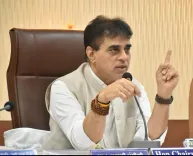
Giriraj Singh flags 6.24% rise in India internet subscribers
Synopsis
Union Textiles Minister Giriraj Singh posted on X via the NaMo App on 24 June 2026, highlighting a 6.24 per cent rise in India's internet subscribers during the March 2026 quarter — a figure aligned with TRAI's quarterly tracking of the country's expanding digital footprint.
Key Takeaways
Union Textiles Minister Giriraj Singh shared the internet subscriber data on 24 June 2026 via the NaMo App on X.
India's internet subscriber base grew by 6.24 per cent in the March 2026 quarter .
The Telecom Regulatory Authority of India (TRAI) is the statutory body that publishes quarterly subscriber data used as the official benchmark.
India is the world's second-largest internet market by subscriber base, a position built on policy initiatives including Digital India (launched 2015) and the Jio -driven tariff disruption of 2016.
Key beneficiaries of rising internet penetration include telecom operators, e-commerce platforms, and rural broadband users .
The next TRAI quarterly report will be watched for state-wise breakdowns and updates on 5G rural rollout progress.
Union Textiles Minister Giriraj Singh on Wednesday, 24 June 2026, shared data showing that internet subscribers in India grew by 6.24 per cent in the March 2026 quarter, posting the update via the NaMo App on his official X account.
Context
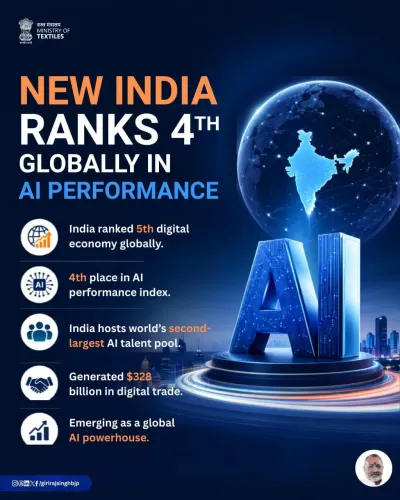
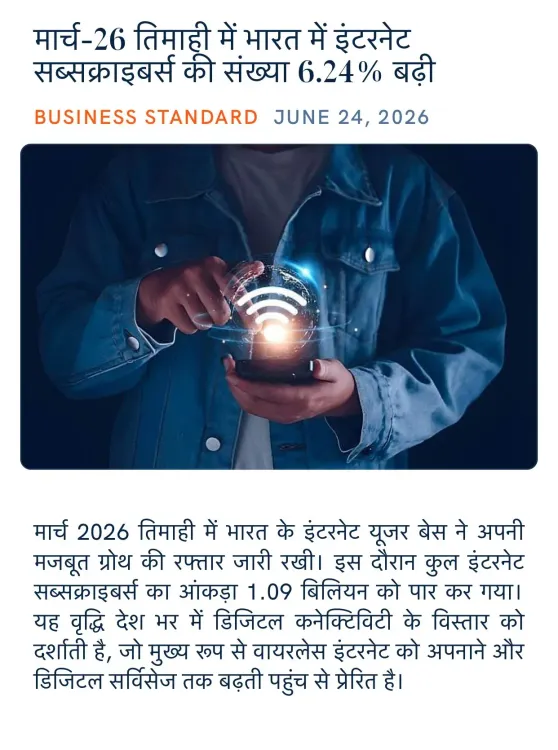
Singh shared a headline stating 'मार्च-26 तिमाही में भारत में इंटरनेट सब्सक्राइबर्स की संख्या 6.24% बढ़ी' — translated as 'Internet subscribers in India rose 6.24 per cent in the March 2026 quarter.' The post was accompanied by an image and shared through the NaMo App, a platform associated with Prime Minister Narendra Modi's outreach ecosystem and frequently used by BJP leaders to amplify government-aligned data points.
The subscriber growth figure is consistent with the kind of quarterly telecom data published by the Telecom Regulatory Authority of India (TRAI), which has been releasing Indian Telecom Services Performance Indicators reports for several decades. These reports serve as the official benchmark for tracking internet and telecom penetration across the country.
Policy Backdrop
India's steady rise in internet subscriptions is rooted in a decade-long policy push. The Digital India programme, launched in July 2015 by the Modi government, set out to expand broadband infrastructure, improve digital literacy, and integrate e-governance services across urban and rural geographies.
A pivotal inflection point came in 2016 with the entry of Reliance Jio into the telecom market, which triggered a sharp reduction in mobile data tariffs and set off a multi-year surge in internet subscriptions. Subsequent investments in 4G and 5G networks, alongside public schemes targeting last-mile rural connectivity, have sustained this upward trend through successive quarters.
India is currently the world's second-largest internet market by subscriber base, and the government has consistently cited quarterly TRAI data to benchmark progress against its digital economy targets.
Stakeholders and Impact
The growth in internet subscribers has broad implications across sectors. Telecom operators — both private and state-owned — stand to benefit from expanding active user bases that drive data revenue and network utilisation. E-commerce platforms, fintech firms, and ed-tech providers depend on growing internet penetration to reach new customers, particularly in Tier-2 and Tier-3 cities and rural areas.
For rural broadband users, each quarterly uptick in subscriber numbers signals improved access to digital public services, from direct benefit transfers to health and education portals. Advocacy groups tracking the digital divide have long pointed to subscriber growth as a necessary — though not sufficient — indicator of meaningful connectivity.
What's Next
Attention will now turn to the next TRAI quarterly report, which could provide granular breakdowns of subscriber additions by state, technology type (wireless versus wireline), and operator. Analysts will also watch for any government announcements on 5G rural rollout timelines or revisions to data pricing regulations that could further accelerate subscriber growth in underserved regions.
With India's digital economy increasingly central to the government's growth narrative, quarterly subscriber data is likely to remain a frequently cited metric by ministers across portfolios — not just those directly overseeing telecom policy.
Point of View
With ministers across departments routinely sharing digital economy wins. The 6.24 per cent quarterly growth figure, if confirmed by the full TRAI report, would reinforce the government's flagship Digital India narrative ahead of what is shaping up as a data-driven policy cycle. However, the choice of a minister not directly overseeing telecom or IT to circulate such data also reflects the broader political imperative to associate the ruling coalition with India's digital growth story at every opportunity. Analysts will watch whether this signals a coordinated pre-announcement communications push ahead of a formal TRAI data release or a major digital policy event.
NationPress
24 Jun 2026
Frequently Asked Questions
How much did internet subscribers in India grow in the March 2026 quarter?
Internet subscribers in India grew by 6.24 per cent in the March 2026 quarter, according to data shared by Union Textiles Minister Giriraj Singh on 24 June 2026.
Which body publishes India's quarterly internet subscriber data?
The Telecom Regulatory Authority of India (TRAI) is the statutory body that compiles and publishes quarterly Indian Telecom Services Performance Indicators reports, which track internet and telecom subscriber numbers.
What is the NaMo App and why did Giriraj Singh use it?
The NaMo App is a platform associated with Prime Minister Narendra Modi's outreach ecosystem; BJP ministers and leaders frequently use it to share government-aligned updates and amplify digital economy data.
Why is India's internet subscriber growth significant?
India is the world's second-largest internet market, and rising subscriber numbers signal progress on the Digital India programme, benefiting telecom operators, e-commerce firms, and rural users accessing digital public services.
What should I watch for next on India's internet subscriber data?
The next full TRAI quarterly report will provide state-wise and technology-wise breakdowns, and any government announcements on 5G rural rollout or data pricing regulations could further shape the subscriber growth trajectory.