Giriraj Singh hails India as low-cost solar power market
Synopsis
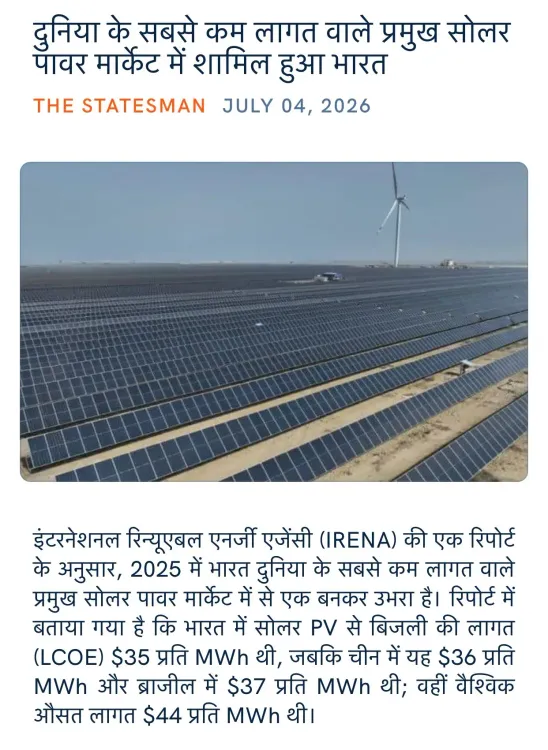
Union Textiles Minister Giriraj Singh on 4 July 2026 amplified a report stating India has joined the world's lowest-cost major solar power markets, reflecting a decade of competitive auctions, falling tariffs, and PLI-driven domestic manufacturing that has reshaped India's clean energy trajectory.
Key Takeaways
Union Textiles Minister Giriraj Singh shared on 4 July 2026 that India has emerged as one of the world's lowest-cost major solar power markets.
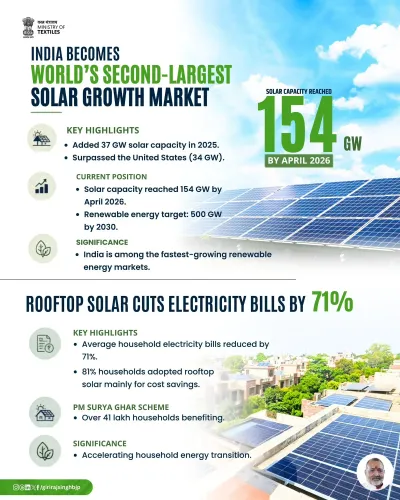
India grew its solar installed capacity from under 3 GW in 2014 to over 70 GW by 2024 through central and state competitive auctions.
Solar tariffs in India fell below Rs 2.50 per unit in multiple SECI auctions between 2017 and 2021 , setting global benchmarks.
India has committed to a 500 GW non-fossil fuel energy target by 2030 , announced after the original 175 GW by 2022 goal.
The Production Linked Incentive (PLI) scheme for solar manufacturing is central to reducing India's import dependence and sustaining cost competitiveness.
India co-founded the International Solar Alliance with France in 2015 , cementing its global leadership role in solar energy deployment.
Union Textiles Minister Giriraj Singh on Saturday, 4 July 2026, shared a report on X highlighting that India has emerged as one of the world's lowest-cost major solar power markets, amplifying the news via the NaMo App.
Context
Singh shared the post in Hindi, writing 'दुनिया के सबसे कम लागत वाले प्रमुख सोलर पावर मार्केट में शामिल हुआ भारत' — translated: 'India has joined the world's lowest-cost major solar power markets.' The post carried an image and was amplified through the NaMo App, a platform frequently used by senior BJP leaders to circulate government achievements to party workers and supporters.
The development underscores a decade-long transformation in India's energy landscape, driven by large-scale competitive bidding, falling global module prices, and sustained policy support from the central government.
Policy Backdrop
India scaled its solar installed capacity from under 3 GW in 2014 to over 70 GW by 2024, powered by successive central and state auctions administered through agencies such as SECI (Solar Energy Corporation of India). Solar tariffs in India fell below Rs 2.50 per unit in multiple SECI auctions between 2017 and 2021, setting global cost benchmarks and attracting large-scale domestic and foreign investment.
The National Solar Mission, launched in 2010, laid the foundation with phased capacity targets that were later revised upward. At the 2015 COP21 summit in Paris, India committed to 175 GW of renewable energy by 2022 and subsequently announced an ambitious 500 GW non-fossil fuel target by 2030. The Production Linked Incentive (PLI) scheme for solar manufacturing has further strengthened the domestic supply chain, reducing import dependence on Chinese modules.
India co-founded the International Solar Alliance (ISA) alongside France in 2015, positioning itself as a global leader in mobilising solar investment across member nations, particularly in the developing world.
Stakeholders and Impact
The cost reduction benefits multiple stakeholders across the energy value chain. State electricity distribution companies (discoms) can procure solar power at lower rates, easing their financial burden and potentially reducing retail tariffs for consumers. Solar developers gain a more competitive environment that attracts fresh capital, while domestic manufacturers stand to benefit from the PLI-driven shift away from imports.
For ordinary households and industries, lower solar generation costs translate into improved energy affordability over time. The achievement also strengthens India's negotiating position in international climate forums, where it has consistently argued that clean energy transitions must be cost-effective for developing economies.
What's Next
The next round of SECI solar auctions and any revision of state Renewable Purchase Obligations (RPOs) in the 2025-26 budget sessions will be closely watched as indicators of whether India can sustain and deepen its cost advantage. Policymakers and industry observers will also track the pace of domestic module manufacturing under the PLI scheme, which is central to insulating Indian projects from global supply-chain volatility. As India pushes toward its 500 GW non-fossil fuel goal by 2030, maintaining the lowest-cost positioning will be critical to attracting the scale of private investment required.
Point of View
While originating from the Textiles Ministry rather than the Power or New and Renewable Energy ministries, reflects a broader BJP communication strategy of amplifying India's clean energy milestones across the party's entire ministerial apparatus. The framing of India as a 'lowest-cost' market is a pointed message directed at both domestic audiences and international climate negotiators who have historically questioned whether developing nations can decarbonise affordably. This milestone, if sustained, strengthens India's hand in arguing that the clean energy transition need not be a fiscal burden, a position central to its leadership of the International Solar Alliance. The post also signals that solar cost competitiveness has crossed from a technical achievement into a mainstream political talking point ahead of future election cycles.
NationPress
4 Jul 2026
Frequently Asked Questions
Why is India considered one of the lowest-cost solar power markets?
India achieved low solar costs through large-scale competitive government auctions, a sharp fall in global solar module prices, and policy support including the Production Linked Incentive scheme for domestic manufacturing, pushing tariffs below Rs 2.50 per unit in several SECI auctions.
What is India's solar energy capacity as of 2024?
India's solar installed capacity grew from under 3 GW in 2014 to over 70 GW by 2024, driven by successive central and state government auctions.
What is India's renewable energy target for 2030?
India has announced a target of 500 GW of non-fossil fuel energy capacity by 2030, revised upward from the earlier commitment of 175 GW of renewable energy by 2022 made at the COP21 summit in Paris.
What is the International Solar Alliance and India's role in it?
The International Solar Alliance is an India-France initiative launched in 2015 to mobilise investment for solar deployment in member countries, particularly developing nations. India is a founding co-leader of the alliance.
What is the PLI scheme for solar manufacturing in India?
The Production Linked Incentive scheme for solar manufacturing provides financial incentives to domestic producers of solar modules, aiming to reduce India's dependence on imported components and build a competitive local supply chain.