Giriraj Singh Hails India's Renewable Energy Surge Under Modi
Synopsis
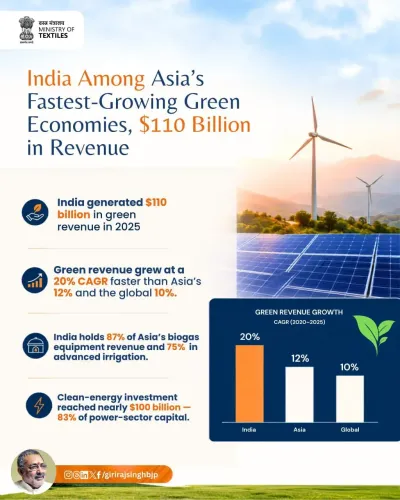
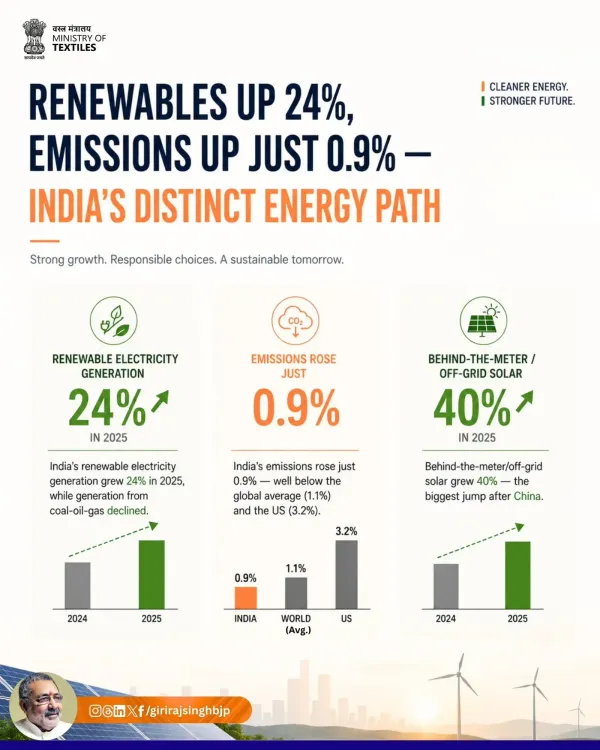
Union Textiles Minister Giriraj Singh on 7 July 2026 cited a 24% jump in renewable energy generation against a mere 0.9% rise in emissions, arguing that India under PM Modi is proving development and environmental protection can go hand in hand.
Key Takeaways
Union Textiles Minister Giriraj Singh posted on 7 July 2026 highlighting India's clean energy progress.
Renewable energy generation reportedly rose by 24% while emissions increased by only 0.9% , according to the post.
Singh linked the figures to PM Narendra Modi 's leadership and three national missions: green energy, Atmanirbhar Bharat , and Viksit Bharat 2047 .
India had pledged 500 GW of non-fossil fuel capacity by 2030 and net-zero by 2070 at COP26 in 2021.
The BJP is framing clean energy milestones as central to its long-term political and economic narrative.
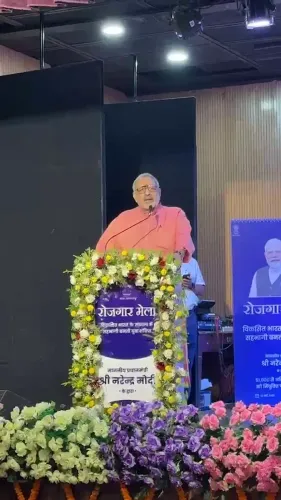
Union Textiles Minister Giriraj Singh on Tuesday, 7 July 2026 highlighted India's accelerating clean energy transition, citing a 24% rise in renewable energy generation and a 0.9% increase in emissions as proof that economic development and environmental protection can advance together under Prime Minister Narendra Modi.
Context
Posting in Hindi on X, the senior BJP leader wrote: 'भारत स्वच्छ ऊर्जा की दिशा में तेजी से आगे बढ़ते हुए सतत विकास का नया उदाहरण प्रस्तुत कर रहा है' ['India is rapidly advancing towards clean energy, presenting a new example of sustainable development']. He framed the figures as evidence that the twin goals of growth and conservation are achievable simultaneously.
Singh linked the achievement to three overlapping national missions: green energy, Atmanirbhar Bharat (self-reliant India), and the long-term Viksit Bharat 2047 vision of transforming India into a developed economy by its centenary of independence.
Policy Backdrop
India's renewable energy push has deep policy roots. At the COP26 climate summit in 2021, Prime Minister Modi announced the five-point Panchamrit strategy, which includes a target of 500 GW of non-fossil fuel capacity by 2030 and a net-zero emissions pledge by 2070.
The country also co-founded the International Solar Alliance in 2015 to accelerate solar deployment globally, with a strong emphasis on domestic manufacturing. The Atmanirbhar Bharat campaign, launched in 2020, extended this logic by channelling industrial incentives toward green technology production inside India.
India has consistently ranked among the top global installers of solar and wind capacity, and government policy has deliberately linked climate commitments to manufacturing self-sufficiency rather than relying solely on emission caps.
Stakeholders and Impact
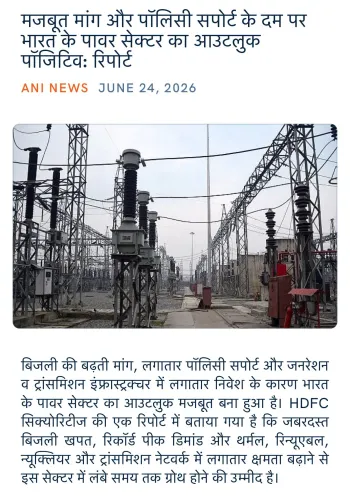
The renewable energy sector — spanning solar developers, wind farm operators, and domestic equipment manufacturers — stands as the primary beneficiary of the policy direction Singh endorsed. Sustained capacity additions translate into long-term procurement contracts and supply-chain opportunities for Indian industry.
For the broader economy, the government's argument that emissions grew at only a fraction of the rate of renewable output suggests a gradual decoupling of GDP growth from carbon intensity — a metric watched closely by international climate finance institutions and sovereign credit analysts.
Citizens in energy-deficient regions also stand to gain as expanded renewable capacity supports rural electrification and reduces dependence on imported fossil fuels, easing pressure on India's current account.
What's Next
Attention will now turn to quarterly renewable capacity addition data and any forthcoming policy announcements on green hydrogen and grid-scale storage — areas identified as critical to sustaining the growth trajectory Singh described. With the next COP cycle approaching, India's ability to demonstrate a widening gap between renewable growth and emissions growth will be central to its international climate diplomacy.
Singh's post signals that the ruling BJP intends to keep clean energy progress at the forefront of its political messaging, tying environmental milestones directly to the broader Viksit Bharat 2047 narrative ahead of future electoral cycles.
Point of View
A messaging strategy that has grown more prominent as the Viksit Bharat 2047 framework matures into an electoral promise. By pairing a high renewable growth figure with a low emissions figure, the party is constructing a 'growth without guilt' narrative aimed at both domestic voters and international audiences. This fits a broader pattern in which Cabinet ministers — even those outside the environment or power portfolios — amplify climate wins to reinforce the government's developmental legitimacy. The approach reflects a calculated bet that climate performance will increasingly shape India's global standing and, by extension, domestic political capital.
NationPress
7 Jul 2026
Frequently Asked Questions
What did Giriraj Singh say about India's renewable energy?
Giriraj Singh stated on 7 July 2026 that India's renewable energy generation grew by 24% while emissions rose by only 0.9%, calling it proof that development and environmental protection can advance together under PM Modi.
What is Viksit Bharat 2047?
Viksit Bharat 2047 is the Indian government's long-term vision to transform India into a fully developed economy by 2047, the centenary of independence, with sustainability as a core pillar.
What is India's renewable energy target by 2030?
India pledged to achieve 500 GW of non-fossil fuel energy capacity by 2030 as part of the Panchamrit climate strategy announced at COP26 in 2021.
What is Atmanirbhar Bharat and how does it relate to clean energy?
Atmanirbhar Bharat, launched in 2020, is India's self-reliance campaign that includes incentives for domestic manufacturing of green technologies such as solar panels and wind equipment.
Why is a Union Textiles Minister commenting on renewable energy?
Senior Cabinet ministers across portfolios routinely amplify government achievements on social media; Giriraj Singh's post reflects the BJP's broader strategy of linking clean energy milestones to its Viksit Bharat 2047 political narrative.