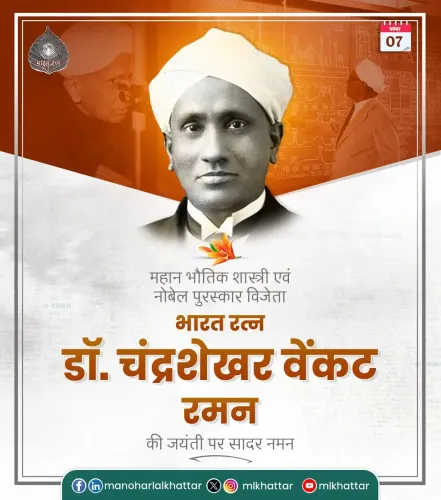
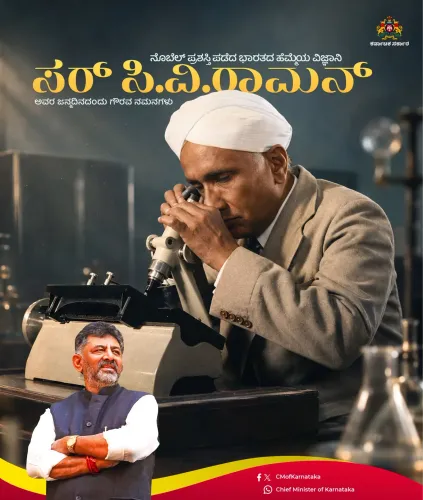
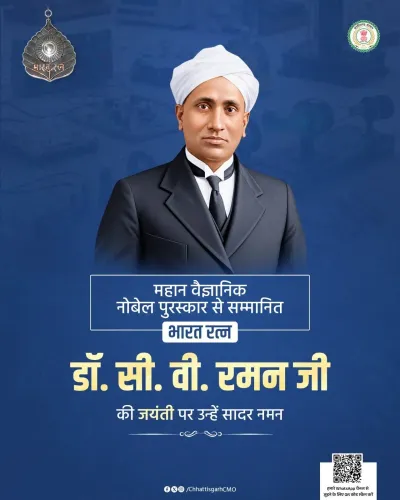
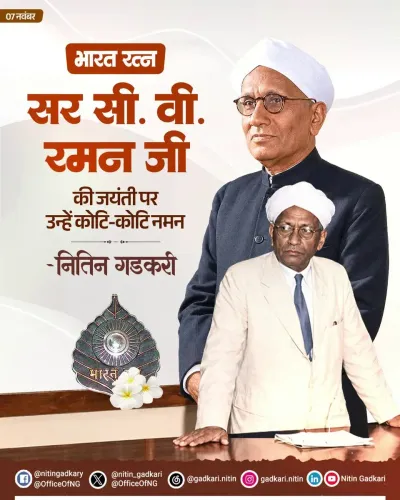
Giriraj Singh pays tribute to CV Raman on birth anniversary
Synopsis
Union Textiles Minister Giriraj Singh paid homage to Sir CV Raman on his birth anniversary, honouring the first Asian Nobel Physics laureate whose 1928 discovery of the Raman Effect remains a cornerstone of modern science and a source of national pride.
Key Takeaways
Giriraj Singh posted a tribute on X marking CV Raman's birth anniversary on 7 November 2026 .
Sir CV Raman was the first Asian scientist awarded the Nobel Prize in Physics , receiving it in 1930 .
The Nobel was awarded for his discovery of the Raman Effect in 1928 , a landmark in the science of spectroscopy.
Raman was conferred the Bharat Ratna in 1954 , India's highest civilian honour.
28 February — National Science Day — marks the anniversary of the Raman Effect's discovery each year.
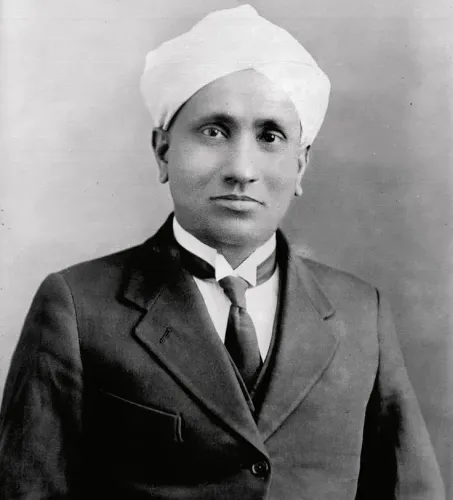
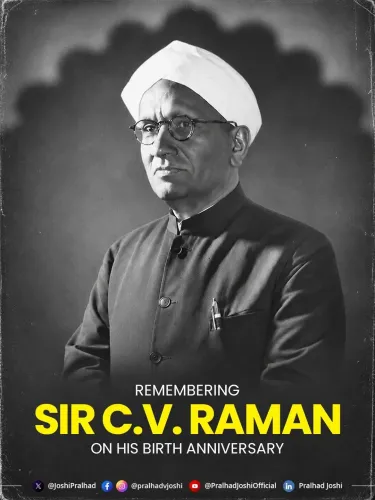
A Nobel laureate whose discovery still lights up laboratories across the world — Union Textiles Minister Giriraj Singh marked the birth anniversary of Sir Chandrasekhara Venkata Raman on Saturday, 7 November 2026, with a heartfelt salute to the physicist whose 'Raman Effect' placed India permanently on the global map of science.
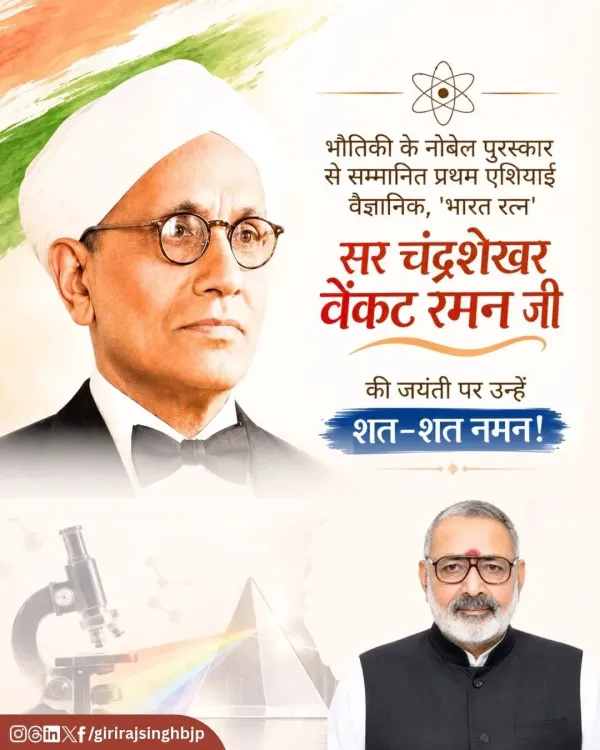
Posting in Hindi on X, the minister wrote: 'Bhautiki ke Nobel Puraskar se sammanit pratham Asiyaai vaigyanik aur Bharat Ratna se vibhushit Sir Chandrashekhar Venkat Raman ji ki jayanti par unhe shat-shat naman!' — 'A hundred salutes to Sir Chandrashekhar Venkat Raman, the first Asian scientist honoured with the Nobel Prize in Physics and decorated with the Bharat Ratna, on his birth anniversary!' He added that Raman's unparalleled contribution to science and the 'Raman Effect' remain a symbol of pride for the entire nation.
The discovery that made history
CV Raman was awarded the Nobel Prize in Physics in 1930 — the first Asian scientist to receive that honour — for his 1928 discovery of the Raman Effect, which demonstrated that light changes wavelength when it passes through a transparent material. The finding fundamentally advanced the science of spectroscopy and continues to underpin modern applications in chemistry, pharmaceuticals, and materials science.
Raman was later conferred the Bharat Ratna in 1954, India's highest civilian award, cementing his stature as one of independent India's foremost scientific icons. His birthday, 7 November, is observed annually across scientific institutions as a day to celebrate his legacy.
India's tradition of honouring its scientific giants
Tributes to Raman on his birth anniversary have become a fixture of India's public calendar, with ministers, scientists, and institutions marking the day each year. The broader national commemoration peaks on 28 February — National Science Day — which marks the anniversary of the Raman Effect's discovery and draws participation from schools and research bodies across the country.
Raman's legacy is a reminder that scientific brilliance forged in pre-independence India continues to carry weight nearly a century later — and that the Raman Effect, conceived in Kolkata in 1928, is still at work in every Raman spectrometer running today.
Point of View
Invoking Raman — a Bharat Ratna recipient and a globally recognised Indian — fits neatly into a cultural nationalism narrative that celebrates indigenous intellectual heritage. The ritual regularity of such posts, however, also signals that commemoration remains largely symbolic, raising a standing question about whether policy investment in basic science research matches the rhetorical reverence on display.
NationPress
7 Nov 2026
Frequently Asked Questions
When is CV Raman's birthday?
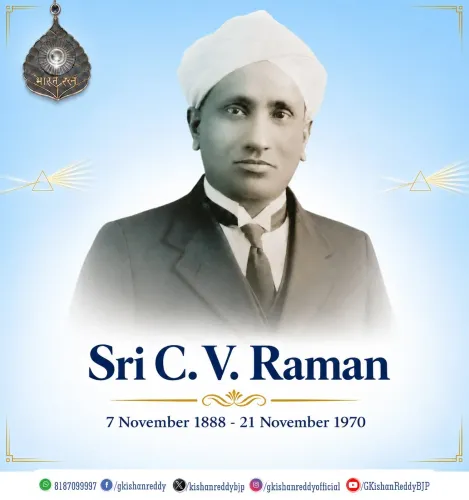
CV Raman was born on 7 November 1888 . His birth anniversary is marked every year by scientific institutions and public figures across India.
What is the Raman Effect?
The Raman Effect , discovered in 1928 , is the phenomenon by which light changes its wavelength after passing through a transparent material. It underpins modern spectroscopy and has wide applications in chemistry, pharmaceuticals, and materials science.
Why did CV Raman win the Nobel Prize?
CV Raman won the Nobel Prize in Physics in 1930 for the discovery of the Raman Effect, which demonstrated inelastic scattering of light. He became the first Asian scientist to receive a Nobel Prize in Physics.
What is National Science Day and why is it celebrated?
National Science Day is observed every year on 28 February , the date in 1928 on which CV Raman announced the discovery of the Raman Effect. Schools, universities, and research institutions across India mark the day with events celebrating science.
Was CV Raman awarded the Bharat Ratna?
Yes. CV Raman was conferred the Bharat Ratna — India's highest civilian award — in 1954 , recognising his extraordinary contributions to physics and to India's scientific standing in the world.