IMD forecasts below-normal rainfall in September 2026 amid El Nino
Synopsis
India's weather agency has put the country on notice for a dry, hot September — with rainfall likely to fall below 91% of the long-period average and El Nino conditions set to strengthen further. For farmers already navigating a volatile kharif season, this forecast adds urgency to contingency planning before the northeast monsoon window opens.
Key Takeaways
IMD forecasts below-normal rainfall for September 2026 , likely under 91% of the Long Period Average of 167.9 mm .
Strong El Nino conditions over the equatorial Pacific are expected to intensify in the coming months.
Neutral IOD conditions prevail; some international centres flag a possible shift to positive IOD from September.
Above-normal temperatures expected across most of India for both maximum and minimum averages.
Risks include strain on agriculture , hydropower , drinking water , and heightened heat stress .
IMD will issue the Northeast Monsoon Season (October–December 2026) forecast by end of September.
The India Meteorological Department (IMD) on Monday, 31 August issued its monthly weather outlook for September 2026, projecting below-normal rainfall across most of the country and above-normal temperatures in the majority of regions. The forecast signals a difficult close to the monsoon season for large parts of India.
Rainfall Outlook for September
According to the IMD, monthly rainfall in September 2026 is most likely to remain below normal — defined as less than 91% of the Long Period Average (LPA). The LPA for September, based on data from 1971 to 2020, stands at approximately 167.9 mm.
Spatially, a wide swath of the country is expected to receive deficient rainfall. However, parts of northwest, northeast, east, east-central, and southeast peninsular India are likely to see normal to above-normal rainfall. The probabilistic tercile forecast indicates that below-normal rainfall is the dominant category nationwide.
Temperature Projections
Monthly average maximum temperatures are expected to be above normal across most parts of the country. Minimum temperatures are also likely to remain above normal in the majority of regions, with the exception of some areas in northwest, west-central, and northeast India, where temperatures may be normal to below normal.
El Nino and Ocean Conditions
The IMD attributed the forecast partly to strong El Nino conditions currently prevailing over the equatorial Pacific Ocean, with sea surface temperatures remaining above normal across the central and eastern equatorial Pacific. These conditions are expected to strengthen further in the coming months.
Meanwhile, neutral Indian Ocean Dipole (IOD) conditions currently prevail over the Indian Ocean. Forecasts from IMD's Monsoon Mission Coupled Forecast System (MMCFS) suggest neutral IOD conditions are likely to persist through September. Notably, some international climate centres indicate a possible transition to positive IOD conditions from September onwards, which could partially offset El Nino's suppressive effect on rainfall.
Impact on Agriculture and Water Resources
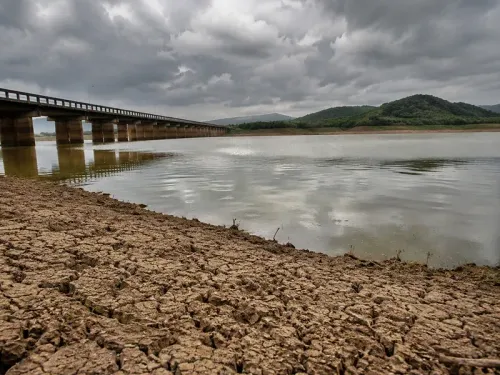
Below-normal rainfall carries significant downstream risks. The IMD has flagged potential adverse effects on agriculture, water resources, hydropower generation, ecosystem sustainability, and drinking water availability. The risk of heat stress is also elevated across several regions.
The department has advised relevant agencies and stakeholders to undertake timely preparedness measures, including water conservation, efficient resource management, and agricultural contingency planning.
What Comes Next
The IMD is scheduled to issue the forecast for the Northeast Monsoon Season (October to December 2026) and the rainfall and temperature outlook for October towards the end of September. With El Nino conditions forecast to intensify, the transition to the northeast monsoon will be closely watched by agricultural and water-management authorities alike.
Point of View
Reservoir levels, and power grid simultaneously. El Nino years have historically correlated with suppressed late-monsoon rainfall, and the IMD's own MMCFS model now points to conditions strengthening, not easing. The neutral IOD is the only partial buffer, and even that may not hold if international models are right about a positive IOD transition arriving too late to rescue September totals. What is missing from the official advisory is a district-level vulnerability map — generic calls for 'water conservation' are insufficient when the deficits are likely to be geographically uneven and agronomically timed at the worst possible moment for late-sown paddy.
NationPress
31 Aug 2026
Frequently Asked Questions
What did IMD forecast for September 2026 rainfall?
The IMD forecast below-normal rainfall for September 2026, likely to be less than 91% of the Long Period Average of 167.9 mm. Most parts of the country are expected to receive deficient rainfall, though some areas in northwest, northeast, east, east-central, and southeast peninsular India may see normal to above-normal rainfall.
What is causing the below-normal rainfall forecast for September?
Strong El Nino conditions prevailing over the equatorial Pacific Ocean are a primary driver, with sea surface temperatures above normal across the central and eastern equatorial Pacific. These conditions are expected to strengthen further, suppressing monsoon rainfall over much of India.
How will below-normal September rainfall affect India?
The IMD has warned of adverse impacts on agriculture, water resources, hydropower generation, ecosystem sustainability, and drinking water availability. Heat stress risks are also elevated. Authorities have been advised to pursue water conservation and agricultural contingency planning.
What is the Indian Ocean Dipole situation and does it help?
Neutral IOD conditions currently prevail over the Indian Ocean and are expected to persist through September, according to IMD's MMCFS model. However, some international climate centres indicate a possible transition to positive IOD conditions from September onwards, which could partially offset El Nino's suppressive effect on rainfall.
When will IMD issue the next major weather forecast?
The IMD will release the forecast for the Northeast Monsoon Season covering October to December 2026, along with the rainfall and temperature outlook for October, towards the end of September 2026.