India invites global bids for 10 GWh ACC battery manufacturing under PLI scheme

Synopsis
India has opened a global tender for 10 GWh of Advanced Chemistry Cell manufacturing capacity earmarked exclusively for grid-scale energy storage — the final tranche of a ₹18,100 crore PLI scheme that has already awarded 40 GWh to four domestic firms. With bids closing in October 2026, this is a pivotal test of whether India can attract international battery capital into a segment it has barely touched domestically.
Key Takeaways
The Ministry of Heavy Industries released a global RFP on 15 July 2026 for 10 GWh of ACC battery manufacturing capacity.
The capacity is reserved for Grid-Scale Stationary Storage (GSSS) applications under the PLI ACC Battery Storage scheme .
Bids must be submitted by 13 October 2026 ; technical bids open on 14 October 2026 .
Of the scheme's total 50 GWh target, 40 GWh has already been awarded to four domestic manufacturers.
The PLI ACC scheme was approved in May 2021 with a budgetary outlay of ₹18,100 crore .
The tender aims to reduce India's import dependence on Asian countries for lithium-ion batteries and related components.
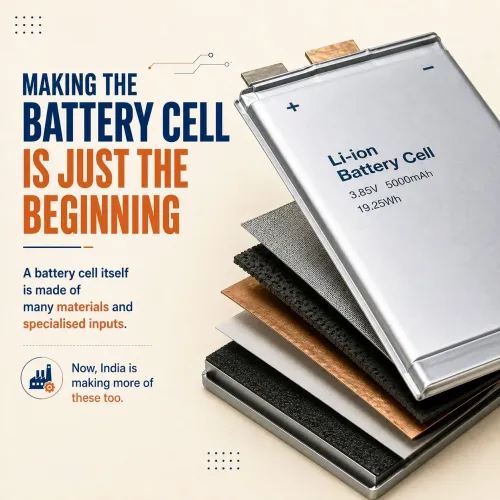
The Ministry of Heavy Industries (MHI) on 15 July 2026 released a global tender inviting bids to select beneficiaries for establishing giga-scale Advanced Chemistry Cell (ACC) manufacturing facilities with a cumulative capacity of 10 GWh in India. The capacity is specifically earmarked for Grid-Scale Stationary Storage (GSSS) applications under the Production-Linked Incentive (PLI) scheme for ACC Battery Storage.
Bidding Process and Key Dates
The Request for Proposal (RFP) has been released for a transparent, two-stage Quality and Cost Based Selection (QCBS) mechanism, conducted online through the Central Public Procurement (CPP) Portal. According to an official statement, tender documents are available from 15 July 2026, with a pre-bid conference scheduled for 29 July 2026. The last date for submission of bids is 13 October 2026, and technical bids will be opened on 14 October 2026.
Where This Fits in the Broader PLI ACC Scheme
Under the PLI ACC scheme, the government had set a total targeted capacity of 50 GWh. Of this, 40 GWh has already been awarded to four domestic manufacturers, with those projects currently under implementation. The remaining 10 GWh — now being tendered — is reserved exclusively for grid-scale stationary energy storage. Notably, the original scheme was approved by the Union Cabinet in May 2021 with a total budgetary outlay of ₹18,100 crore.
Why Grid-Scale Storage Matters Now
India's rapid expansion of renewable energy capacity has created a pressing need for large-scale energy storage solutions to manage intermittency and grid stability. The ministry stated that the 10 GWh allocation will support the country's growing energy storage requirements, strengthen energy security, reduce import dependence, and help develop a globally competitive battery manufacturing ecosystem. This comes amid sustained government pressure to reduce reliance on Asian countries — primarily China — for lithium-ion batteries and related components.
Reducing Import Dependence
A core objective of the PLI ACC scheme is to curtail India's dependence on imported advanced chemistry cells by incentivising both large domestic and international players to build competitive manufacturing capacity onshore. The four beneficiary firms already awarded 40 GWh of capacity represent the first wave of this industrial push. The new 10 GWh tender is designed to extend that momentum into the grid storage segment, which has seen limited domestic manufacturing activity so far.
What Comes Next
Industry stakeholders and global battery manufacturers are expected to closely watch the pre-bid conference on 29 July 2026, which will clarify technical and financial eligibility criteria. The outcome of this tender will be a key indicator of India's ability to attract international capital into its energy storage supply chain — a sector that analysts consider critical to the country's 2070 net-zero ambitions.
Point of View
Grid-scale stationary storage requires a different manufacturing profile and a buyer ecosystem that India is still building. The real question is whether global battery majors — who have largely watched India's energy storage market from the sidelines — will find the incentive structure compelling enough to bid seriously. If they don't, India risks filling this capacity with domestic players who lack the technology depth for grid-grade cells, which would undermine the very import-substitution goal the scheme was designed to achieve.
NationPress
14 Oct 2026
Frequently Asked Questions
What is the 10 GWh ACC battery manufacturing tender India has launched?
The Ministry of Heavy Industries has invited global bids to select manufacturers for establishing 10 GWh of Advanced Chemistry Cell (ACC) battery manufacturing capacity in India, reserved for grid-scale stationary storage applications. It is part of the broader PLI ACC Battery Storage scheme approved in May 2021 with a ₹18,100 crore outlay.
What are the key dates for the ACC battery manufacturing tender?
Tender documents are available from 15 July 2026. A pre-bid conference will be held on 29 July 2026, the last date for bid submission is 13 October 2026, and technical bids will be opened on 14 October 2026.
How much of the 50 GWh PLI ACC target has already been awarded?
Of the total 50 GWh targeted under the PLI ACC scheme, 40 GWh has already been awarded to four domestic manufacturers and is under implementation. The remaining 10 GWh is now being tendered for grid-scale stationary storage.
Why is India focusing on grid-scale stationary storage for this tender?
India's rapid renewable energy expansion has created an urgent need for large-scale storage to manage grid intermittency. The 10 GWh allocation targets this gap, aiming to strengthen energy security and reduce dependence on imported batteries, particularly from Asian countries.
What is the PLI ACC Battery Storage scheme?
The PLI ACC Battery Storage scheme was approved by the Union Cabinet in May 2021 with a total outlay of ₹18,100 crore. It aims to build 50 GWh of domestic ACC manufacturing capacity, reduce import dependence, and create a globally competitive battery manufacturing ecosystem in India.