What Transformative Measures Are Boosting India's Agricultural Sector?

Synopsis
Discover how the Economic Survey 2025-26 unveils transformative initiatives that are revolutionizing India's agriculture, boosting farmer incomes, and enhancing sustainability through innovative practices and robust support systems.
Key Takeaways
Economic Survey 2025-26 highlights key reforms in Indian agriculture.
Increased irrigation from 41.7% to 55.8% enhances crop yield.
Direct income support through the Pradhan Mantri Kisan Samman Nidhi scheme.
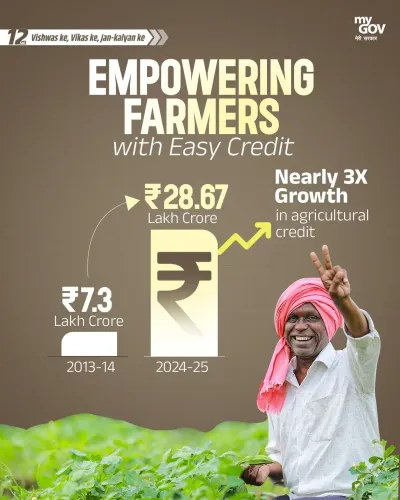
Substantial credit delivery surpassing ₹28.69 lakh crore .
Mechanisation improves efficiency for small farmers.
New Delhi, Jan 29 (NationPress) The Economic Survey 2025-26, introduced in Parliament by Finance Minister Nirmala Sitharaman, has detailed a range of impactful reforms that have considerably enhanced India's agricultural landscape.
The report emphasizes that advancements in input quality, mechanisation, market support, crop insurance, and credit access have resulted in significant benefits for farmers nationwide.
Income support plays a vital role, as the Union government upholds Minimum Support Prices (MSPs) at 1.5 times the production cost, with recent increases for both Kharif and Rabi crops.
The Pradhan Mantri Kisan Samman Nidhi initiative has disbursed over ₹4.09 lakh crore to 11 crore farmers in 21 phases, ensuring direct financial stability.
Credit disbursement has exceeded expectations, reaching ₹28.69 lakh crore in FY25.
The Kisan Credit Card scheme, featuring 7.72 crore active accounts, has been enhanced by the Modified Interest Subvention Scheme, providing ₹1.77 lakh crore in subsidies since FY15.
A standout achievement has been the Sub-Mission on Seeds and Planting Materials, initiated in 2014-15, which has established 6.85 lakh seed villages and produced 1649.26 lakh quintals of quality seeds, aiding 2.85 crore farmers.
Furthermore, the Union government has introduced the National Mission on High-Yielding Seeds in the Union Budget 2025-26 to create climate-resilient crop varieties and make over 100 new seed types commercially available.
Remarkable progress has also been made in irrigation.
The proportion of gross irrigated area relative to the gross cropped area has escalated from 41.7 percent in 2001-02 to 55.8 percent in 2022-23, as noted in the survey.
This improvement has been supported by the Per Drop More Crop program, which offers financial aid for micro-irrigation systems like drip and sprinkler setups, enhancing water-use efficiency and resilience to climate changes.
The Economic Survey identifies soil health management as another essential aspect of productivity growth.
Over 25.55 crore Soil Health Cards have been issued, promoting balanced nutrient management through a combination of chemical fertilizers, organic manures, and bio-fertilizers.
Reforms such as nutrient-based pricing, neem-coated urea, and Aadhaar-linked point-of-sale verification have improved transparency and fertilizer efficiency.
Mechanisation has rapidly evolved under the Sub-Mission on Agricultural Mechanisation, with 25,689 custom hiring centers established since 2014-15, including 558 in 2025-26 alone.
These centers provide collective access to modern machinery, lowering costs and enhancing efficiency for small and marginal farmers.
Marketing infrastructure has been reinforced through initiatives like the Agriculture Marketing Infrastructure sub-scheme and the Agriculture Infrastructure Fund, together financing thousands of storage and marketing projects.
The National Agriculture Market (e-NAM) platform, initiated in 2016, now links 1.79 crore farmers and 2.72 lakh traders across 1,522 mandis, while the Farmer Producer Organisation scheme has successfully registered 10,000 farmer producer organisations to enhance collective bargaining power.
Point of View
It is imperative to recognize the profound impact of the Economic Survey 2025-26. These reforms are not mere statistics but represent real change for millions of farmers across India. The government's commitment to enhancing agricultural productivity and sustainability is commendable, and we must continue to support these initiatives for a prosperous agricultural future.
NationPress
10 Oct 2026
Frequently Asked Questions
What are the key highlights of the Economic Survey 2025-26?
The Economic Survey 2025-26 highlights significant improvements in irrigation, mechanisation, income support through MSPs, and credit delivery that positively impact farmers' incomes.
How does the Pradhan Mantri Kisan Samman Nidhi scheme support farmers?
This scheme provides direct financial assistance to farmers, having disbursed over ₹4.09 lakh crore to 11 crore farmers in 21 instalments.
What role does irrigation play in agriculture according to the survey?
The survey notes that the gross irrigated area has increased from 41.7% in 2001-02 to 55.8% in 2022-23, greatly enhancing agricultural productivity.
How has mechanisation affected small farmers?
Mechanisation has been bolstered by custom hiring centers, allowing small farmers to access modern machinery, thereby reducing costs and increasing efficiency.
What initiatives support soil health management?
Over 25.55 crore Soil Health Cards have been issued to promote balanced nutrient management and improve soil productivity.