KLA: ISI's most dangerous Khalistan card hidden in plain sight
Synopsis
While Indian agencies have been chasing the BKI, KZF, and KLF, intelligence officials say the ISI has been quietly building its most dangerous asset — the Khalistan Liberation Army. Trained by Lashkar-e-Taiba and Jaish-e-Mohammad operatives, the KLA is reportedly battle-ready and on the verge of formal re-activation, with six Punjab blasts this year serving as cover for the real threat still in the shadows.
Key Takeaways
Indian intelligence agencies have identified the Khalistan Liberation Army (KLA) as the most dangerous ISI-backed Khalistani outfit, kept deliberately in the shadows.
The ISI has roped in trainers from Lashkar-e-Taiba and Jaish-e-Mohammad to build KLA's operational capacity over several years.
The KLA is reportedly battle-ready and awaiting formal re-activation, at which point officials warn it could deliver a major strike in Punjab .
Six low-intensity explosions in Punjab this year are assessed by officials as a deliberate distraction strategy — not a failure to mount larger attacks.
The KLA has established links with criminal networks and drug syndicates , expanding its reach and funding base.
Post-attack claims alternating between KLA and KLF have been a deliberate ISI tactic to confuse Indian investigating agencies.
Indian intelligence agencies have identified the Khalistan Liberation Army (KLA) as the most potent and battle-ready terror outfit operating under Pakistan's Inter-Services Intelligence (ISI) patronage — a group that has been deliberately kept in the shadows while better-known organisations such as Babbar Khalsa International (BKI), Khalistan Zindabad Force (KZF), and Khalistan Liberation Force (KLF) absorb security attention in Punjab. Officials warn that the KLA's formal re-activation could mark a dangerous escalation in cross-border terrorism targeting India.
The ISI's Deliberate Misdirection Strategy
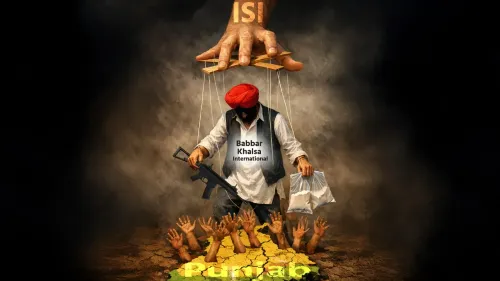
According to officials familiar with intelligence assessments, the ISI has spent the last several years running a calculated smokescreen operation. By pushing the BKI to the forefront of Khalistan-linked violence — and occasionally directing the KZF and KLF to claim responsibility for attacks — the Pakistani spy agency has ensured that the KLA stays below the radar of Indian security agencies.
An official said the ISI's strategy is to have Indian agencies chase groups such as the BKI, KLF, and KZF, while keeping the KLA's activities low-key and under wraps. Post-attack claim confusion has been a key tool: some of the low-intensity explosions that have rocked Punjab have been claimed by the KLA, others by the KLF — a deliberate effort, officials say, to confuse investigating agencies about the true organisational structure on the ground.
KLA's Origins and Current Threat Profile
Historically, the KLA operated as a smaller faction within the wider Khalistani network during the 1990s, typically working alongside the BKI and KZF. It was also a faction group of the KLF. However, intelligence agencies now assess that the ISI has fundamentally changed its role — from proxy to principal.
Officials say the KLA currently has a cadre of heavily-trained operatives, with the ISI having roped in top trainers from Lashkar-e-Taiba and Jaish-e-Mohammad to work alongside KLA personnel. The Intelligence Bureau has indicated that the scale of training investment the ISI has put into KLA cadres is significant. The group is described as battle-ready, awaiting only a formal order for full re-activation.
Criminal Networks and Drug Syndicate Links
Beyond its trained operatives, the KLA has reportedly established connections with criminal networks and drug syndicates operating in Punjab — a convergence that security analysts say amplifies both its funding capacity and its reach into local communities. This nexus between terror outfits and organised crime has been a recurring concern for Punjab Police and central agencies alike.
Officials note that six low-intensity attacks have taken place in Punjab this year alone. These should not be read as an inability to mount larger strikes, officials caution — rather, they represent a deliberate strategy to keep the Punjab Police and central agencies stretched and distracted, buying time for the ISI to position the KLA for a larger operation.
What Security Agencies Are Watching
Intelligence assessments suggest a growing sense of desperation within the Khalistan movement's ISI-backed ecosystem, which officials say is driving the current tempo of low-intensity strikes. According to officials, the KLA is expected to step out of its proxy avatar in the months ahead and begin taking the lead role in operations.
Indian agencies have also noted a pattern where the ISI floats the KLA's name after an incident, only for investigations to surface a loosely connected proxy — a tactic that has historically deflected scrutiny from the group's actual capabilities. Security agencies are now working to close that intelligence gap before a full re-activation can be executed.
Point of View
The security establishment may be measuring the wrong threat. The convergence of terror infrastructure with drug and criminal networks in Punjab is the detail that most mainstream coverage has underweighted.
NationPress
1 Jul 2026
Frequently Asked Questions
What is the Khalistan Liberation Army (KLA)?
The Khalistan Liberation Army (KLA) is an ISI-backed Khalistani terror outfit that historically operated as a smaller faction within the broader Khalistani network alongside the BKI and KZF during the 1990s. Indian intelligence agencies now assess it as the most well-organised and heavily-armed group in the Khalistan ecosystem, trained in recent years by operatives from Lashkar-e-Taiba and Jaish-e-Mohammad.
Why is the KLA considered a bigger threat than BKI or KLF?
Unlike the BKI, KZF, and KLF — which have been active and visible — the KLA has been kept deliberately low-profile by the ISI, allowing it to build capability without attracting sustained counter-terror scrutiny. Officials say it has the most well-trained operatives, significant ISI investment in its cadres, and connections to criminal and drug networks, making it battle-ready for a major operation.
What is the ISI's strategy behind the KLA?
According to Indian intelligence officials, the ISI's strategy has been to push the BKI, KZF, and KLF to the forefront of Khalistan-linked activity, using them as a smokescreen to keep the KLA under the radar. The ISI has also encouraged post-attack claim confusion between the KLA and KLF to prevent Indian agencies from accurately mapping the KLA's true capabilities.
What do the low-intensity blasts in Punjab signal?
Officials say the six low-intensity explosions recorded in Punjab this year should not be interpreted as a failure to carry out larger strikes. Rather, they represent a deliberate strategy to keep Punjab Police and central agencies stretched and distracted, creating a window for the ISI to launch the KLA into Punjab in a significant way.
Which terror groups has the ISI used to train KLA operatives?
The ISI has reportedly brought in top trainers from Lashkar-e-Taiba and Jaish-e-Mohammad to work alongside and train KLA cadres, according to the Intelligence Bureau. This level of investment signals that the KLA is being groomed for high-impact operations rather than low-level proxy activity.