Jitendra Singh Signs MoU to Operationalise North India's First Biotech Park in Kathua

Synopsis
Union Science Minister Dr. Jitendra Singh signed an MoU between J&K's science council and CSIR-IIIM on 1 August 2026 to operationalise North India's first Industrial Biotech Park at Ghatti, Kathua, targeting startups, agri-entrepreneurs, and employment across J&K and neighbouring states.
Key Takeaways
Union Science Minister Dr.
Jitendra Singh signed the MoU on 1 August 2026 between JKST&IC and CSIR-IIIM .
The agreement operationalises North India's first Industrial Biotech Park (IBP) at Ghatti, Kathua district , Jammu and Kashmir.
CSIR-IIIM , based in Jammu, specialises in natural-product drug discovery and traditional medicine research — a direct scientific fit for the park's mandate.
The IBP is designed to support biotech startups , agri-entrepreneurs , skill development, and employment in J&K and neighbouring states.
The collaboration continues a pattern of central scientific institutions building research-to-industry infrastructure in J&K following the 2019 reorganisation .
Roll-out milestones, first tenant agreements, and budget allocations for the IBP are the key developments to watch.
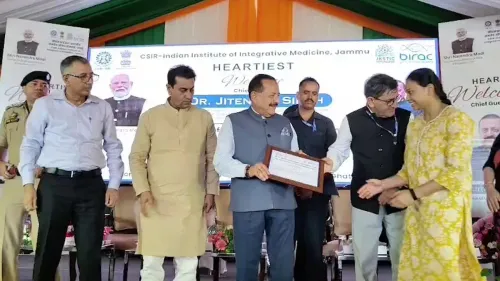
A landmark agreement signed on Saturday, 1 August 2026 could reshape the biotechnology map of northern India — and it starts in a district most policy maps have long overlooked. Union Science and Technology Minister Dr. Jitendra Singh signed a Memorandum of Understanding (MoU) between the J&K Science, Technology and Innovation Council (JKST&IC) and CSIR–Indian Institute of Integrative Medicine (CSIR-IIIM) to operationalise the Industrial Biotech Park (IBP) at Ghatti, Kathua — formally bringing North India's first industrial biotech park a decisive step closer to reality.
What the MoU actually does
The agreement is an operationalisation pact — not a feasibility study, not a letter of intent. It binds two institutions: JKST&IC, the Jammu and Kashmir government body charged with translating science into regional development, and CSIR-IIIM, the Jammu-based national laboratory with deep expertise in natural-product drug discovery and traditional medicine research. Together they will drive the park's activation, channelling CSIR-IIIM's scientific infrastructure and the council's on-ground administrative reach into a single delivery mechanism.
Dr. Singh described the collaboration as one that 'will strengthen North India's first Industrial Biotech Park, promote biotechnology-driven innovation, support startups and agri-entrepreneurs, and create new opportunities for research, skill development and employment in Jammu and Kashmir as well as neighbouring states.'
Kathua's Ghatti site and the biotech gap it fills
India's biotech industry has historically clustered around Bengaluru, Hyderabad, and Pune. The northern belt — rich in medicinal plant biodiversity and agricultural output — has lacked the hard infrastructure to convert that raw material into commercial science. The IBP at Ghatti is designed to close that gap, offering biotech firms and startups a physical base with proximity to CSIR-IIIM's research pipeline. Kathua district, in the Jammu region, sits at a logistical crossroads that also gives the park access to markets in Punjab, Himachal Pradesh, and Haryana.
CSIR laboratories have maintained technology-transfer and industry-linkage programmes in Jammu and Kashmir since the 1990s, but the IBP represents a qualitative shift: a dedicated, purpose-built facility rather than ad hoc partnerships.
Startups, agri-entrepreneurs, and the bio-economy push
The MoU's explicit focus on startups and agri-entrepreneurs signals alignment with national bio-economy goals that seek to connect public laboratories with private enterprise — and to move value addition upstream, closer to where raw agricultural and herbal inputs originate. For J&K, which has seen a deliberate push to build research-to-industry infrastructure since the 2019 reorganisation, the IBP is part of a wider pattern of central scientific institutions deepening their footprint in the union territory.
The park is also expected to generate employment and skill-development opportunities, making it relevant not just to scientists and entrepreneurs but to the broader workforce of the region and neighbouring states.
What comes next for the IBP
The MoU sets the institutional framework; the harder work begins now. Watchers will track roll-out milestones for park facilities, the first tenant agreements, and any state or central budget allocations earmarked for the IBP. Whether the model prompts replication announcements for other J&K districts or neighbouring states will be a key indicator of how seriously the centre intends to scale the northern biotech corridor.
North India's first biotech park has a home, a mandate, and now a formal institutional engine. The question is how fast that engine fires.
Point of View
The government sidesteps the long gestation of building new infrastructure from scratch, a pragmatic choice that also keeps the initiative within the Union's scientific establishment rather than delegating it entirely to the territory. The explicit targeting of agri-entrepreneurs alongside biotech startups reflects a broader national bio-economy narrative that frames public labs as engines of rural value addition — a politically resonant message in a region where agriculture remains central. Whether the IBP translates from MoU to operational park on any meaningful timeline will be the real test of whether this institutional framework produces results or remains another well-intentioned agreement on paper.
NationPress
1 Aug 2026
Frequently Asked Questions
What is the Industrial Biotech Park at Ghatti, Kathua?
The Industrial Biotech Park (IBP) at Ghatti in Kathua district, Jammu and Kashmir, is North India's first dedicated industrial biotech park, designed to host biotech firms, startups, and agri-entrepreneurs and to bridge the gap between scientific research and commercial enterprise in the northern region.
What did the MoU signed by Dr. Jitendra Singh do?
The MoU signed on 1 August 2026 between JKST&IC and CSIR-IIIM formally sets out the institutional framework for operationalising the IBP at Ghatti, Kathua, binding the J&K science council and the CSIR laboratory to jointly drive the park's activation.
What is CSIR-IIIM and why is it involved in the biotech park?
CSIR–Indian Institute of Integrative Medicine (CSIR-IIIM) is a national laboratory based in Jammu that specialises in natural-product drug discovery and traditional medicine research, making it a natural scientific partner for a biotech park in the region.
Who will benefit from the Kathua Industrial Biotech Park?
The IBP is intended to benefit biotech startups, agri-entrepreneurs, researchers, and the broader workforce of Jammu and Kashmir, with employment and skill-development opportunities also expected to extend to neighbouring states such as Punjab, Himachal Pradesh, and Haryana.
Is the Kathua biotech park the first of its kind in North India?
Yes, the Industrial Biotech Park at Ghatti, Kathua is described as North India's first industrial biotech park, addressing a long-standing gap in dedicated biotech infrastructure in the northern region compared to established hubs in southern and western India.