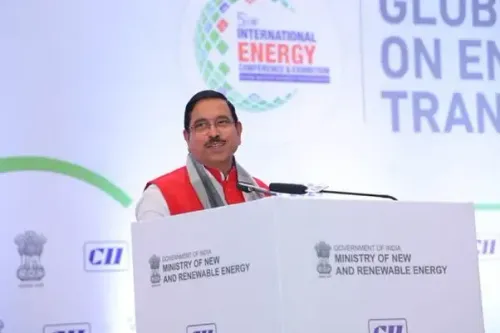
Joshi: India to be world's No. 2 solar market, capacity tops 150 GW

Synopsis
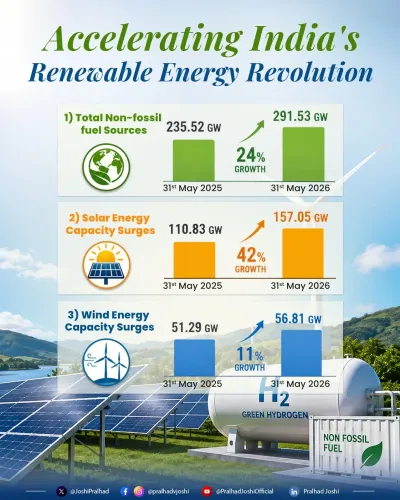
India is poised to become the world's second-largest solar market after its total installed solar capacity crossed 150 GW, Union Minister Pralhad Joshi announced on 27 June 2026. The milestone reflects a decade-long policy push anchored in the National Solar Mission and India's COP26 pledge of 500 GW non-fossil capacity by 2030.
Key Takeaways
Union Minister Pralhad Joshi announced on 27 June 2026 that India's total solar capacity has crossed 150 GW .
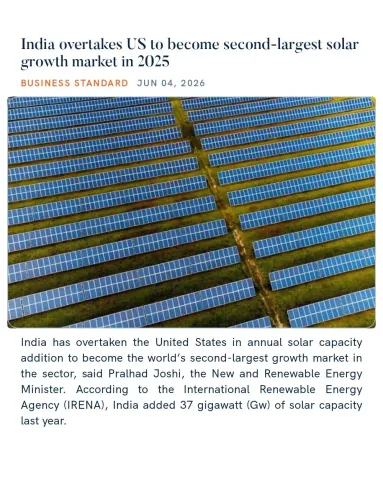
India is set to become the world's No.
2 solar market , behind only China .
The milestone builds on the Jawaharlal Nehru National Solar Mission launched in 2010 with an initial 20 GW target.
At COP26 in 2021 , India pledged 500 GW of non-fossil fuel electricity capacity by 2030 ; solar is central to meeting that goal.
The PM Surya Ghar Muft Bijli Yojana (2024) and PLI programmes have broadened solar deployment beyond utility-scale projects.
The Central Electricity Authority 's monthly capacity reports will be key for tracking further progress.
Union Minister of New and Renewable Energy Pralhad Joshi on Saturday, 27 June 2026 shared that India is set to become the world's second-largest solar market, with the country's total installed solar capacity crossing the 150 GW milestone. The minister shared the development via the NaMo App, signalling the ruling dispensation's intent to highlight the achievement as a marker of India's clean-energy ambitions.
Context
The 150 GW figure, if confirmed by official capacity reports, would represent a landmark in India's solar journey — one that began in earnest with the launch of the Jawaharlal Nehru National Solar Mission in 2010, which set an initial target of just 20 GW by 2022. That target was subsequently scaled to 100 GW, and actual installations have consistently outpaced earlier projections as solar tariffs fell and policy support intensified.
Crossing 150 GW of solar capacity would place India ahead of all markets except China, which has dominated global solar installations for over a decade. The achievement underscores the pace at which India has climbed the global renewable energy rankings in a relatively short period.
Policy Backdrop
India's solar push is anchored in a series of escalating national commitments. At the COP26 climate summit in Glasgow in 2021, Prime Minister Narendra Modi pledged that India would achieve 500 GW of non-fossil fuel electricity capacity by 2030 — a target that makes continued solar expansion non-negotiable. Solar is expected to account for the largest share of that 500 GW goal.
On the demand side, the PM Surya Ghar Muft Bijli Yojana, launched in 2024, has aimed to accelerate rooftop solar adoption across millions of households, broadening the base of solar capacity beyond large utility-scale projects. Simultaneously, Production Linked Incentive (PLI) programmes have been deployed to build domestic solar manufacturing capability and reduce import dependence.
Stakeholders and Impact
The 150 GW milestone carries direct implications for solar developers, state electricity distribution companies (discoms), and industrial consumers. Developers stand to benefit from continued policy momentum and grid expansion, while discoms face the dual challenge of integrating variable renewable power and managing legacy coal-based power purchase agreements.
For India as a whole, the ranking shift carries strategic weight: a No. 2 position in global solar capacity strengthens the country's hand in international climate negotiations and supports its pitch as a credible partner for green technology investment and export. The broader shift from coal dependence toward non-fossil sources also aligns with India's net-zero pledge for 2070.
What's Next
The trajectory toward 500 GW of non-fossil capacity by 2030 means the pace of solar addition will need to be sustained — and likely accelerated. Watchers will track monthly capacity data from the Central Electricity Authority for confirmation of the 150 GW figure and updates on the pipeline of projects under construction.
State-level solar policy updates, fresh budget allocations for manufacturing incentives, and grid infrastructure investment will be key variables determining whether India consolidates its No. 2 position or faces headwinds from land acquisition bottlenecks and discom financial stress in the months ahead.
Point of View
Using a significant capacity milestone to reinforce the ruling party's clean-energy narrative ahead of any future electoral or diplomatic cycle. The framing of India as the world's No. 2 solar market is strategically potent: it positions the country as a credible climate actor on the global stage while projecting domestic economic competence. The 150 GW figure, set against the 500 GW target for 2030, also quietly signals that the hardest stretch of the journey still lies ahead, making sustained policy continuity the implicit ask. Whether the momentum holds will depend on resolving structural constraints — discom finances, grid integration, and land acquisition — that have periodically slowed India's renewable rollout.
NationPress
27 Jun 2026
Frequently Asked Questions
Has India's solar capacity really crossed 150 GW?
Union Minister Pralhad Joshi announced on 27 June 2026 that India's total installed solar capacity has crossed 150 GW, a claim that will be formally confirmed through Central Electricity Authority capacity data.
Which country has the most solar capacity in the world?
China holds the top position in global solar capacity by a wide margin; India's crossing of 150 GW is expected to place it at No. 2, ahead of the United States and European markets.
What is India's solar energy target for 2030?
At the COP26 summit in Glasgow in 2021, Prime Minister Modi pledged 500 GW of non-fossil fuel electricity capacity by 2030, with solar expected to contribute the largest share of that total.
What is the PM Surya Ghar Muft Bijli Yojana?
The PM Surya Ghar Muft Bijli Yojana, launched in 2024, is a central government scheme aimed at accelerating rooftop solar installations across Indian households, complementing large utility-scale solar projects.
What was the Jawaharlal Nehru National Solar Mission?
Launched in 2010, the Jawaharlal Nehru National Solar Mission was India's foundational solar policy, starting with a 20 GW target by 2022 that was later revised upward to 100 GW as ambitions and capacities grew.