Karnataka CM Office Launches Multi-Dept Anti-Drug Drive
Synopsis
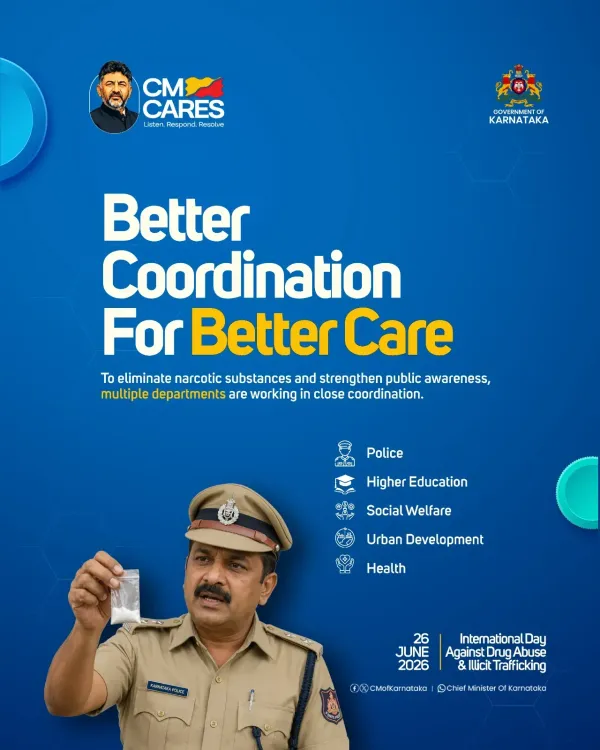
The Chief Minister's Office of Karnataka on 26 June 2026 unveiled a unified anti-narcotics drive involving five departments — Police, Higher Education, Social Welfare, Urban Development, and Health — to eliminate drug abuse and spread awareness, signalling a whole-of-government approach to achieving a drug-free Karnataka.
Key Takeaways
Five departments — Police, Higher Education, Social Welfare, Urban Development, and Health — are jointly leading Karnataka's anti-drug campaign as of 26 June 2026 .
The initiative targets both supply reduction (enforcement) and demand reduction (awareness and rehabilitation) simultaneously.
The campaign was announced on International Day Against Drug Abuse and Illicit Trafficking , amplifying its symbolic and policy weight.
The Higher Education department's inclusion specifically addresses drug vulnerability among college-going youth aged 18–25 in urban Karnataka.
The model aligns with the central government's Nasha Mukt Bharat Abhiyaan launched in 2020 , which encouraged states to adopt integrated, multi-agency frameworks.
Progress reports, budgetary moves, and Karnataka Assembly proposals will determine whether this coordinated intent translates into lasting institutional change.
The Chief Minister's Office of Karnataka on Friday, 26 June 2026 announced a coordinated, multi-departmental offensive against narcotics in the state, declaring that departments spanning Police, Higher Education, Social Welfare, Urban Development, and Health are working in unison to eliminate drug abuse and build awareness across Karnataka.
Context
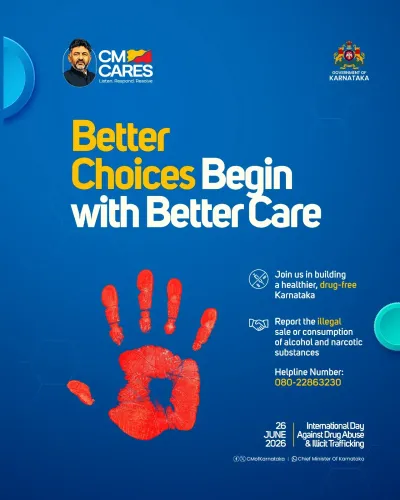
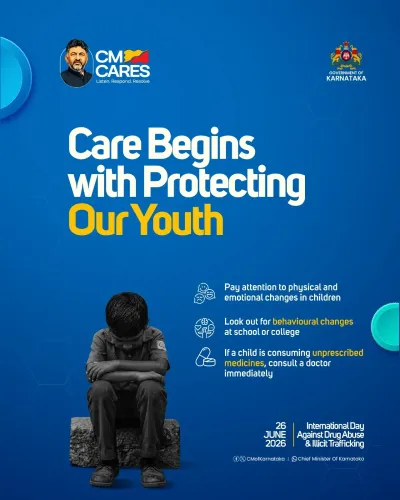
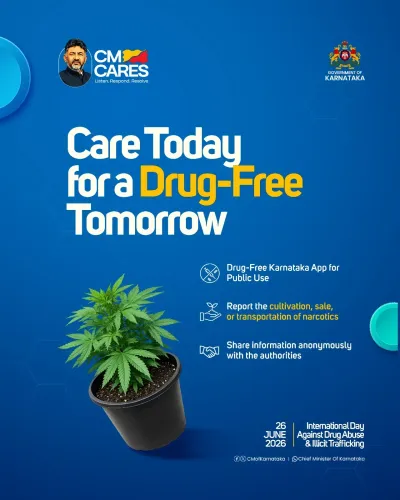
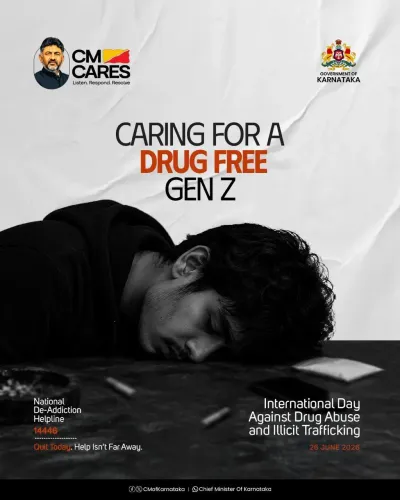
The official post from @CMofKarnataka carried the message in both English and Kannada, with the Kannada text reading 'ಇಲಾಖೆಗಳ ನಡುವೆ ಸಮನ್ವಯಯುತ ಕಾರ್ಯಾಚರಣೆ' ('coordinated inter-departmental operation'), signalling that this is not a single-agency effort but a whole-of-government push. The post was tagged with #DrugFreeKarnataka, #SayNoToDrugs, and #CMCares, indicating a sustained public communication campaign alongside operational action. The announcement coincides with International Day Against Drug Abuse and Illicit Trafficking, observed globally on 26 June each year.
Policy Backdrop
Karnataka's inter-departmental model mirrors a broader national approach to substance abuse that gained momentum after the Ministry of Social Justice and Empowerment launched the Nasha Mukt Bharat Abhiyaan in 2020, a demand-reduction programme that called on state governments to integrate enforcement, education, and rehabilitation under one coordinated framework. Indian states with high drug-burden districts have progressively moved away from siloed policing responses toward unified task forces that combine supply-side enforcement by police with demand-side awareness driven by education and health agencies. Karnataka's approach — looping in Urban Development and Social Welfare alongside the more conventional police-health axis — represents a wider net than most state-level models.
The inclusion of the Higher Education department is particularly significant, as college campuses in urban Karnataka have been identified in policy circles as vulnerable points of entry for synthetic drugs and cannabis. Awareness programmes run through universities and colleges can reach a demographic — students aged 18 to 25 — that is statistically most at risk.
Stakeholders and Impact
Youth and students are the primary beneficiaries of the awareness component of this drive, while urban residents across Karnataka's cities stand to gain from the Urban Development department's involvement, which typically covers community outreach, municipal surveillance, and de-addiction facility access in city limits. Karnataka Police, as the enforcement anchor, is expected to lead narcotics seizure operations while the other departments reinforce rehabilitation and prevention pipelines. Social welfare agencies play a critical role in post-rehabilitation support, ensuring that individuals who exit de-addiction programmes are reintegrated into community structures rather than left vulnerable to relapse.
The multi-departmental structure also distributes accountability, reducing the risk of enforcement-only approaches that have historically shown limited long-term impact on drug demand in Indian states.
What's Next
Observers will watch for concrete progress metrics from the Government of Karnataka — including inter-departmental operation reports, data on narcotics seizures, and enrolment figures in state-run de-addiction programmes. Any new budgetary allocations or legislative proposals tabled in the Karnataka Legislative Assembly for strengthening narcotics control infrastructure will be an indicator of how far this coordinated intent translates into institutional muscle. If the model delivers measurable results, it could serve as a template for other southern states grappling with rising substance abuse among urban youth.
Point of View
The government distances itself from a purely punitive image and positions the drive within the more palatable language of welfare and education. This mirrors a national trend where state governments compete to demonstrate 'whole-of-government' credibility on social issues ahead of electoral cycles. The real test will be whether the inter-departmental coordination survives bureaucratic silos and produces verifiable outcomes in seizure data and de-addiction enrolments.
NationPress
26 Jun 2026
Frequently Asked Questions
Which departments are involved in Karnataka's anti-drug drive announced in June 2026?
Five departments are involved: Police, Higher Education, Social Welfare, Urban Development, and Health. The Chief Minister's Office of Karnataka announced on 26 June 2026 that all five are working in coordination to eliminate narcotics and spread awareness.
What is the Drug Free Karnataka initiative?
'Drug Free Karnataka' is the state government's campaign — promoted under the hashtag #DrugFreeKarnataka — to eliminate narcotics through a coordinated multi-departmental approach combining law enforcement, education, social welfare, and health services.
What is the Nasha Mukt Bharat Abhiyaan and how does it relate to Karnataka's drive?
The Nasha Mukt Bharat Abhiyaan is a central government programme launched in 2020 by the Ministry of Social Justice and Empowerment to reduce drug demand through awareness, counselling, and rehabilitation. Karnataka's multi-departmental model aligns with this national framework by integrating enforcement with education and welfare outreach.
Why is the Higher Education department part of an anti-drug campaign?
College campuses in urban Karnataka are considered high-risk environments for drug experimentation among youth aged 18 to 25. Including the Higher Education department allows the government to run awareness and prevention programmes directly within universities and colleges.
When was Karnataka's multi-department anti-drug campaign announced?
The campaign was announced on 26 June 2026, which is also observed globally as International Day Against Drug Abuse and Illicit Trafficking, through an official post by the Chief Minister's Office of Karnataka on X.