Kashmiri Pandits mark Zyestha Ashtami at Ghaziabad's Tulmulla temple
Synopsis
Every year, Zyestha Ashtami turns a Ghaziabad temple into a mirror of Kashmir — and a measure of how far nearly seven lakh Kashmiri Pandits remain from the homeland they were forced to flee in the 1990s. The gathering is devotion, yes, but also a quiet, persistent demand that has yet to be answered.
Key Takeaways
Hundreds of Kashmiri Pandits from Delhi-NCR gathered at the Mata Ragnya Bhagwati temple , Ghaziabad, on 22 June for Zyestha Ashtami .
The temple is modelled on the Mata Kheer Bhawani shrine at Tulmulla, Ganderbal — one of the holiest Kashmiri Hindu sites, referenced in the 12th-century Rajatarangini .
The original shrine's septagonal spring is historically noted for changing colour; accounts by Abu'l Fazl and Swami Vivekananda document the phenomenon.
Nearly seven lakh Kashmiri Pandits were displaced from the Valley in the 1990s ; large-scale return and rehabilitation remain uncertain.
The Ghaziabad temple serves as a centre for preserving Kashmiri bhajans, rituals, and culinary traditions such as nadir monje and lucchi for future generations.
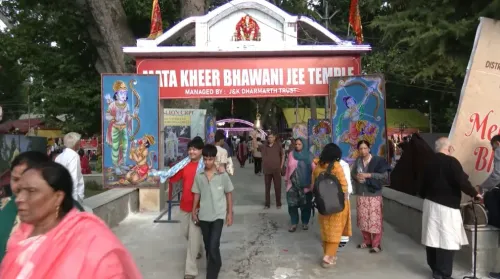
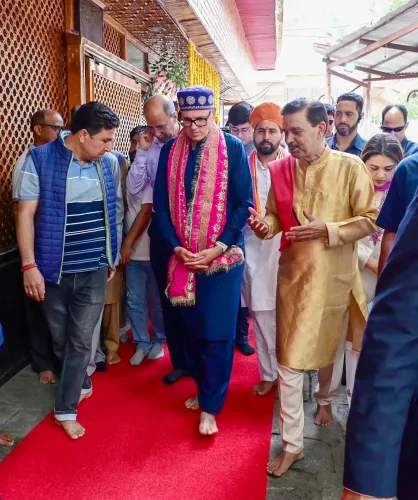
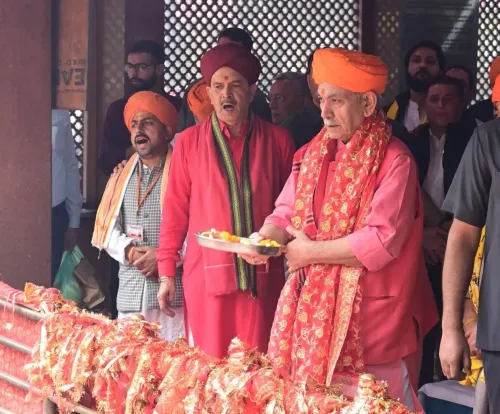
Hundreds of Kashmiri Pandits settled across Delhi-NCR gathered on Monday, 22 June at the Mata Ragnya Bhagwati temple in Ghaziabad, Uttar Pradesh, to observe Zyestha Ashtami — the annual festival dedicated to Mata Kheer Bhawani. The occasion blended devotion with a deep, collective mourning for a homeland left behind more than three decades ago.
A Temple Built on Memory
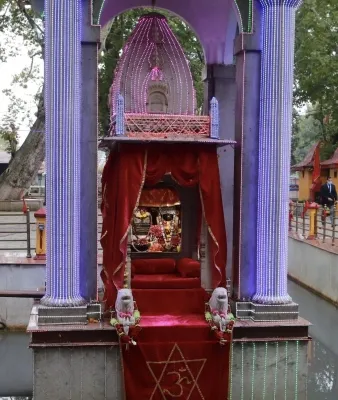
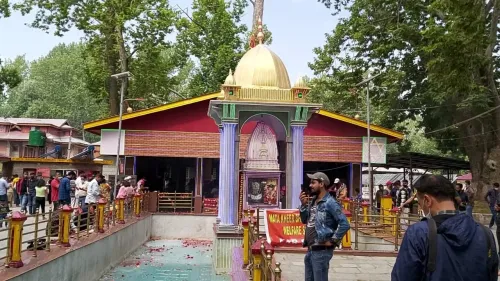
The Mata Ragnya Bhagwati temple in Ghaziabad is modelled on the revered Mata Kheer Bhawani shrine at Tulmulla in Ganderbal district, Kashmir — one of the holiest sites in the Kashmiri Hindu tradition. The original shrine, nestled beside a natural spring and shaded by Chinar trees, is so ancient that its precise origins are unknown. It finds mention in Kalhana's Rajatarangini of the 12th century and in the 16th-century Ain-i-Akbari. Spiritual figures including Swami Vivekananda and Swami Rama Tirtha visited the shrine in the late 19th century.
The original temple is particularly noted for its unique septagonal spring, which flows from west to east. Devotees over centuries have recorded the spring changing colour — displaying shades of red, pink, orange, green, blue, and white. Historical accounts by Abu'l Fazl and Swami Vivekananda both reference this phenomenon. A dark or black hue in the water is traditionally regarded as inauspicious.
What Ghaziabad's Tulmulla Represents
The Ghaziabad temple does not replicate the grandeur or the spring of its Kashmiri counterpart, but it has become far more than a replica. It is, in the words of community members, a physical expression of longing — a tribute to those killed by militants in Kashmir after 1989 and a living reminder that justice, they argue, has remained elusive despite decades of suffering linked to what the community describes as Pakistan-sponsored terrorism.
The temple symbolises the story of nearly seven lakh people who were forced to flee their homes in the 1990s and spent years struggling to find a platform from which to tell their story. Scattered across India and beyond, the community has continued to sustain itself with limited political and economic support, according to community representatives.
The Festival Atmosphere
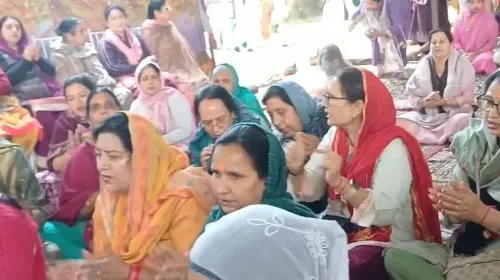
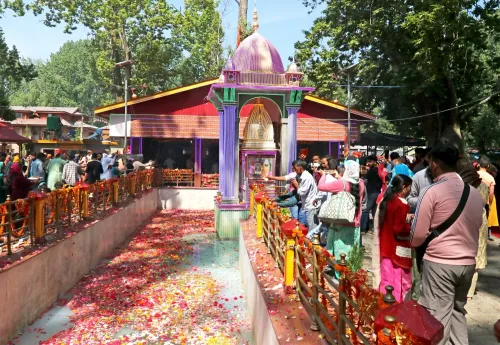
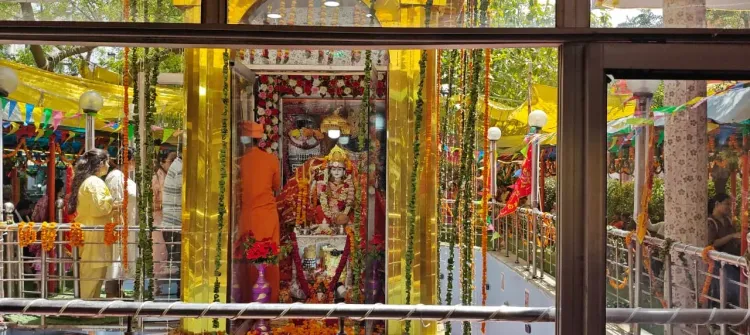
On Monday, conch shells and temple bells filled the air as devotees offered prayers and traditional kheer to Mata Bhawani. Flowers covered the pond, and the aroma of traditional dishes — including nadir monje and lucchi — drifted through the gathering. Community members dressed in traditional attire sang Kashmiri bhajans and devotional songs. For many, tears surfaced alongside the prayers as memories of the Valley resurfaced.
The majestic Chinars of Kashmir were absent, but sprawling canopies offered shade in the summer heat — a small but telling detail of the distance between the original and its diaspora echo.
A Community Still Waiting
Those gathered at Ghaziabad's Tulmulla are acutely aware that the original shrine — and the roots of their civilisation — lie far away in a Kashmir where hopes of large-scale return and rehabilitation remain uncertain. The community has worked to preserve its traditions, customs, and rituals for future generations, viewing gatherings like Zyestha Ashtami as essential acts of cultural continuity.
As long as the question of return remains unresolved, temples like the one in Ghaziabad will continue to serve as both sanctuary and symbol — keeping alive the memory of a homeland that nearly seven lakh Kashmiri Pandits were forced to leave behind.
Point of View
The absence of a credible, large-scale rehabilitation framework means that cultural preservation has become the community's primary act of resistance. The Ghaziabad temple is both a workaround and an indictment: a community that should be worshipping at Tulmulla in Ganderbal is instead recreating it on the outskirts of Delhi. The question of return rarely surfaces with urgency in mainstream political discourse, and that silence is itself a data point.
NationPress
21 Sept 2026
Frequently Asked Questions
What is Zyestha Ashtami and why is it significant for Kashmiri Pandits?
Zyestha Ashtami is an annual festival dedicated to Mata Kheer Bhawani, one of the holiest deities in the Kashmiri Hindu tradition, observed on the eighth day of the Jyeshtha month. The festival holds deep cultural and spiritual significance for Kashmiri Pandits, many of whom gather at temples modelled on the original Tulmulla shrine to pray, remember their homeland, and honour the displaced community.
What is the Mata Ragnya Bhagwati temple in Ghaziabad?
The Mata Ragnya Bhagwati temple in Ghaziabad, Uttar Pradesh, is a temple modelled on the revered Mata Kheer Bhawani shrine at Tulmulla in Ganderbal district, Kashmir. It was established by and for the Kashmiri Pandit diaspora in Delhi-NCR as a space to maintain their spiritual and cultural traditions after displacement from the Valley in the 1990s.
What is the history of the original Kheer Bhawani shrine at Tulmulla?
The Mata Kheer Bhawani shrine at Tulmulla in Ganderbal, Kashmir, is among the oldest Hindu temples in the region, with references dating to Kalhana's 12th-century Rajatarangini and the 16th-century Ain-i-Akbari. Swami Vivekananda and Swami Rama Tirtha both visited the shrine in the late 19th century. The temple is famous for its septagonal spring, which historical accounts describe as occasionally changing colour.
How many Kashmiri Pandits were displaced from the Valley?
Nearly seven lakh Kashmiri Pandits were forced to flee their homes in Kashmir in the 1990s amid militant violence. Decades later, large-scale return and rehabilitation remain uncertain, and the community continues to live primarily in Delhi-NCR, Jammu, and other parts of India.
Why does the Ghaziabad temple matter to the Kashmiri Pandit community?
For a community dispersed across India and the world, the Ghaziabad temple serves as a focal point for preserving Kashmiri Hindu rituals, music, language, and culinary traditions. It is both a place of worship and a symbol of the community's longing to return to Kashmir — a homeland they were forced to leave more than three decades ago.