CM Pema Khandu explains why SUMP can counter China's 60,000 MW dam

Synopsis
Arunachal Pradesh CM Pema Khandu explains that India's 11,000 MW SUMP holds 9.2 BCM of live storage — nearly 1.7 times China's Medog dam — making water storage, not power rating, the decisive metric for transboundary flood moderation on the Brahmaputra.
Key Takeaways
China's Medog project on the Yarlung Tsangpo is reported to hold approximately 5.5 BCM of storage; India's SUMP is designed for 9.2 BCM — about 1.7 times more.
China's 60,000 MW capacity comes from the extreme elevation drop at the Yarlung Tsangpo Great Bend, not from superior water storage.
In Dibang Valley , the Etalin project generates 3,097 MW from just 7.5 MCM of storage, while Dibang Multipurpose generates 2,880 MW with roughly 4 BCM — illustrating that MW and storage are independent variables.
SUMP's flood-moderation role rests on live storage volume, not installed power capacity — a distinction central to India's transboundary river strategy.
India has been engaging China on upstream Brahmaputra dam concerns in bilateral talks since the 2000s ; SUMP is the primary structural response proposed on the Indian side.
The megawatt number has been misleading people — and Arunachal Pradesh Chief Minister Pema Khandu wants to correct the record. In a pointed explainer posted on Wednesday, 30 September 2026, Khandu broke down why India's proposed 11,000 MW Siang Upper Multipurpose Project (SUMP) can still moderate floodwaters from a Chinese dam rated at nearly six times the power capacity, using a single, decisive distinction: storage volume beats megawatt count every time.
MW versus BCM: the number that actually matters for flood control
Khandu's post cuts straight to the engineering reality. China's Medog project on the Yarlung Tsangpo in Tibet is reported to carry roughly 5.5 Billion Cubic Metres (BCM) of storage. SUMP, despite its far lower power rating, is designed for 9.2 BCM of live storage — nearly 1.7 times the water-holding capacity of the upstream Chinese project. That margin is precisely what gives India a structural lever over downstream flood peaks, irrespective of how many turbines sit on either side of the border.
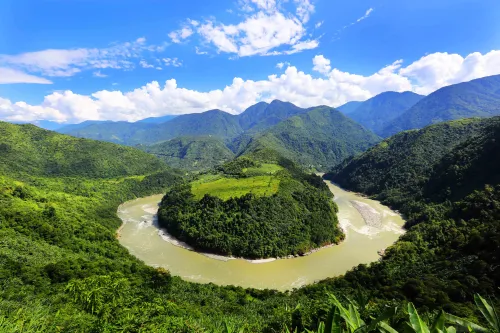
The reason the Medog project generates such colossal power, Khandu explains, is pure geography. The Yarlung Tsangpo Great Bend — a dramatic gorge in Tibet where the river drops thousands of metres in a short horizontal distance — hands Chinese engineers an extraordinary hydraulic head. More elevation drop means more power from the same volume of water. 'More MW does not mean more stored water,' Khandu wrote, and in four words he closes the argument that has stumped many commentators.
Dibang Valley projects make the same point closer to home
To make the abstraction concrete, Khandu pointed to two projects in Arunachal Pradesh's Dibang Valley that sit side by side. The proposed Etalin Hydropower Project is designed to generate 3,097 MW but holds a mere 7.5 Million Cubic Metres (MCM) of storage — essentially a run-of-river scheme that converts flow to electricity without retaining it. The Dibang Multipurpose Project, by contrast, is rated at 2,880 MW — actually lower than Etalin — yet carries roughly 4 BCM of storage, making it a genuine reservoir that can buffer seasonal surges. Same river basin, wildly different flood-moderation value. The comparison is hard to argue with.
Why India has been building the storage case for years
India's concern about upstream Chinese dams on the Brahmaputra system has been a recurring thread in bilateral water-resources diplomacy since the 2000s, when Beijing began announcing large-scale hydropower ambitions on the Yarlung Tsangpo. The worry is straightforward: a dam upstream can withhold water during dry seasons and, critically, release sudden surges that devastate downstream communities in Arunachal Pradesh and Assam.
SUMP has been positioned in Indian technical circles as the answer — a high-storage reservoir that could absorb an abnormal release from Tibet before it hits the plains. Khandu's post is, in effect, a public-education campaign for a project that has faced scrutiny over the apparent mismatch between its modest power rating and the scale of the geopolitical task assigned to it. By walking through the BCM arithmetic in plain language, the Chief Minister is making the case that the engineers got it right — and that the critics have been reading the wrong number.
Clearances and investment decisions for SUMP remain in progress. But the intellectual groundwork, Khandu is signalling, is already settled.
Point of View
He preempts the most common objection to SUMP and builds a public constituency for a project still awaiting full clearances. The Dibang Valley comparison is politically shrewd: it keeps the argument entirely on Indian soil and Indian data, avoiding any assertion about Chinese intent. The broader arc is clear — New Delhi is moving from protest to pre-emption on Brahmaputra water security, and Arunachal Pradesh is positioning itself as the frontline state with the technical answer.
NationPress
30 Sept 2026
Frequently Asked Questions
What is the Siang Upper Multipurpose Project (SUMP)?
SUMP is a proposed multipurpose hydropower and water-storage project on the Siang river in Arunachal Pradesh, designed with approximately 9.2 BCM of live storage and an installed capacity of around 11,000 MW. Its primary purpose beyond power generation is to buffer downstream communities against abnormal water releases from upstream dams in China.
Why does China's Medog dam produce 60,000 MW when SUMP is only 11,000 MW?
China's Medog project benefits from the extreme elevation drop at the Yarlung Tsangpo Great Bend in Tibet, which creates enormous hydraulic head and allows massive power generation from a given volume of water. Power output depends on the height through which water falls, not on how much water is stored, so a high-head site can generate far more megawatts than a lower-head storage reservoir.
How can India's smaller dam moderate floods from a bigger Chinese dam?
Flood moderation depends on live storage capacity — the volume of water a reservoir can absorb and hold — not on installed power. SUMP's reported 9.2 BCM of live storage exceeds the Medog project's estimated 5.5 BCM, giving India the physical capacity to capture and regulate an abnormal upstream release before it reaches the Assam plains.
What is the difference between the Etalin and Dibang Multipurpose projects?
Etalin is a proposed run-of-river project in Dibang Valley rated at 3,097 MW but with only about 7.5 MCM of storage, meaning it converts river flow to electricity without retaining significant water. The Dibang Multipurpose Project is a storage-based design rated at 2,880 MW — lower power but roughly 4 BCM of storage — making it far more capable of flood moderation.
What is India's policy position on Chinese dams on the Brahmaputra?
India has raised concerns about upstream Chinese hydropower development on the Yarlung Tsangpo — known downstream as the Brahmaputra — in bilateral water-resources talks since the 2000s. The core concern is that large upstream reservoirs can manipulate seasonal flows, causing droughts or flash floods downstream. SUMP is India's principal proposed structural response to that risk.