Kishan Reddy hails Glaw Lake as India's 101st Ramsar site
Synopsis
Glaw Lake in Arunachal Pradesh has been designated India's 101st Ramsar site and the state's first, Union Minister G. Kishan Reddy announced on August 11, 2026, highlighting a roughly four-fold rise in recognised wetlands under PM Modi's government since 2014.
Key Takeaways
Glaw Lake in Arunachal Pradesh is now India's 101st Ramsar site and the state's first-ever Ramsar-listed wetland.
India had only 26 Ramsar sites in 2014 ; the count has grown roughly four-fold under the Modi government .
India acceded to the Ramsar Convention in 1982 , initially designating Chilika Lake and Keoladeo National Park .
A Ramsar listing requires the government to maintain the site's ecological character and develop a formal management plan.
The designation marks the first time a northeastern state bordering China, Bhutan, and Myanmar has a Ramsar-listed wetland.
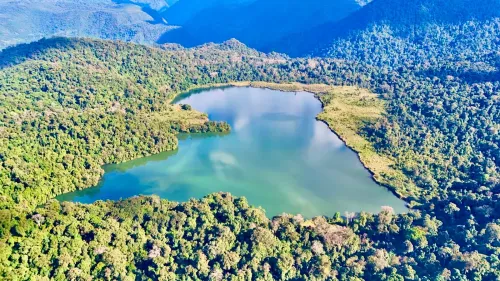
A freshwater wetland tucked in the hills of Arunachal Pradesh has just put India's northeastern frontier on the global conservation map. Union Coal and Mines Minister G. Kishan Reddy on Tuesday, August 11, 2026, announced that Glaw Lake has been recognised as India's 101st Ramsar site — and the first-ever from Arunachal Pradesh.
Arunachal Pradesh enters the Ramsar map
Until now, Arunachal Pradesh — one of India's most biodiverse states, sharing borders with China, Bhutan, and Myanmar — had no wetland listed under the Ramsar Convention, the 1971 international treaty on wetland conservation that India acceded to in 1982. Glaw Lake's designation ends that gap. The move extends formal international protection to a northeastern ecosystem that has long been ecologically significant but institutionally overlooked.
From 26 sites to 101: the scale of the shift
Kishan Reddy framed the milestone within a broader arc: India had just 26 Ramsar sites in 2014. That number has now crossed 101 — a roughly four-fold increase over the tenure of Prime Minister Narendra Modi's government. The expansion reflects sustained coordination between the Union Ministry of Environment and state governments to widen the country's protected wetland network. India's first two Ramsar sites, designated in 1982, were Chilika Lake in Odisha and Keoladeo National Park in Rajasthan — both now iconic conservation success stories.
What Ramsar recognition actually means for Glaw Lake
A Ramsar listing obliges the signatory government to maintain the ecological character of the site and draw up a management plan. For Glaw Lake, that means Arunachal Pradesh's state machinery must now move toward formal conservation planning — monitoring water quality, regulating land use in the catchment, and engaging local communities whose livelihoods are tied to the wetland. The designation also unlocks international technical cooperation and, in some cases, funding from the Ramsar Small Grants Fund.
The kicker: with the northeast now on the Ramsar map, the question is no longer whether India's biodiversity-rich frontier states belong in global conservation frameworks — it is how fast the management plans follow the plaques.
Point of View
A region it has prioritised strategically. The four-fold expansion of Ramsar sites since 2014 gives the government a concrete, internationally verifiable metric on biodiversity, useful at both domestic and multilateral forums. However, the true test will be whether management plans and enforcement follow the designation, since several earlier Ramsar sites in India have faced encroachment and water quality degradation despite their protected status. Arunachal Pradesh's entry into the Ramsar network could also catalyse similar moves from Nagaland, Manipur, and Meghalaya, which host significant wetland ecosystems still outside the framework.
NationPress
12 Aug 2026
Frequently Asked Questions
What is Glaw Lake and where is it located?
Glaw Lake is a freshwater wetland in Arunachal Pradesh , a northeastern Indian state bordering China, Bhutan, and Myanmar. It has been designated India's 101st Ramsar site and is the first Ramsar-listed wetland in Arunachal Pradesh.
What is the Ramsar Convention?
The Ramsar Convention is an international treaty signed in 1971 in Ramsar, Iran, for the conservation and sustainable use of wetlands. India acceded to the convention in 1982 , initially designating Chilika Lake and Keoladeo National Park as its first two sites.
How many Ramsar sites does India have in 2026?
India now has 101 Ramsar sites following the designation of Glaw Lake in Arunachal Pradesh, up from just 26 sites in 2014 — a roughly four-fold increase over the tenure of Prime Minister Narendra Modi's government.
What does a Ramsar designation mean for a wetland?
A Ramsar listing requires the government to maintain the site's ecological character, prepare a formal management plan, and report periodically to the Ramsar Secretariat. It can also unlock international technical cooperation and access to the Ramsar Small Grants Fund.
Why is Glaw Lake significant for Arunachal Pradesh?
Glaw Lake is the first-ever Ramsar site from Arunachal Pradesh, bringing one of India's most biodiverse but institutionally underrepresented states into the global wetland conservation framework for the first time.