Kishan Reddy Highlights 12 Years of Defence Reforms Under Modi Govt
Synopsis
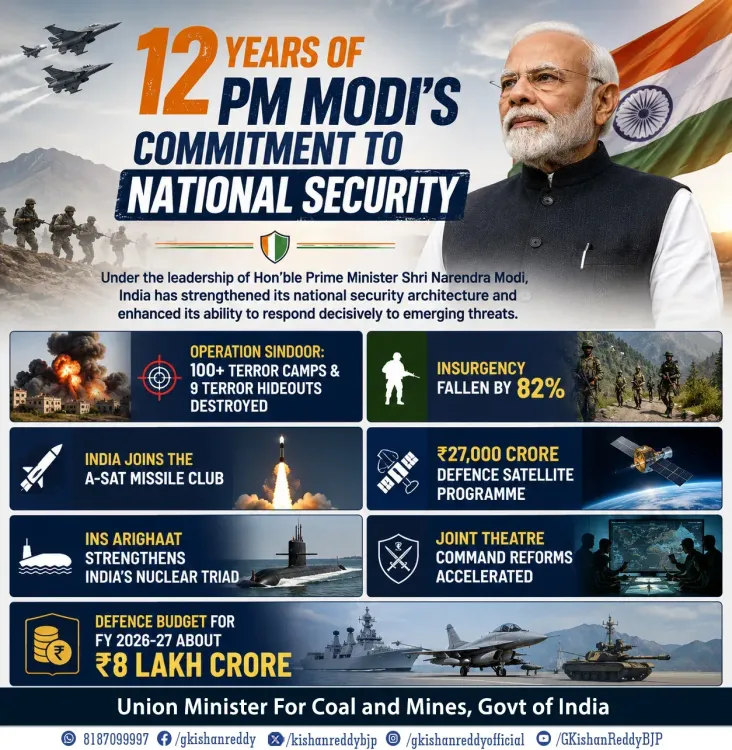
Union Minister G. Kishan Reddy has outlined 12 years of defence milestones under the Modi government, citing Operation Sindoor, a completed nuclear triad, ASAT capability, a 52-satellite programme, Joint Theatre Command reforms, and a defence budget nearing ₹8 lakh crore for FY 2026-27.
Key Takeaways
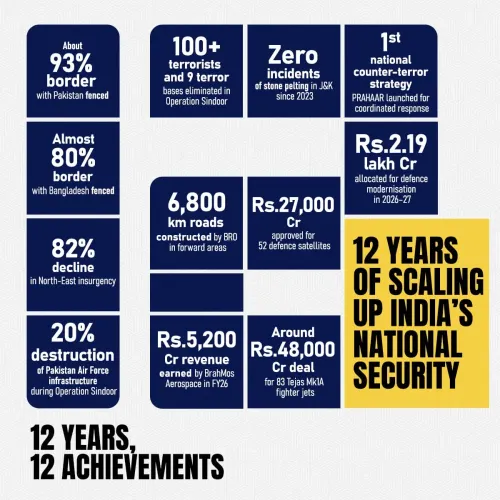
Operation Sindoor destroyed more than 100 terror camps and 9 terror hideouts , according to Union Minister G.
Insurgency has fallen by 82% over the past 12 years under the Modi government .
India joined the select group of nations with Anti-Satellite (A-SAT) capabilities , demonstrated through Mission Shakti in March 2019.
A ₹27,000-crore, 52-satellite programme is enhancing surveillance, communication, and operational readiness.
The induction of INS Arighaat has completed India's nuclear triad , strengthening strategic deterrence.
India's defence budget has grown to nearly ₹8 lakh crore for FY 2026-27 , reflecting sustained security investment.
Union Coal and Mines Minister G. Kishan Reddy on Monday, 22 June 2026, outlined a series of defence and national security milestones achieved over the past 12 years under the Narendra Modi government, citing advances in space warfare capability, nuclear deterrence, counter-insurgency, and defence budgeting as evidence of a transformed security architecture.
Context
Posting on X, Kishan Reddy — who also serves as BJP Telangana state president — enumerated what he described as the foundational pillars of the Modi government's national security doctrine. 'For the Modi Government, national security is the foundation upon which a strong and prosperous India is built,' he wrote, before listing specific outcomes across military, space, and budgetary domains.
The post arrives against a backdrop of heightened public attention to India's strategic posture following Operation Sindoor, which the minister cited as having destroyed more than 100 terror camps and 9 terror hideouts, demonstrating, in his words, 'India's resolve against terrorism.'
Policy Backdrop
Several of the milestones Kishan Reddy referenced have documented policy lineages. India joined the select group of nations with Anti-Satellite (A-SAT) capabilities through Mission Shakti in March 2019, making it the fourth country globally to demonstrate such technology. The test was conducted by the Defence Research and Development Organisation (DRDO) and was described at the time as a significant leap in space deterrence.
The induction of INS Arighaat — India's second nuclear-powered ballistic missile submarine — builds on the commissioning of INS Arihant in November 2016, which first established the sea leg of India's nuclear triad. Together, these vessels give India a credible second-strike capability, completing the triad alongside land-based and air-delivered nuclear options.
The Chief of Defence Staff (CDS) post, created in December 2019, underpins the Joint Theatre Command reforms the minister referenced. The reforms aim to integrate the Army, Navy, and Air Force into unified operational commands, a structural overhaul that defence planners have described as the most significant organisational change in India's military since independence.
Kishan Reddy also cited a ₹27,000-crore, 52-satellite programme aimed at strengthening surveillance, communication, and operational readiness, alongside a defence budget that has grown to nearly ₹8 lakh crore for FY 2026-27. He added that insurgency has fallen by 82% over the period under review.
Stakeholders and Impact
The cumulative reforms touch every branch of India's security establishment. For the armed forces, Joint Theatre Commands represent a shift from single-service operations to integrated warfighting, reducing redundancy and improving response times. The satellite programme directly enhances real-time intelligence, surveillance, and reconnaissance (ISR) capacity available to field commanders.
For the domestic defence industry, sustained budget growth and the Atmanirbhar Bharat push have created significant procurement opportunities. Capital expenditure within the defence budget has been consistently prioritised, with an increasing share directed at indigenously developed platforms, reducing import dependence that has historically made India one of the world's largest arms importers.
Border communities and internal security stakeholders are the primary beneficiaries of the claimed 82% decline in insurgency, a figure that, if sustained, would represent one of the most significant improvements in internal security in decades.
What's Next
Parliamentary deliberations on defence appropriations and any formal government notifications on the operationalisation of theatre commands will be closely watched as indicators of whether the reform momentum continues. The 52-satellite programme is also expected to see further launches in the coming fiscal years, with each addition incrementally expanding India's strategic surveillance envelope.
As India navigates persistent border sensitivities on both its western and northern frontiers, the political messaging around defence modernisation is likely to remain central to the ruling party's national security narrative ahead of state and general electoral cycles.
Point of View
Framing over a decade of incremental reforms — from ASAT tests to theatre commands — as a coherent strategic vision rather than a series of isolated decisions. The timing, following Operation Sindoor, allows the party to anchor abstract modernisation metrics to a concrete, high-visibility military action. By invoking the defence budget figure of nearly ₹8 lakh crore, the post also makes a fiscal argument: that security investment under Modi is not rhetoric but a measurable budgetary commitment. This kind of comprehensive stocktaking typically signals that national security will be a primary electoral and legislative talking point in the near term.
NationPress
22 Jun 2026
Frequently Asked Questions
What is Operation Sindoor and what did India achieve in it?
Operation Sindoor is a military operation cited by Union Minister G. Kishan Reddy in which India reportedly destroyed more than 100 terror camps and 9 terror hideouts , which the government has described as a demonstration of India's resolve against cross-border terrorism.
What is India's Anti-Satellite (ASAT) capability?
India demonstrated its Anti-Satellite (A-SAT) capability through Mission Shakti in March 2019 , becoming the fourth country in the world with such technology. The test involved intercepting a satellite in low-earth orbit using a ground-launched missile developed by DRDO .
What is INS Arighaat and why does it matter?
INS Arighaat is India's second nuclear-powered ballistic missile submarine. Its induction completes India's nuclear triad — the ability to deliver nuclear weapons from land, air, and sea — significantly strengthening the country's second-strike deterrence capability.
What are Joint Theatre Commands in India?
Joint Theatre Commands are a structural reform aimed at integrating the Army, Navy, and Air Force under unified operational commands. The reform is overseen by the Chief of Defence Staff (CDS) , a post created in December 2019 , and is considered the most significant military organisational change since independence.
How much is India's defence budget for FY 2026-27?
According to G. Kishan Reddy , India's defence budget has grown to nearly ₹8 lakh crore for FY 2026-27 , reflecting what the government describes as a sustained commitment to strengthening national security and modernising the armed forces.