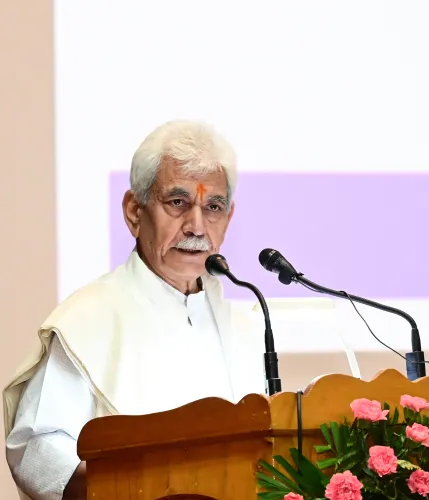
J&K identity beyond geography: L-G Sinha lays foundation of culture centre
Synopsis
J&K L-G Manoj Sinha used the foundation stone ceremony of a new culture and dialects research centre in Srinagar to reframe how Jammu and Kashmir should be understood — not through its geography or politics, but through its languages, folklore, and lived experiences. The move signals a deliberate institutional push to document and preserve the region's endangered knowledge systems at a time when its political identity remains in flux.
Key Takeaways
L-G Manoj Sinha laid the foundation stone of the Kashmir Chapter of the Centre for Regional Studies, Culture, Dialects and Emotional Intelligence on 28 October 2026 in Srinagar .
The Centre is affiliated with the University of Jammu and will focus on manuscript preservation, digital archives, linguistic mapping, and ethnographic studies.
Sinha identified four key pillars : balancing global connectivity with local identity, preserving endangered languages, interdisciplinary approaches, and emotional well-being in education.
The Lieutenant Governor stressed that emotional intelligence and technological capability are complementary, not competing, priorities for future institutions.
The dual-campus structure — main Centre in Jammu and Kashmir Chapter in Srinagar — is intended to serve as a model research institution for J&K universities.
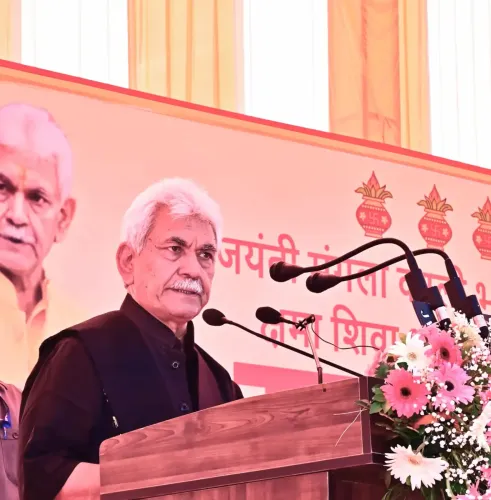
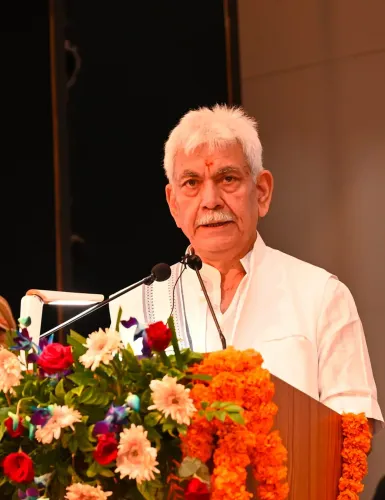
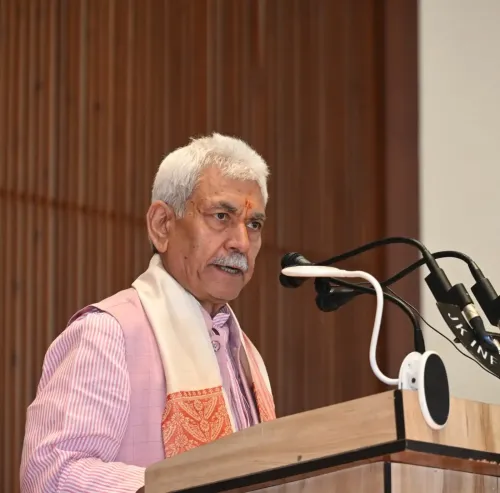
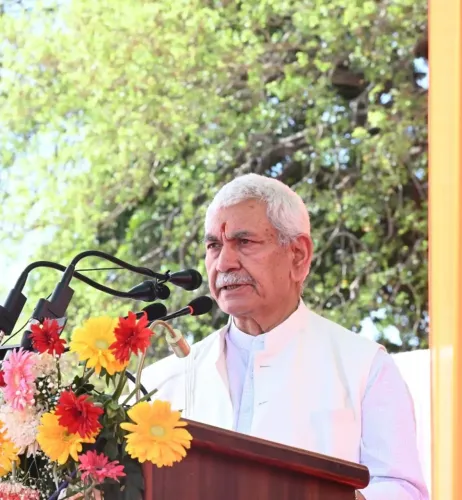
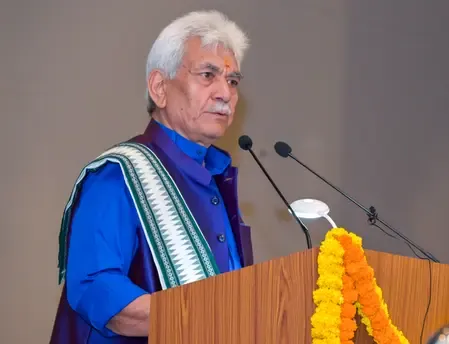
Jammu and Kashmir Lieutenant Governor Manoj Sinha on Wednesday, 28 October 2026, declared that Jammu and Kashmir cannot be understood through geography alone, emphasising that languages, folklore, cultural practices, arts, faith, and lived experiences collectively shape the region's identity. He made the remarks at the foundation stone ceremony of the Kashmir Chapter of the Centre for Regional Studies, Culture, Dialects and Emotional Intelligence of the University of Jammu, held in Srinagar.
What the New Centre Aims to Do
The Lieutenant Governor described the Centre as a 'unique and forward-looking confluence' of regional studies, culture, dialects, and emotional intelligence. Its wide-ranging objectives include the preservation of manuscripts, creation of digital archives, linguistic mapping, ethnographic studies, research on pilgrimage and tourism, mountain ecology, and local entrepreneurship.
The Centre will also offer fellowships for young scholars — an initiative Sinha described as a unique endeavour by the University aimed at building a shared repository of knowledge for future generations.
Four Pillars the L-G Highlighted
Addressing the gathering, L-G Sinha underlined four key factors that make such a Centre relevant in contemporary times. These are: the need to balance global connectivity with local identity; the urgency of preserving endangered languages and knowledge systems; the importance of interdisciplinary approaches to complex challenges; and the growing recognition of emotional well-being in education.
He noted that while technology is rapidly transforming societies, the preservation of cultural roots and human values remains equally important — a point he tied directly to the Centre's mandate.
Emotional Intelligence and the AI Age
Speaking on the role of universities in an era of rapid technological change and artificial intelligence, Sinha argued that emotional intelligence and technological capability complement rather than compete with each other. He stressed that future-ready institutions must encourage continuous learning, adaptability, ethical awareness, and multidisciplinary collaboration.
This comes amid a broader national conversation about preserving indigenous knowledge systems even as India pushes aggressively into digital and AI-driven education frameworks.
A Model Institution for J&K Universities
The Lieutenant Governor expressed confidence that the main Centre at Jammu University's Jammu campus and its newly inaugurated Kashmir Chapter together have the potential to emerge as a model institution for research. He said the dual-campus structure would contribute to knowledge creation, cultural preservation, and human-centred development while enhancing the global standing of the universities of Jammu and Kashmir.
Notably, the initiative integrates the civilisational heritage of a region that has long been studied primarily through its political and security dimensions — a deliberate reframing toward its cultural and intellectual depth. How the Centre attracts research funding and scholar participation in the coming months will determine whether this foundation stone translates into a lasting academic institution.
Point of View
Or whether it remains a ceremonial milestone. Emotional intelligence as an academic pillar alongside regional studies is an unconventional pairing that could either produce genuinely interdisciplinary work or dilute the rigour of both fields. The timing — as J&K navigates its status as a Union Territory with aspirations for statehood — makes a cultural reclamation project both symbolically loaded and administratively complex.
NationPress
28 Oct 2026
Frequently Asked Questions
What is the Centre for Regional Studies, Culture, Dialects and Emotional Intelligence at Jammu University?
It is a new academic institution established by the University of Jammu, with its main campus in Jammu and a Kashmir Chapter inaugurated in Srinagar on 28 October 2026. Its objectives include manuscript preservation, digital archiving, linguistic mapping, ethnographic research, and fellowships for young scholars.
What did L-G Manoj Sinha say about Jammu and Kashmir's identity?
L-G Sinha said that Jammu and Kashmir cannot be understood through geography alone, and that languages, folklore, cultural practices, arts, faith, traditions, and lived experiences together shape the region's identity. He made these remarks at the foundation stone ceremony of the Centre's Kashmir Chapter.
Why does L-G Sinha consider this Centre relevant today?
Sinha highlighted four reasons: the need to balance global connectivity with local identity, the urgency of preserving endangered languages, the value of interdisciplinary approaches to complex challenges, and the growing importance of emotional well-being in education. He also linked the Centre to the role of universities in an age of artificial intelligence.
How does the Centre plan to preserve J&K's cultural heritage?
The Centre will pursue manuscript preservation, creation of digital archives, linguistic mapping, ethnographic studies, research on pilgrimage, tourism, and mountain ecology, as well as local entrepreneurship programmes and fellowships for young scholars — all aimed at building a shared knowledge repository for future generations.
What is the significance of having both a Jammu campus and a Kashmir Chapter?
The dual-campus structure is designed to serve the distinct cultural and linguistic traditions of both the Jammu and Kashmir divisions under a single institutional framework. L-G Sinha expressed confidence that the combined structure could emerge as a model research institution, enhancing the global standing of J&K universities.