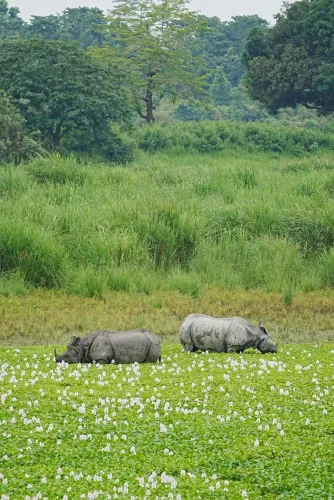
CM Assam Office: Manas hits 3-yr zero poaching mark

Synopsis
Manas National Park in Assam has achieved zero poaching of rhinoceros and tigers for three straight years, the Chief Minister's Office announced on 17 June 2026 — marking a historic conservation turnaround for the UNESCO World Heritage Site that was once on the global danger list.
Key Takeaways
Manas National Park has recorded zero rhino and tiger poaching for three consecutive years , as highlighted by the Chief Minister's Office of Assam on 17 June 2026 .
Manas was placed on the UNESCO List of World Heritage in Danger in 1992 due to poaching and insurgency, and was removed in 2011 after sustained recovery efforts.
The milestone builds on the foundations of Project Tiger (1973) and the Indian Rhino Vision 2020 programme, both of which targeted Manas as a priority conservation zone.
Community engagement with local Bodoland communities and technology-aided surveillance by the Assam Forest Department have been key drivers of the zero-poaching outcome.
The NTCA's All India Tiger Estimation report and an Assam rhino census , both expected in 2026-27 , will provide independent verification of population trends.
The Chief Minister's Office of Assam on Wednesday, 17 June 2026 highlighted a landmark conservation achievement at Manas National Park, announcing that the UNESCO World Heritage Site has recorded zero poaching of rhinoceros and tigers for three consecutive years — a milestone that underscores a dramatic turnaround for one of India's most storied wildlife reserves.
Context
Manas National Park, located in the Bodoland Territorial Region of Assam, is one of India's most ecologically significant protected areas, sheltering the greater one-horned rhinoceros and the Bengal tiger alongside a rich mosaic of biodiversity. The park was declared a UNESCO World Heritage Site in 1985, but by 1992 it had been placed on the List of World Heritage in Danger — a consequence of rampant poaching and armed insurgency that decimated its wildlife populations over nearly two decades.
The park's removal from the danger list in 2011 marked the beginning of a sustained recovery phase, driven by improved security conditions following the 2003 Bodoland peace accords and a renewed commitment by the Assam Forest Department to anti-poaching operations and community engagement.
Policy Backdrop
The zero-poaching record at Manas sits within a broader framework of centrally and state-sponsored conservation initiatives. Project Tiger, launched in 1973, designated Manas as one of India's original tiger reserves, providing dedicated funding and a legal architecture for protection. In parallel, the Indian Rhino Vision 2020 programme — a joint initiative of the Assam government, WWF, and partner organisations launched around 2005 — set an ambitious target of 3,000 wild rhinos in Assam through habitat protection and translocation efforts.
Assam's anti-poaching drive in recent years has leaned heavily on technology-aided surveillance, joint forest management with local communities, and stricter enforcement under the Wildlife Protection Act. This combination has been credited with reversing decades of conflict-related habitat stress across northeast India's major reserves.
Stakeholders and Impact
The three-year zero-poaching milestone has direct implications for the local Bodoland communities, whose cooperation has been central to the park's recovery. Community-based forest management has transformed former conflict zones into active conservation corridors, creating livelihoods tied to wildlife tourism and eco-development.
Wildlife NGOs working in the region have long argued that sustained zero-poaching outcomes require not just enforcement but genuine community ownership — and Manas is increasingly cited as a model for that approach. The milestone also strengthens India's standing in global biodiversity commitments, particularly as the country advances targets under the Kunming-Montreal Global Biodiversity Framework.
What's Next
The National Tiger Conservation Authority (NTCA) is expected to release the next All India Tiger Estimation report in 2026-27, which will provide independently verified population data for Manas Tiger Reserve. An Assam rhino census is also anticipated in the same window, and its results will be closely watched to see whether the zero-poaching record has translated into measurable population growth.
If confirmed by independent surveys, the three-year milestone at Manas could serve as a template for scaling similar protection models to other at-risk reserves across northeast India — and would mark one of the most complete wildlife recoveries in the country's conservation history.
Point of View
Coming at a time when the state is seeking to consolidate its image as a conservation success story in the northeast. The milestone is a direct vindication of the post-2003 Bodoland peace dividend — security normalisation was the precondition without which no forest department intervention could have succeeded. Framing this achievement through the Chief Minister's Office signals that wildlife conservation is being positioned as a governance deliverable, not merely an environmental footnote. The real test, however, will come when independent census data either corroborates or complicates the narrative of recovery.
NationPress
15 Sept 2026
Frequently Asked Questions
Has Manas National Park really recorded zero poaching for 3 years?
The Chief Minister's Office of Assam announced on 17 June 2026 that Manas National Park has recorded zero rhino and tiger poaching for three consecutive years; independent verification is expected from the NTCA tiger estimation and Assam rhino census due in 2026-27.
Why was Manas National Park on the UNESCO danger list?
Manas was placed on the UNESCO List of World Heritage in Danger in 1992 because rampant poaching and armed insurgency in the Bodoland region had severely depleted its wildlife populations and degraded its Outstanding Universal Value; it was removed from the danger list in 2011 .
What is Project Tiger and how does it relate to Manas?
Project Tiger is a centrally sponsored scheme launched in 1973 to protect tigers through dedicated reserves; Manas was one of the original tiger reserves designated under the project and continues to receive protection funding and oversight through it.
What is the Indian Rhino Vision 2020 programme?
The Indian Rhino Vision 2020 was a joint initiative of the Assam government, WWF , and partner organisations launched around 2005 , aimed at achieving a population of 3,000 wild rhinos in Assam through habitat protection and translocation.
What comes next for Manas wildlife conservation?
The National Tiger Conservation Authority is expected to publish the next All India Tiger Estimation in 2026-27 , and an Assam rhino census is also anticipated in the same period, both of which will independently assess whether the zero-poaching record has driven measurable population growth.