Meghalaya launches MSPGI 2025-26 to grade 11,443 schools across 12 districts

Synopsis
Meghalaya has become one of the first states to adapt India's national school grading framework at the individual institution level, rolling out the MSPGI to assess 11,443 schools on 43 indicators. The launch coincides with the state's best-ever national PGI score — a jump of over 124 points in three years — signalling a genuine shift in how the state tracks educational quality.
Key Takeaways
Education Minister Rakkam A.
Sangma launched the Meghalaya School Performance Grading Index (MSPGI) 2025-26 in Shillong .
The framework covers 11,443 recognised schools across 12 districts , assessed on 43 indicators across five domains.
Each school receives a School Report Card with a composite score out of 1,000 and is classified into one of 17 performance categories .
Grading is based on authenticated UDISE+ 2025-26 data and is benchmark-based, not purely comparative.
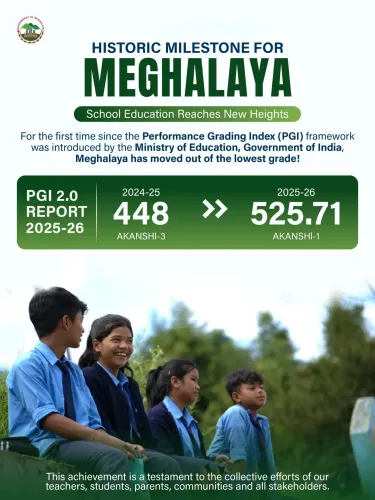
Meghalaya's national PGI score rose from 401.62 (2022-23) to 525.71 (2025-26) , moving the state from Akanshi-3 to Akanshi-1 .
Meghalaya is among the first states to adapt the Union Ministry of Education's national PGI for individual school-level assessment.
The Education Department of Meghalaya on 25 July 2025 introduced the state's first-ever school-level performance assessment system, with Education Minister Rakkam A. Sangma launching the Meghalaya School Performance Grading Index (MSPGI) 2025-26 in Shillong to evaluate the quality and institutional readiness of all recognised schools across the state.
Scope and Coverage
The MSPGI will cover 11,443 recognised schools spread across Meghalaya's 12 districts, with the stated aim of strengthening data-driven planning and raising institutional standards throughout the school education system. Each institution will be assigned a composite score out of 1,000 and receive a detailed School Report Card carrying its overall score, performance grade, and state ranking.
How Schools Are Assessed
Developed using certified UDISE+ 2025-26 data, the framework evaluates schools on 43 indicators grouped under five broad domains: accessibility, digital education, infrastructure, implementation of National Education Policy (NEP) initiatives, and quality-related parameters. Officials noted that the evaluation relies entirely on authenticated UDISE+ information submitted and verified by the schools themselves, ensuring uniformity and transparency.
Schools have been classified into 17 performance categories, ranging from 'Utkarsh' for outstanding institutions to 'Akanshi-10' for those requiring intensive support. Crucially, the grading is benchmark-based — schools measure progress against predefined standards rather than purely against one another.
What the Government Said
Launching the framework, Minister Sangma said the MSPGI should be viewed as a tool for institutional improvement rather than a mechanism for competition among schools. He added that the grading system would help school heads, teachers, School Management Committees, and education officials identify strengths, address deficiencies, and prepare targeted improvement plans grounded in objective data.
Meghalaya's National PGI Progress
The department also highlighted that Meghalaya has recorded its highest-ever national Performance Grading Index (PGI) score of 525.71 in 2025-26, a significant jump from 401.62 in 2022-23. This improvement has moved the state from the Akanshi-3 category to Akanshi-1 — marking its first exit from the lowest performance band under PGI 2.0.
The MSPGI has been modelled on the Union Ministry of Education's national PGI framework, making Meghalaya one of the first states in the country to adapt that national architecture for assessing individual schools rather than the state system as a whole. How effectively the index translates into on-ground improvements in learning outcomes will be the measure of its true impact.
Point of View
Yet Meghalaya still sits in the 'Akanshi-1' band, well below top-performing states. The MSPGI's value will depend entirely on whether the Education Department links grades to actionable budget lines and teacher deployment — not just to rankings on a portal.
NationPress
25 Jul 2026
Frequently Asked Questions
What is the Meghalaya School Performance Grading Index (MSPGI)?
The MSPGI is Meghalaya's first school-level performance assessment framework, launched on 25 July 2025, to evaluate all 11,443 recognised schools in the state on 43 indicators across five domains, assigning each a composite score out of 1,000. It is modelled on the Union Ministry of Education's national Performance Grading Index but applied at the individual school level.
How many schools and districts does the MSPGI cover?
The MSPGI covers 11,443 recognised schools spread across all 12 districts of Meghalaya. Every school will receive a School Report Card with an overall score, performance grade, and state ranking.
What are the 17 performance categories under MSPGI?
Schools are classified into 17 benchmark-based categories ranging from 'Utkarsh' for the highest-performing institutions to 'Akanshi-10' for those requiring intensive support. The grading measures each school against predefined standards rather than only against other schools.
What data is used to assess schools under the MSPGI?
The framework relies entirely on authenticated UDISE+ 2025-26 data submitted and verified by the schools themselves, covering 43 indicators across accessibility, digital education, infrastructure, NEP implementation, and quality parameters.
How has Meghalaya's national PGI score changed in recent years?
Meghalaya recorded its highest-ever national PGI score of 525.71 in 2025-26, up significantly from 401.62 in 2022-23. This improvement moved the state from the Akanshi-3 category to Akanshi-1, marking its first exit from the lowest performance band under PGI 2.0.