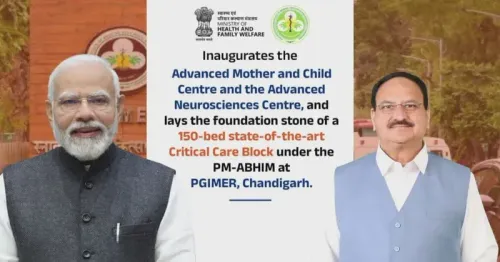
Nadda approves medical college at PGIMER Chandigarh Sarangpur campus
Synopsis
The Government of India has approved a new medical college at PGIMER Chandigarh's Sarangpur campus with a ₹456 crore investment, 125 annual MBBS seats, and state-of-the-art training infrastructure — advancing PM Modi's target of adding 75,000 medical seats in five years.
Key Takeaways
The Government of India has approved a new medical college at PGIMER Chandigarh's Sarangpur campus .
Total investment is ₹456 crore , spread across a 50.76-acre site.
The college will admit 125 MBBS students annually and feature modern labs, simulation facilities, and research infrastructure.
The move is part of PM Narendra Modi 's goal to add 75,000 medical seats in five years.
PGIMER Chandigarh , established in 1962, is one of India's premier postgraduate medical and research institutions.
NMC regulatory clearance and construction completion are the next milestones before the first batch can be admitted.
A ₹456 crore investment is set to reshape medical education in Chandigarh — and it begins at PGIMER's Sarangpur campus. Union Health Minister J. P. Nadda announced on Thursday, November 19, 2026, that the Government of India has granted approval for a brand-new medical college at the sprawling 50.76-acre Sarangpur site, with an annual intake of 125 MBBS students.
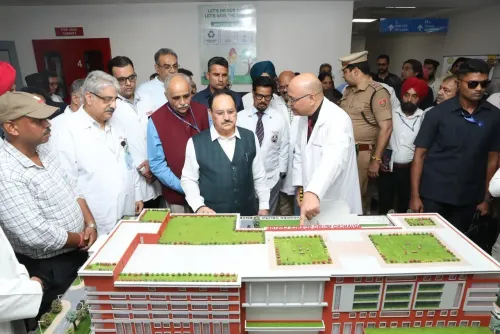
The approval places Sarangpur at the centre of India's most ambitious push to expand its medical workforce in a generation. The new college will house modern laboratories, advanced simulation facilities, and dedicated clinical training and research infrastructure — essentially a full-spectrum training ecosystem grafted onto one of the country's most storied postgraduate institutions.
PGIMER's Sarangpur expansion: what the campus will offer
PGIMER Chandigarh, established in 1962 under an Act of Parliament, has long been a flagship of postgraduate medical training in India. The Sarangpur campus extension now becomes the launchpad for undergraduate MBBS education, broadening the institute's reach beyond its traditional postgraduate identity. With simulation labs and research infrastructure integrated from day one, the college is designed to produce practice-ready doctors, not just degree-holders.
The 125-seat annual intake may sound modest in isolation, but each cohort compounds. Over a standard MBBS cycle, the campus will carry hundreds of students at any given time — feeding a pipeline that feeds public hospitals, primary health centres, and eventually the specialist workforce.
Modi's 75,000-seat target and where this fits
Nadda framed the Sarangpur approval squarely within Prime Minister Narendra Modi's stated goal of adding 75,000 medical seats in five years. That target — ambitious by any measure — has driven a wave of central approvals for new government medical colleges across states, often co-funded through schemes such as the Pradhan Mantri Swasthya Suraksha Yojana (PMSSY), which has underwritten medical college creation and upgrades since 2003.
India's doctor-to-population ratio has historically lagged World Health Organization benchmarks, with the gap sharpest in rural and semi-urban regions. Every new government MBBS seat — especially at an institution with PGIMER's clinical depth — directly addresses that deficit. The Sarangpur college, once operational, will not just train doctors; it will train them inside a live tertiary-care environment, an advantage most standalone colleges cannot match.
Construction, NMC clearance, and the road to first admissions
The approval marks a beginning, not a finish line. The college must still clear the National Medical Commission (NMC) regulatory process for formal recognition before the first MBBS batch can be admitted. Construction timelines, faculty recruitment, and clinical-training protocols at the Sarangpur site will all determine how quickly the ₹456 crore investment translates into doctors on the ground.
What is already clear is the government's signal: premier research institutes are no longer just for postgraduates. India's medical education expansion is now reaching deep into the country's most elite institutions — and Chandigarh's Sarangpur campus is next in line.
The question now is not whether India is building the capacity. The question is how fast it can get those 125 seats filled, those doctors trained, and those communities served.
Point of View
Not just quantity. For the BJP government, it also delivers a visible, concrete deliverable against PM Modi's publicly committed 75,000-seat target, with Chandigarh's national visibility amplifying the announcement's reach. The choice of a research-intensive host institution could set a template for embedding undergraduate training within postgraduate and research environments — a structural shift that, if replicated, would meaningfully raise the floor of MBBS education in India. The next test is execution: NMC approvals and construction timelines will determine whether this approval translates into doctors or remains a headline.
NationPress
19 Nov 2026
Frequently Asked Questions
What is the new medical college approved at PGIMER Chandigarh?
The Government of India has approved a new MBBS medical college at PGIMER Chandigarh's Sarangpur campus, with an annual intake of 125 students and an investment of ₹456 crore.
How many MBBS seats will the new PGIMER Sarangpur college have?
The new college at PGIMER's Sarangpur campus will admit 125 MBBS students annually.
What is PM Modi's target for adding medical seats in India?
Prime Minister Narendra Modi's government has set a target of adding 75,000 medical seats over five years to expand India's healthcare workforce.
What is PGIMER Chandigarh and why is it significant?
PGIMER — the Postgraduate Institute of Medical Education and Research — in Chandigarh was established in 1962 under an Act of Parliament and is one of India's premier postgraduate medical education and research institutions.
When will the new PGIMER Sarangpur medical college start admitting students?
No specific date has been announced yet. The college must first receive National Medical Commission (NMC) regulatory approval, complete construction, and recruit faculty before the first MBBS batch can be admitted.