Nadda Credits Modi's 12 Years for Medical Education Leap
Synopsis
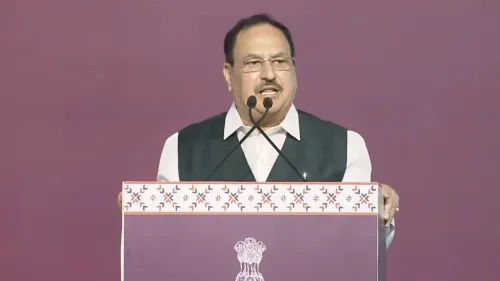
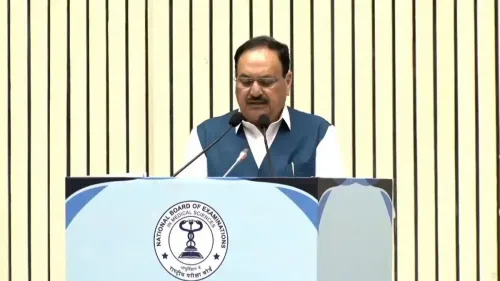
Union Health Minister J. P. Nadda credited PM Modi's 12 years in office for a sweeping transformation in Indian medical education, citing gains in speed, scale, and quality backed by the National Medical Commission Act and AIIMS expansion under PMSSY.
Key Takeaways
Nadda posted on 18 November 2026 crediting 12 years of PM Modi's leadership for transforming Indian medical education.
The post emphasises quality alongside quantity, framing progress around 'speed, scale, and skill.' The National Medical Commission Act (2019) replaced the Medical Council of India, introducing competency-based curriculum reforms and tighter norms.
Multiple phases of Pradhan Mantri Swasthya Suraksha Yojana post-2014 have added new AIIMS campuses and upgraded existing government medical colleges.
Postgraduate seat expansion and state-level NMC compliance remain active legislative watch-points.
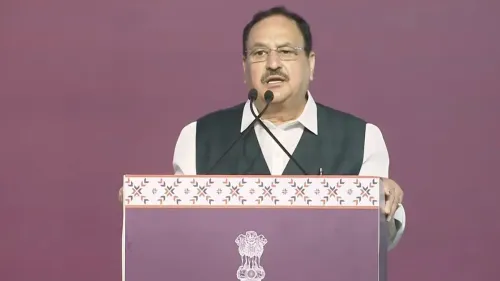
Twelve years into Narendra Modi's leadership, India's medical education landscape looks almost unrecognisable — and Union Health Minister J. P. Nadda wants that story told. On Wednesday, 18 November 2026, Nadda took to X to frame the transformation as a trifecta of 'speed, scale, and skill,' arguing the gains go well beyond raw seat counts.
From MCI to NMC: the regulatory reset that changed everything
The most consequential structural shift of the past decade came in 2019, when Parliament replaced the century-old Medical Council of India with the National Medical Commission. The NMC Act introduced competency-based curriculum reforms and tightened faculty and infrastructure norms — a direct attempt to fix what critics had long called a gap between classroom credentials and clinical readiness. That regulatory overhaul forms the 'quality' plank Nadda's post leans on hardest.
Before the NMC, medical education regulation was widely criticised for opacity and uneven enforcement. The new body's mandate explicitly links seat approvals to measurable standards — meaning expansion and accountability are, at least in design, two sides of the same coin.
PMSSY and the new AIIMS wave
The infrastructure engine behind the numbers is the Pradhan Mantri Swasthya Suraksha Yojana, a central scheme that pre-dates 2014 but was significantly scaled up under the Modi government. Multiple phases of PMSSY have greenlit new All India Institutes of Medical Sciences campuses across states that previously had little or no tertiary public medical infrastructure, while simultaneously upgrading existing government medical colleges to add postgraduate capacity.
The logic is straightforward: more AIIMS means more MBBS and postgraduate seats, more specialist doctors in underserved regions, and a higher benchmark for affiliated colleges to match. Whether every sanctioned institution has met its operational milestones remains a live question for Parliament's health committee.
The 'quantity vs quality' debate India's medical sector keeps having
Nadda's framing — 'not just an increase in quantity but also a strong commitment to quality' — is a deliberate answer to a recurring critique: that seat expansion has outpaced the supply of qualified faculty, leaving some newly minted colleges structurally underprepared. The NMC's faculty norms and inspection regime are the government's primary rebuttal to that charge.
The broader pattern holds across successive governments: India's doctor-to-population ratio has long lagged World Health Organization benchmarks, making medical seat expansion a near-permanent policy priority. What the Modi era has added is a simultaneous push to overhaul the regulator itself — a harder, slower reform than simply announcing new colleges.
With postgraduate seat expansion and state-level NMC compliance still works in progress, the next parliamentary session is likely to test whether the quality rhetoric has translated into verifiable outcomes on the ground.
Point of View
New AIIMS) and regulatory overhaul (NMC) — into a single 'quality-plus-quantity' message ahead of what are likely to be parliamentary questions on seat utilisation and faculty shortfalls. The reference to '12 years' rather than '11' or 'over a decade' is precise: it anchors credit firmly in the Modi era while implicitly drawing a contrast with the pre-2014 MCI regime that was widely seen as corrupt and ineffective. For the BJP, medical education expansion is a durable middle-class deliverable, and Nadda's post signals that the Health Ministry intends to keep it front and centre in the political conversation. The real test of the narrative will come when NMC publishes compliance data on newly approved colleges — the gap between sanctioned seats and functional capacity will determine whether the 'quality' claim holds up under scrutiny.
NationPress
18 Nov 2026
Frequently Asked Questions
What changes has India made to medical education in the last 12 years?
India replaced the Medical Council of India with the National Medical Commission in 2019, introduced competency-based curriculum reforms, expanded the number of AIIMS institutions under PMSSY, and increased MBBS seats in government medical colleges across states.
What is the National Medical Commission and why was it created?
The National Medical Commission is a statutory body established by the NMC Act of 2019 to regulate medical education standards in India. It replaced the Medical Council of India, which faced criticism for opacity, and introduced tighter faculty norms and competency-based training requirements.
What is Pradhan Mantri Swasthya Suraksha Yojana?
PMSSY is a central government scheme originally launched in 2003 and significantly expanded after 2014 to establish new AIIMS campuses and upgrade existing government medical colleges, aiming to improve tertiary healthcare access in underserved states.
Why did JP Nadda post about medical education?
Union Health Minister J. P. Nadda posted on 18 November 2026 to highlight what the government describes as a decade-long transformation in Indian medical education under PM Modi, stressing improvements in both the number of seats and the quality of training.
What are the concerns about India's rapid medical seat expansion?
Critics have raised concerns that fast seat expansion has outpaced the supply of qualified faculty, leaving some newer colleges below infrastructure and teaching standards. The NMC's inspection and approval regime is the government's primary mechanism to address these quality gaps.