Nadda Hits Back at Congress Over Election Commission Attacks
Synopsis
BJP national president and Union Health Minister J. P. Nadda accused the Congress-led INDIA alliance of attempting to weaken public faith in the Election Commission of India, calling the defence of constitutional institutions a collective national responsibility.
Key Takeaways
Nadda posted on November 4, 2026 accusing Congress and the INDIA alliance of targeting the Election Commission to undermine democratic trust.
He framed the defence of constitutional institutions as a 'collective responsibility' of all citizens.
The post carried the hashtag #SaveDemocracyRemoveAnarchy , indicating a coordinated BJP messaging campaign.
The INDIA alliance , formed in 2023 , has a documented pattern of raising concerns over ECI neutrality during major election cycles.
The Election Commission of India derives its authority from Article 324 of the Constitution and oversees all Parliamentary and state assembly elections.
Nadda speaks as both BJP national president and a Union Cabinet minister, amplifying the statement's institutional weight.
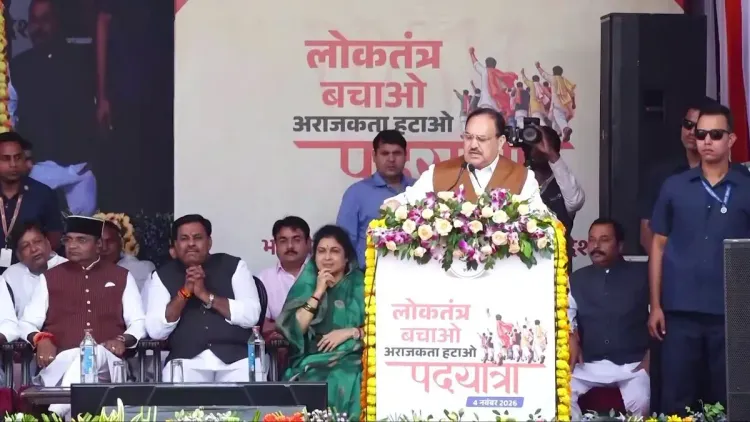
Protecting democracy is a collective responsibility — and Union Health Minister J. P. Nadda made clear on Wednesday, November 4, 2026, that he believes the Congress-led INDIA alliance is failing that test by targeting the Election Commission of India.
Posting on X, Nadda wrote: 'लोकतंत्र और संवैधानिक संस्थाओं की रक्षा हमारी सामूहिक जिम्मेदारी है।' ('Protecting democracy and constitutional institutions is our collective responsibility.') He went further, charging that the allegations being levelled against the Election Commission of India (ECI) by the Congress and the INDIA alliance are 'an attempt to weaken the public's trust in the country's democratic institutions.' The post carried the hashtag #SaveDemocracyRemoveAnarchy.
The charge sheet against the ECI — and who is making it
The Indian National Congress and the INDIA alliance — the multi-party opposition bloc formed in 2023 to coordinate electoral strategy against the NDA — have periodically questioned the neutrality of the Election Commission, raising objections across the 2019 and 2024 general election cycles. The pattern is now a fixture of Indian political rhetoric: when results disappoint, the constitutional umpire becomes a target. Nadda's broadside is the ruling establishment's counter-move.
The ECI is a constitutionally mandated body under Article 324, vested with the superintendence, direction, and control of elections to Parliament and state legislatures. Its independence is a foundational pillar of Indian electoral democracy — which is precisely why attacks on it, Nadda argues, land as attacks on democracy itself.
A rhetorical battle that tracks the election calendar
This is not a new skirmish. Ruling-party leaders have consistently framed opposition criticism of the ECI as institutional sabotage, while opposition parties frame the same criticism as legitimate accountability. The cycle has intensified whenever state assembly elections loom or electoral reform legislation moves through Parliament.
What gives Nadda's statement added weight is the dual platform from which he speaks: as BJP national president, his words carry the official ideological line of the country's largest party; as a Union Cabinet minister, they carry government authority. The hashtag #SaveDemocracyRemoveAnarchy signals a coordinated messaging push, not a solo observation.
The ECI has not yet publicly responded to whichever specific allegations prompted this exchange — but the battlefield is now clearly drawn: institutional credibility versus accountability, and both sides are claiming the democratic high ground.
Point of View
Amplified by a branded hashtag, suggests this is choreographed party communication, not a spontaneous reaction. For the INDIA alliance, the dilemma is structural: every criticism of the ECI can now be reframed as anti-democratic sentiment by the ruling side, raising the political cost of institutional oversight. As assembly elections draw closer, this war over whose narrative owns the word 'democracy' will only intensify.
NationPress
4 Nov 2026
Frequently Asked Questions
What did J. P. Nadda say about the Election Commission?
Nadda said that allegations being levelled against the Election Commission by Congress and the INDIA alliance are an attempt to weaken the public's trust in India's democratic institutions, calling the protection of constitutional bodies a collective responsibility.
Why is the INDIA alliance criticising the Election Commission?
The INDIA alliance, formed in 2023, has periodically questioned the neutrality of the Election Commission across the 2019 and 2024 election cycles. The specific allegations referenced in Nadda's November 2026 post have not been independently verified from available sources.
What is the Election Commission of India and why does it matter?
The Election Commission of India is a constitutional body under Article 324 that oversees the conduct of elections to Parliament and state legislatures. Its perceived independence is central to the credibility of Indian democracy, making any controversy around it politically significant.
What does the hashtag #SaveDemocracyRemoveAnarchy mean?
The hashtag appears to be part of a coordinated BJP messaging campaign framing the opposition's criticism of constitutional institutions as anarchic or anti-democratic, and positioning the BJP as the defender of India's democratic framework.
What is J. P. Nadda's current role in the government and BJP?
J. P. Nadda is currently the Union Minister of Health and Family Welfare as well as Minister of Chemicals and Fertilizers in the Union Cabinet, and he simultaneously serves as the national president of the Bharatiya Janata Party (BJP).