Nepal floods: 626 dead, Congress MP Tewari warns on Himalayan ecology

Synopsis
A transboundary flash flood originating in Tibet has killed at least 626 people in Nepal, with the toll still rising. Congress MP Manish Tewari’s warning about Himalayan ecology cuts to the core of a recurring crisis: the world’s youngest mountain range is also its most climate-vulnerable, and repeated disasters suggest the warnings are not being heeded fast enough.
Key Takeaways
Nepal’s NDRRMA confirmed 626 bodies recovered as of 10 am, 29 August , with the toll expected to rise.
The flash flood struck Nepal on Wednesday , originating in the Tibetan region of China and sweeping through the Bhote Koshi River .
Affected districts include Rasuwa , Nuwakot , Dhading , Chitwan , Gorkha , Tanahun , and both Nawalparasi districts.
Congress MP Manish Tewari called the disaster “heartbreaking” and warned of the ecological vulnerability of the Himalayas to climate change.
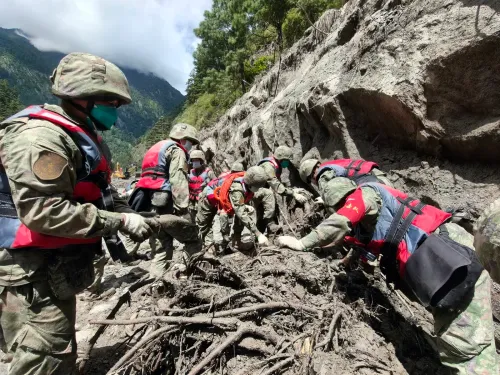
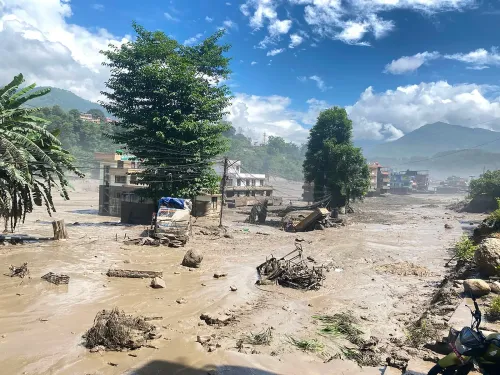
Search and rescue operations are ongoing; roads blocked by debris and landslides are being cleared to enable relief access.
Congress MP Manish Tewari on Saturday, 29 August called the devastating Nepal flash floods “heartbreaking,” warning that the catastrophe is a stark reminder of how fragile the Himalayan ecosystem is in the face of climate change and unchecked infrastructure activity. His remarks came as Nepal’s National Disaster Risk Reduction and Management Authority (NDRRMA) confirmed that 626 bodies had been recovered as of 10 am on Saturday.
How the Disaster Unfolded
The massive flash flood struck Nepal on Wednesday, originating in the Tibetan region of China before sweeping through the transboundary Bhote Koshi River and leaving a trail of destruction across multiple districts. Bodies have been recovered from riverbanks in several downstream districts along the Bhote Koshi and Trishuli river systems, including Rasuwa, Nuwakot, Dhading, Chitwan, Gorkha, Tanahun, Nawalparasi (East), and Nawalparasi (West). Officials have warned that the death toll is expected to rise as search and rescue operations continue.
What Tewari Said
Speaking on the tragedy, Tewari said: “The Himalayas are young fold mountains and, therefore, are very vulnerable and susceptible to any kind of climate change or infrastructure-building activity. The enormous tragedy in Nepal is once again a grim reminder that we need to be very careful with regard to the ecology of these young fold mountains.”
He further cautioned: “We need to be very cognisant of the entire spectacle of climate change because what unfortunately has unfolded in Tibet and Nepal is an example that warnings regarding global warming, if they are ignored, can have very devastating consequences.”
Rescue and Relief Operations
Search and rescue teams are currently active across all affected districts in the Himalayan nation. Police are coordinating with local residents and other agencies to locate missing persons and assist those stranded by floodwaters. Rescued individuals are being evacuated from high-risk zones to safer locations. Authorities are also working to clear roads blocked by flood debris and landslides to restore access and facilitate relief operations.
Broader Context: A Recurring Crisis
This is not the first time that transboundary river systems originating in Tibet have triggered catastrophic flooding in Nepal. The Bhote Koshi has a documented history of glacial lake outburst floods (GLOFs), and scientists have long flagged the accelerating risk posed by glacial retreat driven by rising temperatures. This comes amid growing international concern over the pace of climate change in high-altitude Himalayan zones, where warming is occurring at a rate significantly faster than the global average. Notably, the transboundary nature of the flood—originating in Chinese-administered Tibet—adds a layer of diplomatic complexity to any coordinated disaster response.
Point of View
But its transboundary origin in Tibet raises a question that rarely gets asked: how does India coordinate disaster early-warning with China when rivers cross the border? Tewari’s ecological warning is well-placed, but it sidesteps the harder political issue—infrastructure expansion on both sides of the Himalayas, including in India, is accelerating in terrain that scientists have consistently flagged as geologically immature and climate-sensitive. The Bhote Koshi has flooded before; the pattern is not new. What is new is the scale, and that should force a policy reckoning that goes beyond condolences.
NationPress
29 Aug 2026
Frequently Asked Questions
How many people have died in the Nepal flash floods?
As of 10 am on 29 August , Nepal’s NDRRMA confirmed that 626 bodies had been recovered. Officials warned the death toll is expected to rise as search and rescue operations continue.
Where did the Nepal flash flood originate?
The flash flood originated in the Tibetan region of China and swept through the transboundary Bhote Koshi River into Nepal, causing widespread destruction across multiple districts.
Which districts in Nepal were most affected?
Bodies have been recovered from riverbanks across several districts along the Bhote Koshi and Trishuli river systems, including Rasuwa , Nuwakot , Dhading , Chitwan , Gorkha , Tanahun , and both Nawalparasi districts.
What did Congress MP Manish Tewari say about the Nepal floods?
Tewari called the floods “heartbreaking” and warned that the Himalayas, being young fold mountains, are highly vulnerable to climate change and infrastructure activity. He said ignoring global warming warnings can have “very devastating consequences.”
Why are the Himalayas considered ecologically vulnerable?
The Himalayas are geologically young fold mountains, making them inherently unstable and highly susceptible to seismic activity, glacial lake outburst floods, and the accelerated effects of climate change. Warming in high-altitude Himalayan zones is reportedly occurring faster than the global average.