Odisha CMO notifies corrected English spellings for districts, blocks
Synopsis
The Chief Minister's Office of Odisha issued an official notification on 22 June 2026 correcting impure and corrupted English spellings of place names across the state's districts, sub-divisions, blocks, and urban areas, continuing Odisha's broader linguistic standardisation drive that began with the state's own name change in 2011.
Key Takeaways
The Chief Minister's Office of Odisha published a notification on 22 June 2026 correcting English spellings of administrative place names statewide.
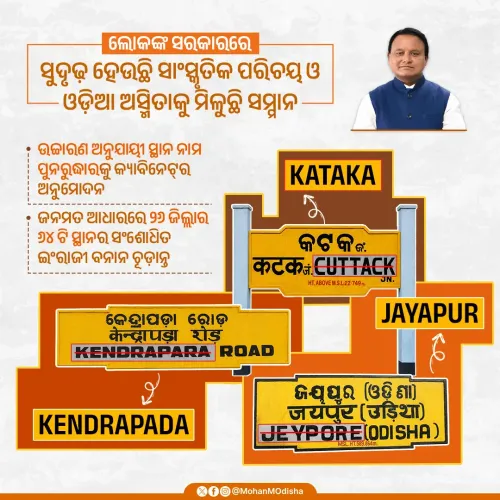
The revision covers districts, sub-divisions, blocks, and urban areas where existing English spellings were deemed impure or corrupted transliterations of Odia names.
A consolidated list of corrected names has been made publicly accessible via an official government link.
The move follows the Odisha (Alteration of Name) Act, 2010 , under which the state's name was changed from Orissa to Odisha in March 2011 .
District administrations, urban local bodies, and block offices will need to update signage, records, and official correspondence to reflect the new spellings.
Gazette notification and subsequent updates to official maps and signboards are the key implementation steps to follow.
The Chief Minister's Office of Odisha published an official notification on Monday, 22 June 2026, announcing corrected English spellings for place names across the state's districts, sub-divisions, blocks, and urban areas, replacing long-standing corrupted or impure transliterations with standardised forms.
The post, shared from the official CMO Odisha account, stated in Odia: 'ରାଜ୍ୟର ବିଭିନ୍ନ ଜିଲ୍ଲା, ଉପଖଣ୍ଡ, ବ୍ଲକ ତଥା ସହରାଞ୍ଚଳର ଅଶୁଦ୍ଧ ତଥା ଅପଭ୍ରଂଶ ଇଂରାଜୀ ବନାମର ସଂଶୋଧିତ ନାମ ସମ୍ବନ୍ଧିତ ବିଜ୍ଞପ୍ତି ପ୍ରକାଶ ପାଇଛି' — meaning, 'A notification has been published regarding the corrected names of impure and corrupted English spellings of various districts, sub-divisions, blocks, and urban areas of the state.'
Context
Odisha has a documented history of place names being rendered in English using colonial-era phonetics that do not accurately reflect local Odia pronunciation. This notification signals a formal administrative effort to align official English-language records with authentic Odia forms, affecting administrative units at multiple tiers — from districts down to blocks and urban bodies.
The corrected names are accessible through a government-published link, indicating the notification carries official force and is intended for reference by departments, citizens, and local bodies alike.
Policy Backdrop
This move is consistent with a longer arc of linguistic standardisation in Odisha. The state's own English name was altered from Orissa to Odisha under the Odisha (Alteration of Name) Act, 2010, which received presidential assent and came into effect in March 2011. That landmark change was driven by the argument that 'Orissa' was a colonial phonetic distortion of the Odia name.
Across India, states have periodically issued similar orders — correcting district and town names to remove colonial-era spellings or phonetic distortions in favour of local-language forms. Odisha's 2026 notification follows this national pattern and builds on the momentum of the 2011 state-name change and earlier campaigns to secure classical-language status for Odia.
Stakeholders and Impact
The revision affects district administrations, urban local bodies, sub-divisional offices, and block-level units across the state, all of which will need to update official signage, records, correspondence, and digital databases. Odia language advocates have long pushed for such corrections, viewing accurate transliteration as a matter of cultural dignity and administrative clarity.
Citizens, businesses, and institutions that reference official place names in legal documents, addresses, and government filings will also need to align with the newly notified spellings. The publication of a consolidated list through an official link is designed to ease that transition.
What's Next
Gazette notifications confirming the legal force of the revised names are the next procedural step to watch. Following formal gazetting, state departments will be expected to update official maps, signboards, and government records to reflect the corrected spellings.
Implementation across multiple administrative tiers — particularly in rural block offices and urban local bodies — will determine how quickly the standardised names take hold in everyday official use. Monitoring compliance across Odisha's 30 districts will be a key governance task in the months ahead.
Point of View
Which began with shedding the colonial name 'Orissa.' By anchoring the correction in an official notification — rather than a mere advisory — the administration signals that linguistic accuracy is now a governance priority with administrative and legal consequences. The move also puts pressure on central government databases, national maps, and digital platforms to align, which historically has been a slow and contested process. Politically, such standardisation efforts tend to resonate strongly with regional identity sentiment, giving the ruling dispensation a low-cost, high-visibility reform to point to.
NationPress
22 Jun 2026
Frequently Asked Questions
Why is Odisha correcting English spellings of its districts and blocks?
The Odisha government says existing English spellings of many districts, sub-divisions, blocks, and urban areas are impure or corrupted transliterations that do not reflect accurate Odia pronunciation. The notification aims to standardise these names in official use.
What is the history of Odisha changing place names?
Odisha changed its own English name from 'Orissa' to 'Odisha' under the Odisha (Alteration of Name) Act, 2010, which took effect in March 2011. The 2026 notification extends that linguistic standardisation to sub-state administrative units.
Which areas are covered by the Odisha place name correction notification?
The notification covers districts, sub-divisions (upakhanda), blocks, and urban areas across the state of Odisha where English spellings were found to be inaccurate or corrupted.
Where can I find the list of corrected place names in Odisha?
The Chief Minister's Office shared an official government link in its 22 June 2026 post on X, directing citizens to the full list of corrected names.
What happens after Odisha notifies corrected place name spellings?
After the notification, district administrations and urban local bodies are expected to update official records, signboards, maps, and correspondence. A gazette notification confirming legal force is the key next procedural step.