CR Paatil Hails GI Tags, Varanasi Craft Hub Boost

Synopsis
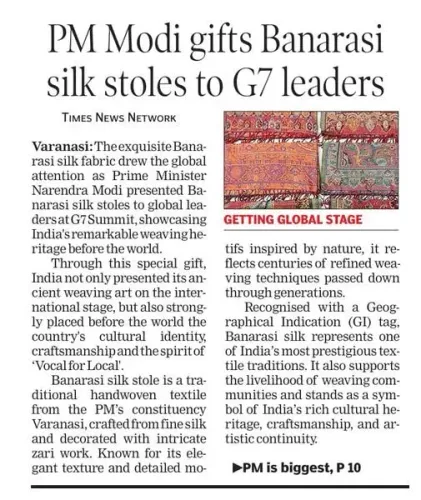
Union Jal Shakti Minister C. R. Paatil has lauded PM Modi's Vocal for Local push and GI tagging for elevating Varanasi's weavers and artisans onto the global stage, pointing to the Deen Dayal Hastkala Sankul as a key enabler of direct international trade access.
Key Takeaways
Paatil , Union Jal Shakti Minister, posted on 28 May 2026 praising the rise of Varanasi's artisan economy on the global stage.
Products including Banarasi saree , wooden toys, Banarasi paan , and Langda mango have received GI Tag protection, granting them global legal recognition.
The Deen Dayal Hastkala Sankul (Trade Facilitation Centre) in Varanasi is cited as enabling artisans to trade directly with international buyers.
Vocal for Local , a cornerstone of the Atmanirbhar Bharat package announced in 2020 , is credited with driving renewed interest in indigenous products.
GI protection under the Geographical Indications of Goods (Registration and Protection) Act, 1999 underpins the legal framework for these registrations.
Varanasi, PM Modi 's parliamentary constituency, has been developed as a flagship model integrating trade infrastructure with GI branding for artisan communities.
Union Jal Shakti Minister C. R. Paatil on Thursday, 28 May 2026, took to X to celebrate the rising global profile of Varanasi's artisan economy, crediting Prime Minister Narendra Modi's 'Vocal for Local' initiative and Geographical Indication (GI) tagging for transforming the livelihoods of the city's weavers and handicraft craftspeople.
Context
Paatil's post, written in Hindi, declares that Banaras is now winning global recognition not only for its iconic ghats and temples but also for its extraordinary craftsmanship. He writes: 'बनारस सिर्फ अपने घाटों और मंदिरों के लिए ही नहीं, बल्कि अपने अद्भुत हुनर के लिए भी आज पूरी दुनिया में छा रहा है!' ('Banaras is today making its mark across the entire world not only for its ghats and temples, but also for its extraordinary skill!'). The minister specifically highlights products such as the world-famous Banarasi saree, wooden toys, Banarasi paan, and Langda mango as beneficiaries of GI protection.
Paatil also points to the Deen Dayal Hastkala Sankul — a Trade Facilitation Centre in Varanasi — as a piece of modern infrastructure enabling artisans to access international markets directly and grow their incomes.
Policy Backdrop
The legal architecture for GI protection in India rests on the Geographical Indications of Goods (Registration and Protection) Act, 1999, which grants region-specific products legal recognition and market exclusivity. Since 2014, the government has accelerated GI registrations for heritage crafts, combining cultural preservation with export promotion.
Vocal for Local was formally highlighted as a pillar of the Atmanirbhar Bharat package announced in 2020, urging Indian consumers and institutions to prefer domestically produced goods. Varanasi, which is also Prime Minister Modi's parliamentary constituency, has served as a flagship site where physical infrastructure such as the Sankul has been integrated with branding tools like GI tags to formalise the artisan economy.
This model mirrors similar efforts across other textile and craft clusters in India, all aimed at raising producer incomes while preserving intangible cultural heritage.
Stakeholders and Impact
The primary beneficiaries of these interventions are Varanasi's handloom weavers and handicraft artisans — communities whose livelihoods are directly tied to the commercial value of traditional products. GI certification raises the premium buyers are willing to pay and reduces the risk of cheaper imitations undercutting authentic producers.
The Deen Dayal Hastkala Sankul provides these artisans with exhibition space, design support, and trade linkages that were previously difficult to access independently. By enabling more direct pathways to export markets, the facility aims to reduce dependence on middlemen and improve the share of final sale value that reaches the craftsperson.
What's Next
Attention will now turn to additional GI applications from other craft clusters across Uttar Pradesh, as the state has been among the most active in pursuing such registrations. Utilisation data and trade figures from the Deen Dayal Hastkala Sankul are expected to feature in forthcoming government updates as a measure of the initiative's on-ground impact.
As the government continues to position heritage crafts as a vehicle for rural economic empowerment, Varanasi's model — combining GI branding, trade infrastructure, and the Vocal for Local messaging — is likely to be cited as a template for replication in other artisan-intensive districts across India.
Point of View
The minister reinforces a consistent ideological arc linking cultural nationalism with economic self-reliance. Whether artisan incomes have risen at the pace implied by the post remains a question that independent utilisation data from the Sankul and GI-registered product exports would need to answer.
NationPress
11 Oct 2026
Frequently Asked Questions
What is the Deen Dayal Hastkala Sankul in Varanasi?
The Deen Dayal Hastkala Sankul is a government-built Trade Facilitation Centre in Varanasi that provides weavers and handicraft artisans with modern infrastructure, exhibition space, design support, and market linkages to help them access domestic and international buyers directly.
Which Varanasi products have received GI Tags?
Among the Varanasi products that have received Geographical Indication protection are the Banarasi saree, wooden toys, Banarasi paan, and Langda mango, giving them legal recognition and market exclusivity tied to their regional origin.
What is the Vocal for Local initiative?
Vocal for Local is a campaign promoted by Prime Minister Narendra Modi urging Indians to prefer domestically produced goods; it was formally incorporated as a pillar of the Atmanirbhar Bharat economic package announced in 2020.
What is a GI Tag and how does it help Indian artisans?
A GI Tag, granted under the Geographical Indications of Goods (Registration and Protection) Act 1999, certifies that a product originates from a specific region and possesses qualities attributable to that origin. For artisans, it raises the premium buyers pay, reduces competition from imitations, and strengthens export branding.
Why does Varanasi receive special government focus for craft development?
Varanasi is both a major heritage craft hub — home to handloom weavers, wooden toy makers, and other artisans — and the parliamentary constituency of Prime Minister Narendra Modi, making it a high-profile site for demonstrating the government's artisan economy and Atmanirbhar Bharat policies.