Jal Shakti Minister Paatil backs water literacy in school texts
Synopsis
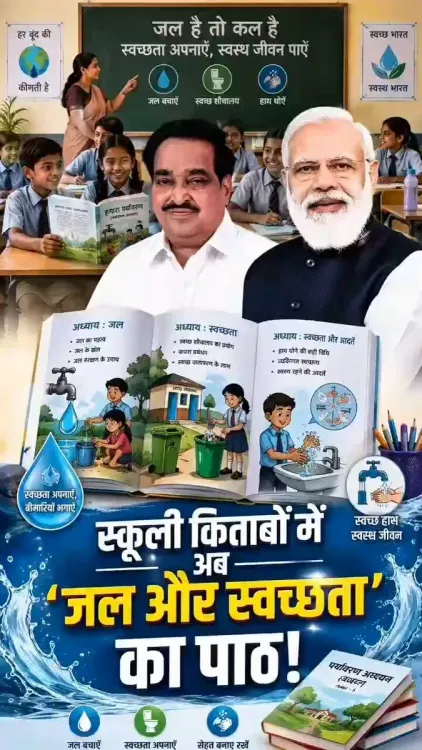
Union Jal Shakti Minister C. R. Paatil announced on 1 June 2026 that water conservation and sanitation topics will be added to school textbooks under PM Modi's leadership, aiming to instil long-term conservation values in future generations.
Key Takeaways
Union Jal Shakti Minister C.
Paatil announced on 1 June 2026 that school textbooks will include water conservation and sanitation subjects.
The decision was described as taken under the leadership of Prime Minister Narendra Modi .
The minister framed the move as building water sensitivity and hygiene values in future generations, not merely expanding the curriculum.
The announcement aligns with the National Education Policy 2020 , which recommended integrating environmental sustainability into school curricula.
NCERT textbook revision cycles and state board adoption orders are the key next steps to watch.
The initiative links the Swachh Bharat Mission and Jal Shakti Abhiyan frameworks directly to formal schooling.
Union Jal Shakti Minister C. R. Paatil announced on Monday, 1 June 2026 that a significant decision has been taken under the leadership of Prime Minister Narendra Modi to include water conservation and sanitation-related subjects in school textbooks — a move the minister described as a step toward building long-term water sensitivity and hygiene values in future generations.
Context
Posting in Hindi on X, Minister Paatil stated: 'माननीय प्रधानमंत्री श्री नरेंद्र मोदी सर के नेतृत्व में एक महत्वपूर्ण फैसला किया गया है' ['An important decision has been taken under the leadership of honourable Prime Minister Shri Narendra Modi'] — that water conservation and sanitation topics will be incorporated into school curricula. He added that this decision is not merely a curriculum expansion, but a meaningful step toward developing sensitivity toward water, a spirit of conservation, and values of cleanliness in the coming generations.
The minister concluded that this initiative will prove to have 'far-reaching and positive results' in building a jal-surakshit aur swachh Bharat ['water-secure and clean India'], tagging the hashtags #JalShakti, #SwachhBharat, and #ViksitBharat.
Policy Backdrop
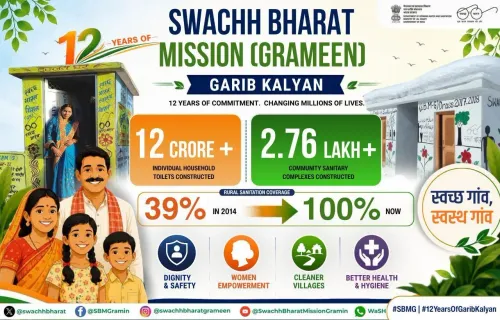
The announcement connects to a broader policy lineage. The Swachh Bharat Mission, launched in 2014, placed sanitation and hygiene at the centre of national governance. The Jal Shakti Abhiyan, initiated in 2019, extended that focus to water conservation in stressed districts, while the Jal Jeevan Mission — also launched in 2019 — aimed to provide tap water connections to every rural household.
Crucially, the National Education Policy 2020 had already recommended integrating environmental sustainability themes into school curricula, providing a formal policy anchor for moves of this kind. NCERT, the National Council of Educational Research and Training, develops model textbooks that influence both central and state board syllabi, making it the natural institutional vehicle for such a reform.
Stakeholders and Impact
The primary beneficiaries of this decision are school students across India, who would encounter water conservation and sanitation as structured academic content rather than as stand-alone awareness campaigns. State education boards, which adapt NCERT frameworks for regional curricula, will be central to how uniformly the change is implemented across the country.
Successive administrations have used curriculum integration to shape long-term public behaviour on natural resources — from environmental studies to value education — and this initiative follows that pattern. Embedding these themes in textbooks is seen as a more durable method of behaviour change than periodic outreach drives, as it reaches children at a formative stage and through a mandatory channel.
What's Next
Attention will now turn to NCERT's textbook revision cycles and to orders from individual state governments directing their boards to adopt the updated content. The specific classes, chapters, and implementation timelines have not yet been detailed in the public domain. Observers will watch whether the curriculum changes are rolled out uniformly across CBSE and state boards, and how quickly the updated textbooks reach classrooms in the coming academic sessions.
If implemented at scale, the integration of water and sanitation content into mainstream schooling could represent one of the more structurally durable policy links between the Jal Shakti ministry and India's education architecture — moving conservation from campaign messaging into compulsory learning.
Point of View
The Jal Shakti Ministry is attempting a structural shift — from episodic public campaigns to embedded, compulsory learning. This mirrors the logic behind earlier curriculum moves on environmental studies and value education, but the explicit ministerial announcement signals that Jal Shakti is staking a claim over the education pipeline, not just the infrastructure one. The move also gives the National Education Policy 2020's sustainability mandate a concrete, ministry-driven expression. Whether the reform translates into classroom reality will depend on how quickly NCERT and state boards act — and that implementation gap has historically been where such announcements lose momentum.
NationPress
15 Oct 2026
Frequently Asked Questions
What did Jal Shakti Minister C. R. Paatil announce about school textbooks?
Minister C. R. Paatil announced on 1 June 2026 that water conservation and sanitation topics will be included in school textbooks, describing it as a decision taken under PM Narendra Modi's leadership to build long-term conservation values in students.
Which government body will revise school textbooks to include water conservation?
NCERT, the National Council of Educational Research and Training, develops model school textbooks in India and is the primary body expected to carry out the curriculum revision. State boards typically adapt NCERT frameworks for their own syllabi.
How does this decision connect to the Swachh Bharat Mission?
The Swachh Bharat Mission, launched in 2014, placed sanitation and hygiene at the centre of national policy. Including these themes in school textbooks is seen as an extension of that mission into formal education, creating a more durable channel for awareness.
Does the National Education Policy 2020 support including water conservation in school curricula?
Yes. The National Education Policy 2020 recommended integrating environmental and sustainability themes into school curricula, providing a formal policy basis for the kind of curriculum change announced by Minister Paatil.
When will the updated school textbooks with water and sanitation content be available?
Specific classes, chapters, and implementation timelines have not yet been publicly detailed. The next steps involve NCERT's textbook revision cycles and state-level adoption orders, which are expected in coming academic sessions.