Pakistan's higher education crisis: 280 universities, mounting debt, failing reforms
Synopsis
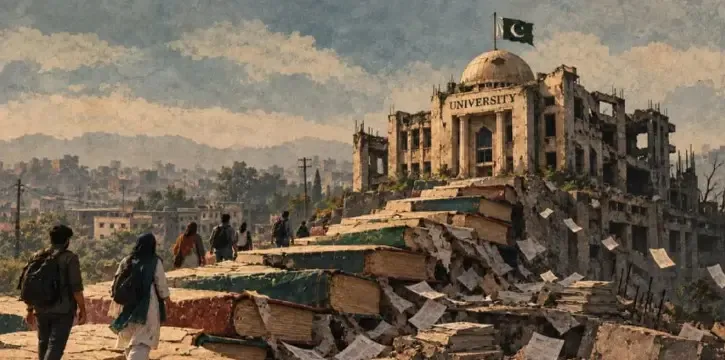
Pakistan's university boom has become a bailout crisis. Nearly 280 institutions built on Musharraf's 2002 reforms are drowning in debt with poor outcomes — and an investigative report reveals the original architects of the system had actually warned this would happen. The sector is now, in its own words, 'too big to fail and too difficult to reform.'
Key Takeaways
Pakistan has nearly 280 universities but the sector faces mounting debts, poor educational outcomes and questionable scholarship quality.
The crisis traces back to General Pervez Musharraf's sweeping higher education reforms launched in 2002 , which created the Higher Education Commission (HEC) .
Billions were invested, including a landmark deal with the US for what was described as the world's largest Fulbright scholarship programme .
Universities in Khyber Pakhtunkhwa collectively demanded a Rs 25 billion bailout package after experiencing severe financial distress.
An investigative report by Pakistani daily The Dawn found that the 2002 Task Force Report — the sector's founding document — had explicitly warned of this collapse risk.
Pakistan's higher education sector, once celebrated as a bold experiment in knowledge-economy building, is now teetering on the edge of systemic collapse — weighed down by debt, poor academic outcomes and governance failures that critics argue were foreseeable from the very start. According to an investigative series by Pakistani daily The Dawn, the crisis has been decades in the making and shows no clear path to resolution.
The Rise: Musharraf's Ambitious Reform Push
Nearly two decades ago, then-President General Pervez Musharraf launched sweeping reforms in Pakistan's higher education sector, with the stated goal of transforming colleges and universities into genuine 'centres of excellence.' The reforms, initiated in 2002, led to the creation of the Higher Education Commission (HEC) through the Higher Education Commission Ordinance — the founding institutional framework for what was envisioned as a knowledge-economy transformation.
The ambition was considerable. Billions were committed to building new universities, and Pakistan reportedly signed a landmark agreement with the United States to launch what was then described as the world's largest Fulbright scholarship programme. The initiative attracted international attention and, for a period, genuine optimism.
The Fall: A Gargantuan System in Distress
Today, Pakistan has nearly 280 universities enrolling millions of students and generating a rapidly expanding volume of research output. Yet, according to The Dawn's findings, the sector is simultaneously struggling with mounting institutional debts, weak educational outcomes, and questions over scholarship quality — rendering many universities' operations financially unviable.
The report describes the situation starkly: 'The bold reforms of 2002 that were to transform Pakistan into a knowledge economy have instead mutated into a gargantuan Frankenstein's monster, which limps into its 25th year, too big to fail and too difficult to reform.' What began as a university boom, it notes, has become a university bailout.
Khyber Pakhtunkhwa Universities Demand Rs 25 Billion Rescue
The financial distress is not abstract. The crisis has played out publicly in Khyber Pakhtunkhwa, where almost all public universities reportedly experienced severe financial strain and collectively demanded a Rs 25 billion rescue package to stabilise the sector. The demand drew national media coverage and underscored how widespread the fiscal rot has become.
This comes amid a broader fiscal squeeze in Pakistan, where foreign exchange pressures and IMF conditionalities have sharply limited the government's capacity to bail out state-funded institutions — making the Rs 25 billion demand politically fraught as well as economically consequential.
The Warning No One Heeded
Perhaps the most damning element of The Dawn's investigative report is its finding that the collapse was anticipated — not in hindsight, but from the very beginning. According to the report, the original architects of Pakistan's higher education experiment explicitly flagged the risks of unsustainable expansion in the Task Force Report of 2002, the founding document that shaped the HEC Ordinance and the Commission itself.
That the warning went unheeded for over two decades, as the system expanded far beyond its financial and institutional capacity, raises uncomfortable questions about policy accountability and political incentives in Pakistan's higher education governance.
What Comes Next
With the sector described as 'too big to fail and too difficult to reform,' Pakistan faces a structural dilemma: a retrenchment would displace millions of students and faculty, while continuing on the current trajectory risks deeper institutional decay. Notably, similar patterns of rapid university expansion followed by fiscal crisis have been observed across South Asia and parts of sub-Saharan Africa, suggesting this is as much a governance failure as a funding one. Whether Islamabad can craft a credible reform roadmap — particularly under IMF fiscal constraints — will determine whether Pakistan's higher education sector stabilises or enters a more acute phase of collapse.
Point of View
But that the collapse was documented and disregarded from day one. When a government's own task force warns against unsustainable expansion and that warning is filed away for two decades while billions are spent, it stops being a policy failure and starts being an accountability failure. Pakistan's higher education crisis also illustrates a wider trap: systems that grow too fast on political capital rather than institutional capacity become impossible to unwind without mass disruption. With IMF conditionalities squeezing Pakistan's fiscal space, the Rs 25 billion bailout demand from Khyber Pakhtunkhwa alone signals that the reckoning can no longer be deferred.
NationPress
2 Nov 2026
Frequently Asked Questions
What is the current state of Pakistan's higher education sector?
Pakistan's higher education sector is in severe financial and institutional distress, with nearly 280 universities struggling with mounting debts, poor educational outcomes and questionable research quality. An investigative report by The Dawn describes the system as 'too big to fail and too difficult to reform.'
What were Musharraf's 2002 higher education reforms?
In 2002, then-President General Pervez Musharraf initiated sweeping reforms aimed at transforming Pakistan's colleges and universities into 'centres of excellence' and building a knowledge economy. The reforms led to the creation of the Higher Education Commission (HEC) and included a landmark Fulbright scholarship agreement with the United States.
Why are universities in Khyber Pakhtunkhwa demanding a bailout?
Almost all public universities in Khyber Pakhtunkhwa have reportedly experienced severe financial distress, collectively demanding a Rs 25 billion rescue package. The demand reflects the broader fiscal unviability of Pakistan's rapidly expanded university system, which grew faster than sustainable funding could support.
Was Pakistan's higher education collapse predicted?
Yes, according to The Dawn's investigative report. The original Task Force Report of 2002 — the founding document behind the HEC Ordinance — reportedly warned explicitly about the risks of the expansion model. Critics argue these warnings were ignored for over two decades as the system grew beyond its institutional and financial capacity.
What happens next for Pakistan's higher education sector?
Pakistan faces a structural dilemma: scaling back risks displacing millions of students and faculty, while staying the course deepens institutional decay. With IMF-imposed fiscal constraints limiting government spending, a credible reform plan has yet to emerge, leaving the sector's future uncertain.