Piyush Goyal: Varanasi Biscuits Exported to Oman Under CEPA
Synopsis
Union Minister Piyush Goyal announced the first export of Varanasi-manufactured biscuits to Oman under the India-Oman CEPA, with duty-free tariff benefits enabling price competitiveness. An MoU for 700 MT of biscuit supply to GCC countries in FY 2026–27 has also been signed, marking a milestone for India's food-processing export ambitions.
Key Takeaways
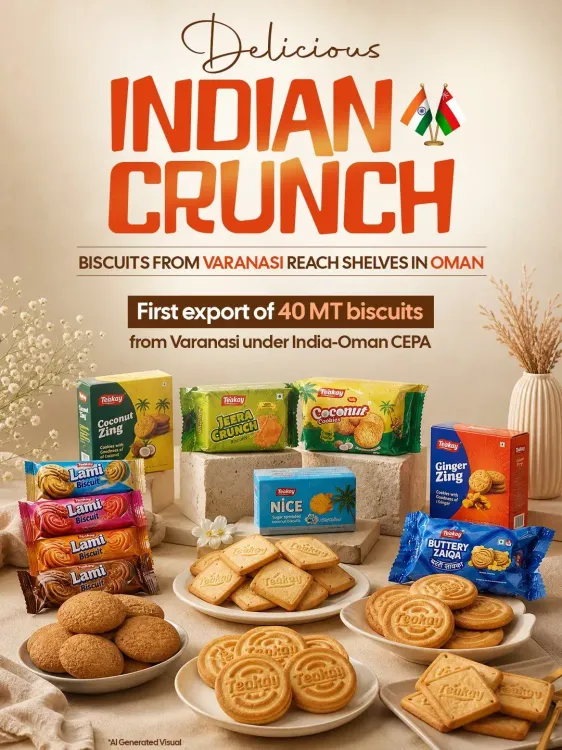
40 MT of biscuits manufactured in Varanasi have been exported to Oman for the first time under the India-Oman CEPA .
An MoU has been signed for the supply of nearly 700 MT of biscuits to Oman and other GCC countries during FY 2026–27 .
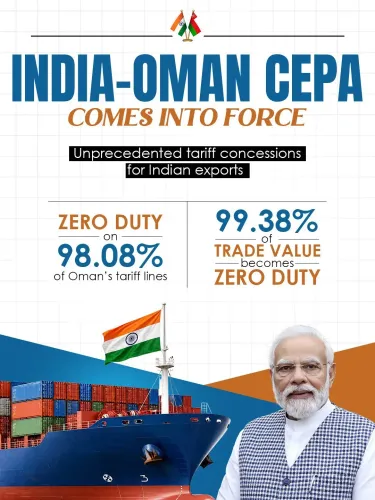
Preferential tariff benefits under the CEPA provide duty-free access for Indian biscuits in the Oman market, improving price competitiveness.
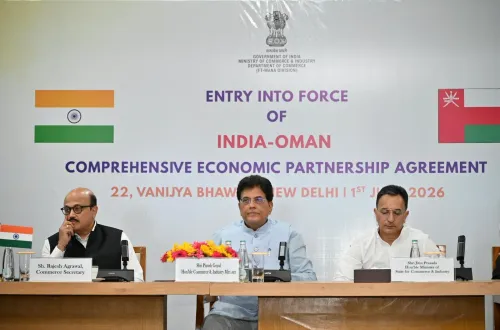
The India-Oman CEPA was signed in May 2023 and entered into force in 2024 , covering processed foods among other categories.
The development is expected to boost production and job generation in India's food-processing sector, particularly for MSME units in Varanasi.
The milestone aligns with PM Modi's Make in India initiative, launched in September 2014, to promote domestically manufactured goods globally.
Union Commerce and Industry Minister Piyush Goyal on Friday, 3 July 2026, announced that biscuits manufactured in Varanasi have been exported to Oman for the first time under the India-Oman Comprehensive Economic Partnership Agreement (CEPA), with an MoU also signed for the supply of nearly 700 metric tonnes (MT) of biscuits to Oman and other Gulf Cooperation Council (GCC) countries during FY 2026–27.
Context
Goyal stated that 40 MT of biscuits produced in Varanasi have been exported to Oman in what he described as a first-of-its-kind shipment under the bilateral trade pact. He framed the development as an advancement of Prime Minister Narendra Modi's vision of taking 'Made In India' products to the world. The minister noted that preferential tariff benefits under the CEPA have enabled duty-free access for Indian-manufactured biscuits, making them 'more price-competitive in comparison to other key competitors in the Oman market.'
Goyal added that the development is 'expected to translate into higher export volumes and repeat orders from importers in the region,' calling it 'clearly a big boost to our food processing sector with increased production and job generation.'
Policy Backdrop
The India-Oman CEPA, signed in May 2023 and entered into force in 2024, grants duty-free or preferential tariff access to a range of Indian goods including processed foods such as biscuits and confectionery. The agreement is part of a broader push by New Delhi to deepen economic ties with Gulf economies and diversify export markets beyond traditional partners.
The CEPA complements the Make in India initiative, launched in September 2014, which targets global promotion of domestically manufactured goods. Production-linked incentive (PLI) schemes for the food-processing sector, introduced from 2021 onward, have further aimed to scale up value-added exports. Varanasi, located in Uttar Pradesh, has seen growing food-processing clusters promoted under these national manufacturing drives.
Stakeholders and Impact
The immediate beneficiaries are food processors and MSME units based in Varanasi that now have preferential access to the Oman market. The duty-free entry removes a cost barrier that had previously made Indian biscuits less competitive against suppliers from other regions in GCC markets. Goyal's post explicitly links the export milestone to job generation and higher production capacity in the food-processing sector.
The GCC — comprising Bahrain, Kuwait, Oman, Qatar, Saudi Arabia, and the United Arab Emirates — is already a significant destination for Indian processed-food exports. The MoU for 700 MT of biscuit supply across the bloc during FY 2026–27 signals an intent to scale the Oman pilot into a broader Gulf footprint for Indian food manufacturers.
What's Next
The key near-term marker will be the execution of the 700 MT supply MoU across Oman and other GCC states through the remainder of FY 2026–27. Successful fulfilment could prompt follow-on orders and encourage other food-processing clusters in India to seek similar preferential-access pathways under existing and forthcoming trade agreements. India is also engaged in ongoing trade negotiations with other Gulf economies, and a positive outcome from this Varanasi-Oman corridor could strengthen the case for expanding similar tariff concessions to additional product categories and partner countries.
Point of View
A specific volume, and a forward-looking MoU, the Commerce Ministry is attempting to demonstrate that CEPAs produce tangible outcomes for domestic manufacturers, not just diplomatic optics. The GCC angle is deliberate: Gulf markets offer scale, proximity, and a large Indian diaspora that creates organic demand for familiar brands. Whether the 700 MT MoU translates into sustained orders — rather than a one-time promotional shipment — will be the real test of whether CEPA-driven food-processing exports can become a durable growth story.
NationPress
3 Jul 2026
Frequently Asked Questions
What is the India-Oman CEPA and how does it help Indian exporters?
The India-Oman Comprehensive Economic Partnership Agreement (CEPA), signed in May 2023 and in force since 2024, grants duty-free or preferential tariff access to Indian goods including processed foods like biscuits, making them more price-competitive in the Oman market compared to suppliers from other countries.
How much has been exported from Varanasi to Oman under the CEPA?
According to Union Minister Piyush Goyal, 40 MT of biscuits manufactured in Varanasi have been exported to Oman under the India-Oman CEPA — described as the first such shipment under the agreement.
What is the MoU signed for biscuit supply to GCC countries?
An MoU has been signed for the supply of nearly 700 MT of biscuits to Oman and other Gulf Cooperation Council (GCC) countries during FY 2026–27, signalling an intent to scale the initial export into a broader Gulf market presence.
Which countries are part of the GCC that India is targeting for biscuit exports?
The Gulf Cooperation Council (GCC) comprises six Arab states: Bahrain, Kuwait, Oman, Qatar, Saudi Arabia, and the United Arab Emirates — all of which are significant destinations for Indian processed-food exports.
How does this export milestone relate to Make in India?
PM Narendra Modi's Make in India initiative, launched in September 2014, aims to promote domestically manufactured goods globally. The Varanasi biscuit export to Oman under duty-free CEPA terms is cited by Minister Piyush Goyal as a direct advancement of this vision.