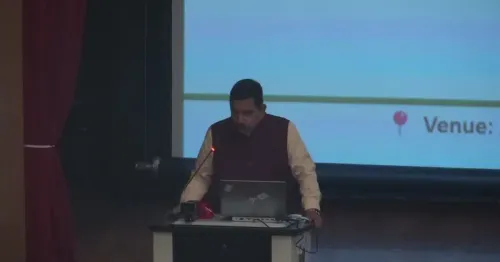
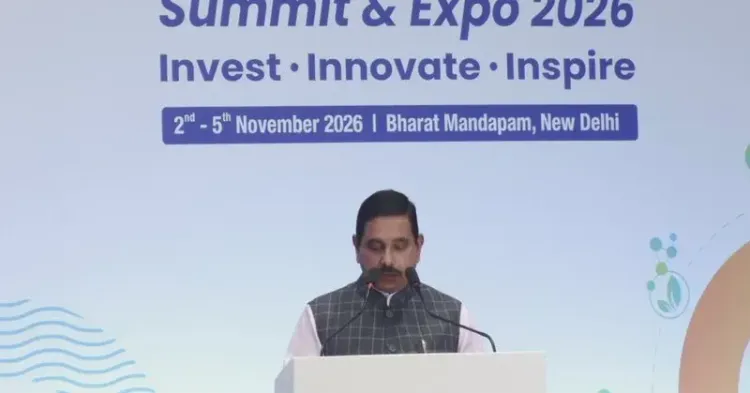
Pralhad Joshi delivers keynote at Denmark Country Session
Synopsis
Union Minister Pralhad Joshi delivered a keynote at the Denmark Country Session on November 3, 2026, spotlighting the India-Denmark Green Strategic Partnership and India's 500 GW renewable energy target by 2030.
Key Takeaways
Union Minister Pralhad Joshi delivered a live keynote at the Denmark Country Session on November 3, 2026 .
The address connects to the India-Denmark Green Strategic Partnership , launched in 2020 to advance clean energy and climate technology cooperation.
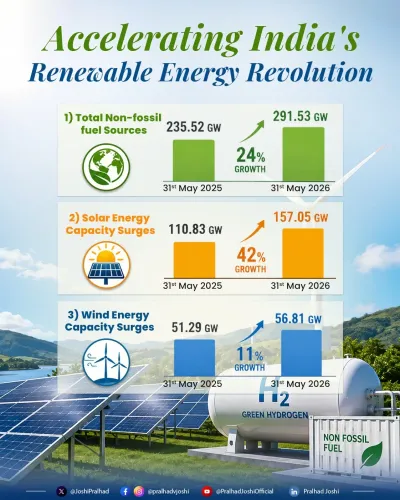
India is targeting 500 GW of non-fossil energy capacity by 2030 and net-zero emissions by 2070 .
Denmark is a key partner for wind energy technology and green hydrogen development with India.
Country-specific sessions routinely precede MoU signings or joint project announcements — outcomes from this address will be watched closely.
Clean energy diplomacy moved to centre stage on Tuesday, November 3, 2026, as Union Minister Pralhad Joshi — who holds the portfolios of Consumer Affairs, Food and Public Distribution, and New and Renewable Energy — took the podium to deliver a keynote address at the Denmark Country Session, signalling the strategic weight New Delhi now places on its Nordic clean-energy partnerships.
The minister confirmed his participation live on X, sharing a broadcast link to the address. Though the specific forum's details remain emerging, the setting — a country-focused session centred on Denmark — points squarely at the India-Denmark Green Strategic Partnership, a bilateral framework the two nations launched in 2020 to accelerate cooperation on wind energy, green hydrogen, and climate technology.
Why Denmark sits at the heart of India's renewables push
Denmark is not a casual partner for India. The Nordic nation is globally recognised for its dominance in wind energy technology, and the 2020 Green Strategic Partnership formalised a relationship that spans clean energy investment, climate research, and policy alignment. Country sessions of this kind are a standard instrument in India's diplomatic toolkit — a structured forum where bilateral project pipelines, technology transfer possibilities, and investment commitments are placed on the table in front of the right audience. For Joshi, this address is a direct extension of his mandate as Minister of New and Renewable Energy. India has set a formidable target: 500 GW of non-fossil energy capacity by 2030, and net-zero emissions by 2070. Closing that gap demands foreign technology, capital, and co-developed projects — and Denmark is one of the partners best positioned to deliver all three.India's 500 GW ambition and what partnerships like this are worth
The numbers governing this moment are enormous. India is already one of the world's top renewable energy markets, and the race to 500 GW non-fossil capacity before the decade ends requires not just domestic policy muscle but sustained international collaboration. Green hydrogen — a sector where India and Denmark have both announced serious national strategies — is one area where joint work could yield commercially viable results at scale. Keynote slots at country-specific bilateral sessions carry real downstream consequence. They often precede or accompany the signing of MoUs, joint project announcements, or the launch of technical working groups. Whether Tuesday's address produced any such commitments is the question the renewable energy sector will be watching closely in the hours that follow. India's clean-energy story is no longer just a domestic policy ambition — it is a live international negotiation, and today Joshi carried it to one of Europe's most credible green-economy forums.Point of View
Not just a domestic infrastructure brief. The India-Denmark partnership has quietly matured since 2020; a keynote at this level could be a precursor to tangible MoUs or project announcements that move the needle on green hydrogen. The timing, as India approaches the mid-point of its 2030 capacity targets, makes any credible international commitment politically and commercially significant.
NationPress
3 Nov 2026
Frequently Asked Questions
What is the India-Denmark Green Strategic Partnership?
The India-Denmark Green Strategic Partnership was launched in 2020 to deepen collaboration on renewable energy, green hydrogen, and climate technology between the two countries.
What is India's renewable energy target by 2030?
India has set a target of 500 GW of non-fossil fuel energy capacity by 2030 , alongside a net-zero emissions goal by 2070 .
Why did Pralhad Joshi attend the Denmark Country Session?
As Union Minister of New and Renewable Energy , Joshi delivered the keynote to advance India's clean energy diplomacy and strengthen bilateral ties with Denmark, a global leader in wind energy.
What could follow from Joshi's keynote at the Denmark session?
Country-specific bilateral sessions of this kind often precede the signing of MoUs, joint project launches, or the formation of technical working groups — the renewable energy sector is watching for follow-up announcements.
What makes Denmark a key partner for India's energy goals?
Denmark is globally recognised for wind energy technology and has co-developed a green hydrogen strategy, making it one of the most capable partners for India's 500 GW non-fossil capacity ambition.