Punjab Police marks 481 days of Yudh Nashian Virudh drive
Synopsis
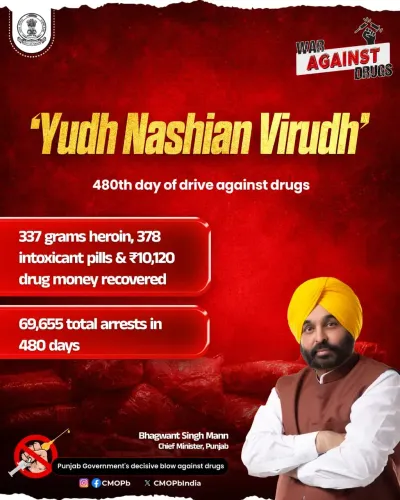
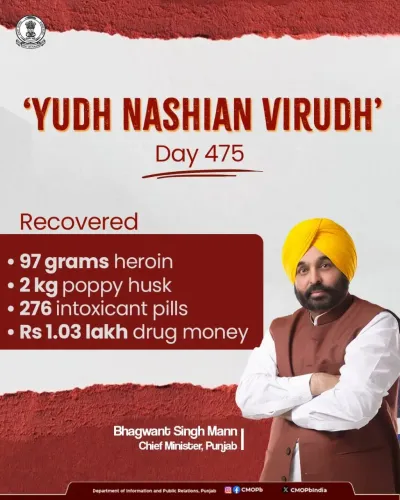
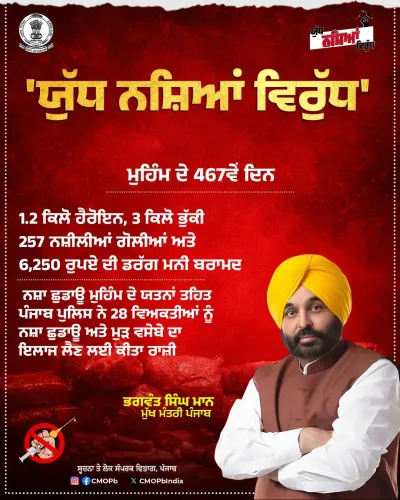
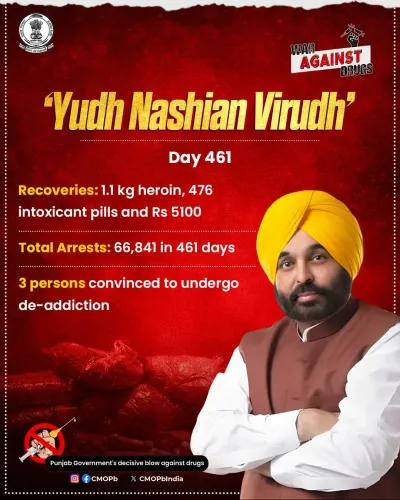
Punjab Police's Yudh Nashian Virudh anti-narcotics drive completed 481 days on 25 June 2026, recovering 1.5 kg heroin and 2,346 intoxicant pills in the latest sweep. Cumulative arrests have reached 69,987, while 14 persons were referred for de-addiction treatment on the same day.
Key Takeaways
481 consecutive days of the Yudh Nashian Virudh anti-drug campaign were reported by the Chief Minister's Office of Punjab on 25 June 2026 .
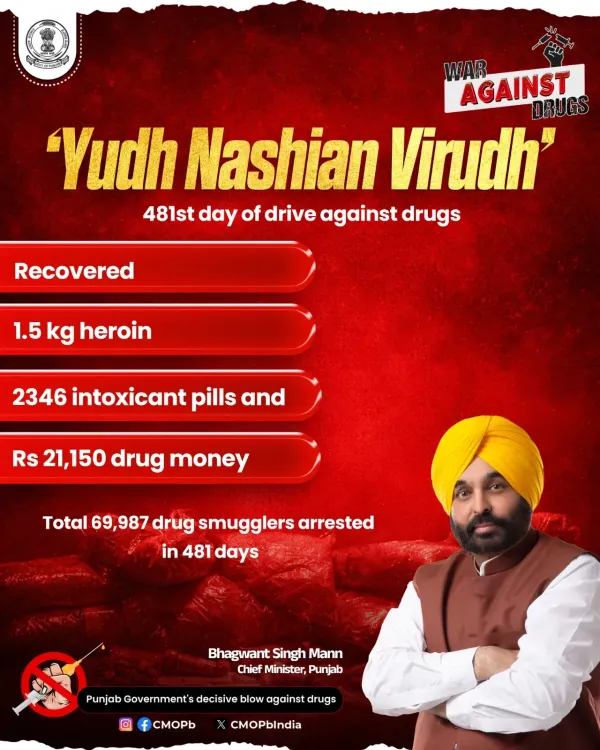
Day-481 recoveries include 1.5 kg heroin , 2,346 intoxicant pills , and Rs 21,150 in drug money.
Total drug smugglers arrested since the campaign began stands at 69,987 .
14 persons were convinced to undergo voluntary de-addiction and rehabilitation treatment on the same day.
The campaign combines daily enforcement raids with a structured rehabilitation referral component targeting Punjab's long-standing drug crisis.
Cross-border smuggling routes linked to the Pakistan border remain a structural challenge underlying Punjab's narcotics problem.
The Chief Minister's Office of Punjab announced on Thursday, 25 June 2026 that the state's ongoing anti-narcotics campaign Yudh Nashian Virudh has entered its 481st consecutive day, with fresh recoveries of 1.5 kg heroin, 2,346 intoxicant pills, and Rs 21,150 in drug money from arrested smugglers.
Context
Punjab Police teams continued their daily enforcement sweep under the campaign, whose name translates from Punjabi as 'Yudh Nashian Virudh' ('War Against Drugs'). The day's operations led to fresh arrests of drug smugglers, from whose possession the recovered contraband and cash were seized. As part of the drive's rehabilitation arm, police convinced 14 persons to voluntarily undergo de-addiction and rehabilitation treatment on the same day.
The cumulative toll since the campaign began stands, per the official post, at 69,987 drug smugglers arrested over 481 days — an average of roughly 145 arrests per day. The CMO's daily bulletin format underscores the state government's intent to keep the operation in public view through consistent, granular reporting.
Policy Backdrop
Punjab has faced a documented and persistent drug crisis for decades, with heroin and synthetic narcotics flowing through smuggling corridors linked to the state's long border with Pakistan. Successive state governments since the 1980s have launched enforcement drives, but the underlying supply and demand dynamics have proved difficult to dismantle durably.
The current campaign, Yudh Nashian Virudh, combines traditional law-enforcement raids with a structured de-addiction referral component — a design that distinguishes it, at least in stated intent, from purely punitive earlier drives. Daily public disclosures of arrest and seizure figures are a deliberate accountability mechanism, making the campaign's progress trackable in near-real time.
Stakeholders and Impact
Punjab's youth and border communities remain the population most directly affected by both the drug crisis and the enforcement response. Families of addicts stand to benefit from the rehabilitation referral component: the 14 persons convinced to seek treatment on day 481 represent a small but consistent daily increment to the de-addiction pipeline.
Drug smugglers and trafficking networks face sustained operational pressure, with the cumulative arrest figure suggesting significant disruption to mid- and street-level distribution. However, analysts who study Punjab's narcotics problem note that supply resilience — rooted in cross-border routes — means enforcement alone rarely eliminates the trade.
What's Next
The state government is expected to continue daily bulletins as the campaign progresses beyond its 481-day milestone. Consolidated monthly seizure and rehabilitation statistics from Punjab Police will offer a clearer picture of cumulative impact on both supply reduction and recovery outcomes.
Scrutiny in the Punjab Legislative Assembly — including questions on budget allocations for de-addiction centres and the long-term recidivism rates of referred individuals — will test whether the campaign's rehabilitation arm is scaling alongside its enforcement numbers. The state's ability to sustain both tracks simultaneously will define the drive's legacy beyond headline arrest counts.
Point of View
The state administration keeps its anti-drug commitment visible and measurable in ways that periodic announcements cannot. The cumulative arrest figure of nearly 70,000 is politically significant, signalling scale, but the more telling metric over time will be whether de-addiction referrals — currently reported in single digits daily — grow proportionally. Punjab's drug crisis has outlasted multiple enforcement surges across political regimes, suggesting that the campaign's durability and its rehabilitation pipeline, not just its arrest tallies, will determine its place in the state's long policy arc on narcotics.
NationPress
26 Jun 2026
Frequently Asked Questions
What is Yudh Nashian Virudh?
Yudh Nashian Virudh is Punjab's ongoing state-run anti-narcotics campaign, combining daily police enforcement raids against drug smugglers with a de-addiction referral programme for users. The name translates from Punjabi as 'War Against Drugs.'
How many drug smugglers have been arrested in Punjab's anti-drug drive?
According to the Chief Minister's Office of Punjab, a total of 69,987 drug smugglers have been arrested since the Yudh Nashian Virudh campaign began, as of its 481st day on 25 June 2026 .
What drugs were seized on day 481 of the Punjab anti-drug campaign?
On the 481st day of Yudh Nashian Virudh, Punjab Police recovered 1.5 kg of heroin , 2,346 intoxicant pills , and Rs 21,150 in drug money from arrested smugglers.
Does the Punjab anti-drug drive include rehabilitation?
Yes. Alongside enforcement, Punjab Police has a de-addiction component under which officers convince arrested or identified individuals to voluntarily enter rehabilitation. On day 481, 14 persons were referred for de-addiction and rehabilitation treatment.
Why is Punjab particularly affected by drug trafficking?
Punjab shares a long border with Pakistan, which has historically served as a conduit for heroin and synthetic drug smuggling into India. Decades of cross-border trafficking have created entrenched supply networks and high rates of domestic drug consumption, particularly among the state's youth.