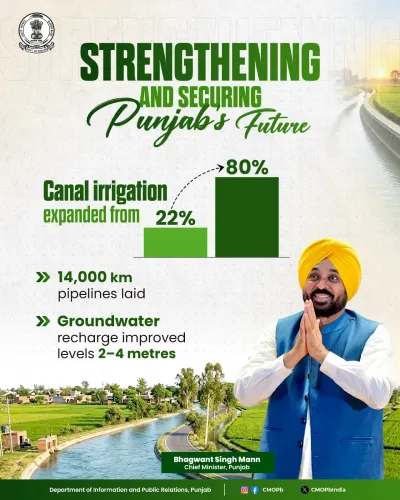
CM Mann's Punjab Delivers 21,000 Cusecs, Raises Water Table
Synopsis
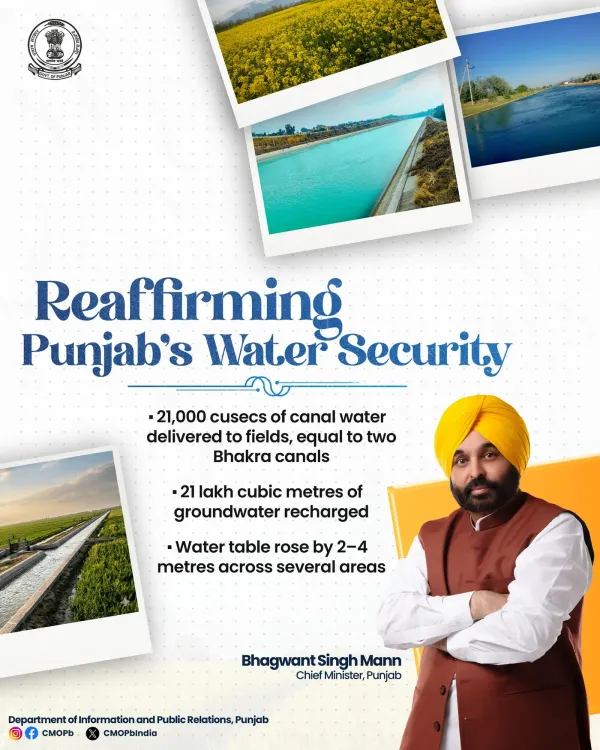
The Chief Minister's Office of Punjab says the Mann government has channelled 21,000 cusecs of canal water — equal to two Bhakra canals — to fields and recharged 21 lakh cubic metres of groundwater, pushing the water table up by 2 to 4 metres in several areas.
Key Takeaways
21,000 cusecs of canal water delivered to agricultural fields, equivalent to two Bhakra canals.
Sustained environmental efforts recharged 21 lakh cubic metres of groundwater.
Water table has risen by 2 to 4 metres in several areas of Punjab.
Effort is anchored in the existing Bhakra Nangal canal network , built in the 1960s.
Intervention follows decades of aquifer depletion driven by tubewell-dependent rice-wheat farming.
Independent verification through Central Ground Water Board seasonal assessments is awaited.
The Chief Minister's Office of Punjab announced on Saturday, 30 May 2026 that the state government, led by Chief Minister Bhagwant Mann, has delivered 21,000 cusecs of canal water to agricultural fields — a volume equivalent to the combined flow of two Bhakra canals — while simultaneously recharging 21 lakh cubic metres of groundwater through sustained environmental efforts.
What the Government Claims
According to the official post, the twin interventions have produced a measurable rise of 2 to 4 metres in the water table across several areas of the state. The government credited coordinated canal-water irrigation and groundwater conservation initiatives for the improvement. The delivery of 21,000 cusecs — benchmarked against the familiar scale of the Bhakra canal network — is presented as a signal of the administration's intent to shift irrigation demand away from tubewells and back toward surface water.
Context: Decades of Aquifer Depletion
Punjab has faced one of India's most acute groundwater crises, driven by a water-intensive rice-wheat cropping cycle and decades of subsidised electricity that made tubewell pumping economically frictionless for farmers. The Central Ground Water Board has documented progressive aquifer depletion across the state's over-exploited blocks since the 1990s, making any measurable reversal in water-table levels a significant development.
The Bhakra Nangal project, completed in the 1960s, created the canal infrastructure that still underpins surface irrigation in Punjab. For years, under-utilisation of this network — alongside unchecked tubewell expansion — accelerated the groundwater decline. Reviving canal-water delivery is therefore not a new idea, but the scale claimed here is notable.
Policy Backdrop
The Punjab Preservation of Subsoil Water Act, 2009 was an early legislative attempt to reduce groundwater stress by delaying paddy transplantation, thereby cutting early-season pumping. The Bhagwant Mann government's current push layers canal-water delivery and active recharge measures on top of that regulatory foundation. The approach aligns with a broader national pattern of states trying to balance agricultural water demand against long-term aquifer sustainability.
Punjab also sits within the contested Indus basin, where inter-state river-water sharing disputes — particularly over the Sutlej-Yamuna Link canal — have historically constrained how much surface water can be allocated to in-state irrigation. Any sustained increase in canal-water delivery therefore carries both agronomic and political significance.
Stakeholders and Impact
The primary beneficiaries are Punjab's farming communities, who depend on reliable irrigation for the kharif and rabi cycles. A rise of 2 to 4 metres in the water table, if sustained, would reduce the cost and energy burden of tubewell operation — a direct economic relief for small and marginal farmers who bear those electricity costs even under subsidy regimes. Environmental groups and water-policy researchers will watch whether the gains hold across successive crop seasons.
What's Next
The next seasonal water-table assessments by the Central Ground Water Board will provide an independent benchmark against the government's claims. State budget announcements on canal lining, recharge infrastructure, and tubewell regulation will indicate whether this initiative is being institutionalised or remains a one-season push. If the water-table recovery proves durable, it could become a replicable model for other groundwater-stressed states in the Indo-Gangetic Plain.
Point of View
Framing canal-water revival as both an agronomic fix and a political credential ahead of future electoral cycles. By benchmarking delivery against the iconic Bhakra canal, the CMO is signalling scale to a farming constituency that understands that reference intuitively. However, the figures cited — water-table rises of 2 to 4 metres across 'several areas' — remain government claims pending independent seasonal assessments, and the durability of the gains will depend on whether canal lining and recharge infrastructure receive sustained budget backing. The broader significance lies in whether Punjab can institutionalise this shift away from tubewell dependence, a structural challenge that has outlasted multiple state governments.
NationPress
13 Oct 2026
Frequently Asked Questions
How much canal water has Punjab delivered to farms in 2026?
The Punjab government says it has delivered 21,000 cusecs of canal water to agricultural fields, a volume it describes as equivalent to the combined flow of two Bhakra canals.
Has Punjab's groundwater level actually risen?
The Chief Minister's Office claims the water table has risen by 2 to 4 metres in several areas following the recharge of 21 lakh cubic metres of groundwater, though independent verification by the Central Ground Water Board is pending.
What is the Bhakra canal and why is it used as a benchmark?
The Bhakra Nangal project , completed in the 1960s, is Punjab's most significant irrigation infrastructure and a widely recognised reference point for surface-water flow, making it an intuitive benchmark for farmers and policymakers.
Why is groundwater depletion such a serious problem in Punjab?
Punjab's rice-wheat cropping cycle is highly water-intensive, and decades of subsidised electricity made tubewell pumping economically attractive, leading the Central Ground Water Board to classify many of Punjab's blocks as 'over-exploited' since the 1990s.
What law exists in Punjab to protect groundwater?
The Punjab Preservation of Subsoil Water Act, 2009 delays paddy transplantation to reduce early-season groundwater pumping, forming the legislative backbone of the state's groundwater conservation framework.