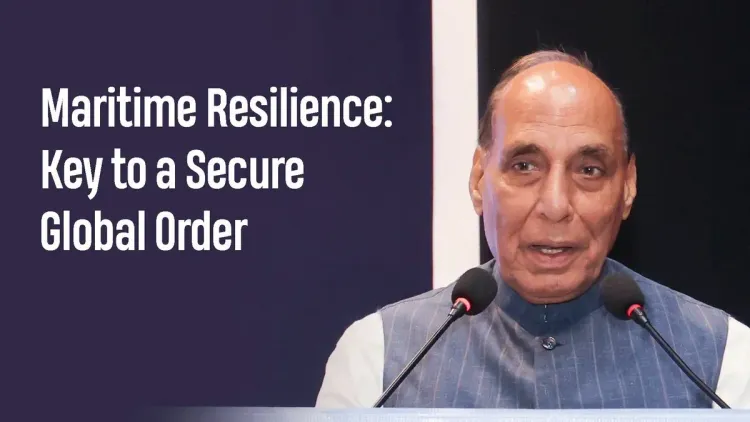
Rajnath Singh: Maritime Resilience Key to Global Order
Synopsis
Union Defence Minister Rajnath Singh on November 4, 2026 declared that maritime resilience is essential to the global order, warning that disruptions to sea routes and freedom of navigation threaten global stability and that retreating from globalisation offers no solution.
Key Takeaways
Rajnath Singh posted on November 4, 2026 that the security of the global order is 'increasingly linked to the resilience of the maritime domain.' He identified global trade, energy supplies, and digital connectivity as the three pillars dependent on open oceans.
Singh explicitly rejected retreat from globalisation as a response to maritime disruptions.
India's SAGAR doctrine (2015) and Maritime Security Strategy 2015 form the policy backbone behind his remarks.
India participates in key maritime security forums including the Quad , Indian Ocean Naval Symposium , and exercises such as Malabar and Milan .
The statement signals India's intent to remain a proactive maritime security provider in the Indo-Pacific , not a bystander.
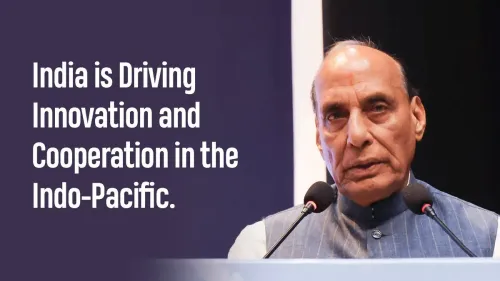
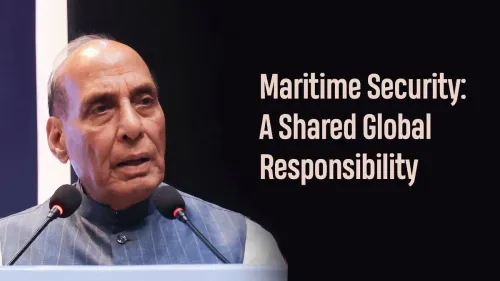
The world's oceans carry its trade, its energy, and its data — and Union Defence Minister Rajnath Singh wants the world to know that abandoning them to disorder is not an option. On Wednesday, November 4, 2026, Singh posted a sharp, globally-pitched statement on X, arguing that maritime resilience — not retreat from globalisation — is the only credible response to mounting threats on the high seas.
The case Singh is making: oceans as the backbone of civilisation
Singh's statement is blunt in its framing: 'The security of the global order is increasingly linked to the resilience of the maritime domain.' He ticks off exactly what is at stake — global trade, energy supplies, and digital connectivity — before landing on the core warning: 'Disruptions to maritime routes and freedom of navigation threaten global stability.'
The final line is a deliberate rebuttal of an increasingly audible argument in some quarters: that nations should simply wall themselves off from an unstable global system. Singh's answer is unequivocal — 'Retreating from globalisation is not the answer.'
SAGAR doctrine and India's rules-based maritime posture
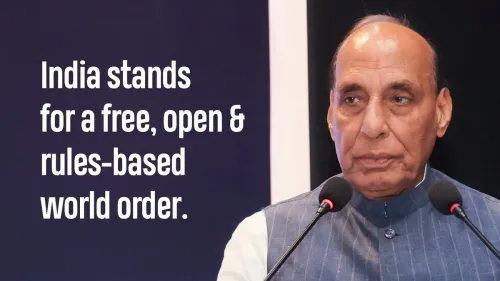
Singh's remarks sit squarely within a policy line that New Delhi has held since at least 2015. Prime Minister Narendra Modi's SAGAR doctrine — Security and Growth for All in the Region — framed open sea lanes as inseparable from regional prosperity. India's Maritime Security Strategy 2015 had already designated protection of sea lanes of communication and energy routes in the Indian Ocean Region as a core national interest.
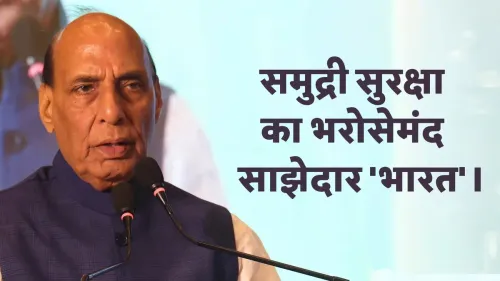
India has since reinforced that posture through multilateral formats — the Quad, the Indian Ocean Naval Symposium, and bilateral exercises such as Malabar and Milan — while expanding its own blue-water naval capabilities. Singh's post is consistent with that institutional momentum: it signals that India has no intention of stepping back from its self-assigned role as a net security provider in the Indo-Pacific.
Why freedom of navigation is a live political question in 2026
The language Singh uses — 'freedom of navigation,' 'maritime routes,' 'resilience' — is not incidental. These are the precise pressure points where regional tensions and global supply-chain anxieties intersect. Choke points from the Red Sea to the Strait of Malacca have faced recurring disruptions, and the economic consequences have rippled far beyond the shipping industry.
For India, a country that depends on seaborne routes for the overwhelming bulk of its energy imports and merchandise trade, the stakes are not abstract. A naval power that projects stability in the Indian Ocean is also protecting its own economic lifeline — and Singh, in a single post, makes that strategic logic explicit for a global audience.
What to watch after this signal
Statements at this register from a sitting Defence Minister typically precede or accompany concrete action — whether that is a fresh Maritime Domain Awareness initiative, a multilateral exercise announcement, or a parliamentary statement on naval readiness. The coming weeks, including outcomes of any scheduled Malabar or Milan naval exercises, will indicate whether this post marks a rhetorical moment or the opening of a broader policy move.
Either way, Singh has planted a flag: India's answer to an unstable maritime world is deeper engagement, not withdrawal — and New Delhi expects its partners to hold that line too.
Point of View
Energy, and digital infrastructure, Singh elevates maritime security from a defence brief into an economic-sovereignty argument, making the case harder to dismiss as military expansionism. The statement also keeps India aligned with Quad partners who face the same pressure to justify forward naval engagement. Watch for follow-through: if concrete initiatives — exercises, domain-awareness agreements, parliamentary statements — do not materialise in coming weeks, the post will read as positioning rather than policy.
NationPress
4 Nov 2026
Frequently Asked Questions
What did Rajnath Singh say about maritime security in November 2026?
On November 4, 2026 , Rajnath Singh stated that the security of the global order is increasingly linked to maritime resilience, warned that disruptions to sea routes threaten global stability, and argued that retreating from globalisation is not the answer.
What is India's SAGAR doctrine?
SAGAR stands for 'Security and Growth for All in the Region' — a maritime doctrine articulated by Prime Minister Narendra Modi in 2015 that frames open sea lanes and Indian Ocean stability as inseparable from regional economic prosperity.
Why does India care about freedom of navigation?
India depends on seaborne routes for the vast majority of its energy imports and merchandise trade, making open sea lanes a direct economic and national-security interest, not merely a diplomatic position.
What forums does India use to promote maritime security?
India engages in maritime security through the Quad , the Indian Ocean Naval Symposium , and bilateral and multilateral naval exercises such as Malabar and Milan .
What could follow Rajnath Singh's maritime resilience statement?
Statements at this level from a Defence Minister often precede concrete action — analysts will watch for Maritime Domain Awareness initiatives, new naval exercise announcements, or a parliamentary statement on India's maritime readiness in the weeks ahead.