Rajnath Singh meets Czech VP Havlicek on defence JVs
Synopsis
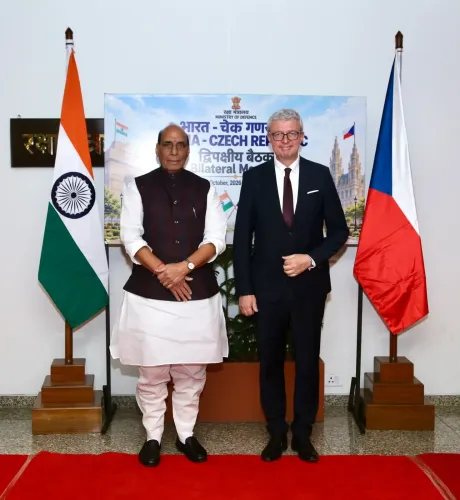
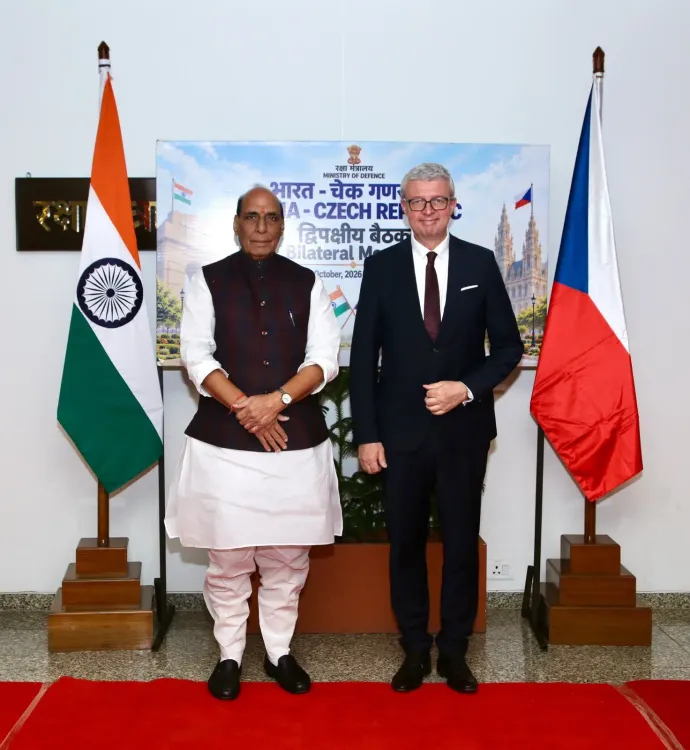
Union Defence Minister Rajnath Singh met Czech Vice PM Karel Havlicek in New Delhi on October 13, 2026, reviewing defence joint ventures and agreeing to expand cooperation under the India-Czech Joint Defence Committee to advance Atmanirbhar Bharat indigenisation goals.
Key Takeaways
Rajnath Singh met Czech VP and Industry Minister Karel Havlicek in New Delhi on October 13, 2026 .
Both sides reviewed 'the entire spectrum of Defence Industrial Cooperation' and noted progress in Joint Ventures.
The two ministers agreed to further expand collaboration through the India-Czech Joint Defence Committee .
The meeting is framed within India's Atmanirbhar Bharat initiative, launched in May 2020 , to boost indigenous defence manufacturing.
Czech firms have engaged in joint ventures in areas such as aerospace components and small arms with Indian partners.
India has increasingly pursued European defence industrial partnerships to diversify suppliers and meet indigenisation targets.
With Central European industrial muscle now firmly in view, Union Defence Minister Rajnath Singh sat down with Czech Republic Vice Prime Minister and Minister of Industry and Trade Karel Havlicek in New Delhi on Tuesday, October 13, 2026 — reviewing a bilateral defence partnership that stretches back decades and is now being reshaped for the Atmanirbhar Bharat era.
Joint ventures, joint ambitions
Singh described the talks as covering 'the entire spectrum of Defence Industrial Cooperation,' with both sides expressing satisfaction at the 'progress and success of various Joint Ventures.' The two ministers agreed to deepen collaboration specifically through the India-Czech Joint Defence Committee — the formal bilateral mechanism that oversees joint projects and tracks indigenisation milestones. The framework gives both governments a structured channel to move from intent to contract without starting from scratch at every meeting.
The Czech Republic brings a storied industrial tradition to the table. Prague's ties to India's defence sector trace back to the Cold War era, when Eastern Bloc supply chains fed Indian military procurement. Today, Czech firms have pivoted toward joint manufacturing in areas including aerospace components and small arms — precisely the kind of high-value, transferable production that India's defence corridors in Uttar Pradesh and Tamil Nadu are designed to absorb.
Atmanirbhar Bharat's European pivot
The Atmanirbhar Bharat initiative, announced in May 2020, set an ambitious target: convert India from the world's largest arms importer into a significant domestic manufacturer and, eventually, a net exporter. Defence indigenisation sits at the core of that goal, and European partnerships have become a key lever. By anchoring joint ventures with technologically advanced partners — rather than simply purchasing finished platforms — India gains intellectual property, trained workforces, and supply-chain depth it could not build through imports alone.
Singh has been one of the most active drivers of this strategy, using ministerial-level meetings to lock in commitments that translate into factory floors and production licences. The Czech meeting follows a broader pattern of India courting mid-size European defence economies — nations with specialised capabilities and fewer geopolitical complications than the largest Western arms suppliers — to diversify its industrial base.
What the India-Czech Joint Defence Committee will be watching
The immediate test is whether the goodwill expressed in New Delhi converts into fresh announcements at the next session of the Joint Defence Committee. Both governments will be measuring progress against actual joint-venture output: components manufactured, technology transferred, and orders placed with Indian firms. A bilateral meeting at vice-prime-ministerial level signals that Prague, too, is treating the India relationship as a strategic industrial priority — not a peripheral trade call.
Havlicek's dual mandate — overseeing both industry and trade — means the conversation almost certainly extended beyond defence hardware into the broader economic partnership, even if Singh's post focused on the defence dimension. That overlap is deliberate: the most durable defence partnerships are the ones embedded in a wider commercial relationship that survives government changes on both sides.
The Joint Defence Committee's next moves will tell the real story — and the world's largest defence-import market turning manufacturer is a story no serious industrial nation can afford to miss.
Point of View
Using the Atmanirbhar Bharat framework as both policy cover and commercial incentive. By engaging a vice-prime-ministerial counterpart who controls industrial policy — not just a defence procurement official — India is signalling that it wants Czech industrial capability, not just Czech hardware. The structured India-Czech Joint Defence Committee gives both sides an accountability mechanism that outlasts any single meeting. Watch whether the next committee session produces concrete joint-venture announcements: that is the metric that separates diplomatic goodwill from industrial transformation.
NationPress
13 Oct 2026
Frequently Asked Questions
Why did Rajnath Singh meet Czech VP Karel Havlicek?
Singh and Havlicek met in New Delhi on October 13, 2026 to review defence industrial cooperation, assess the progress of ongoing joint ventures, and agree to expand collaboration under the India-Czech Joint Defence Committee within the Atmanirbhar Bharat framework.
What is the India-Czech Joint Defence Committee?
It is a bilateral institutional mechanism established to oversee defence industrial collaboration and joint projects between India and the Czech Republic, providing a structured channel for tracking indigenisation milestones and new joint venture commitments.
How does this meeting relate to Atmanirbhar Bharat?
Atmanirbhar Bharat, launched in May 2020, aims to make India self-reliant in defence manufacturing. Partnerships with Czech firms — involving technology transfer and co-production rather than simple imports — directly support that indigenisation goal.
What areas do India and Czech Republic cooperate on in defence?
Czech firms have participated in joint ventures with Indian partners in areas including aerospace components and small arms, with both governments seeking to deepen manufacturing collaboration across the defence sector.
Who is Karel Havlicek?
Karel Havlicek is a Czech politician serving as Vice Prime Minister and Minister of Industry and Trade of the Czech Republic, with a background in bilateral economic and industrial engagement with India.