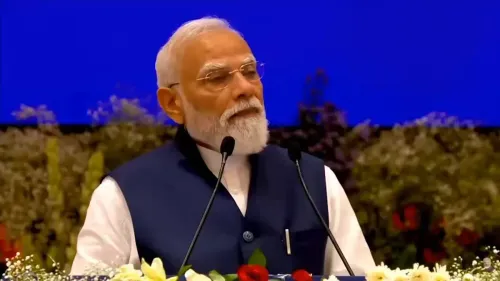
Rijiju Shares Modi Quote on Congress vs NDA Growth Rate
Synopsis
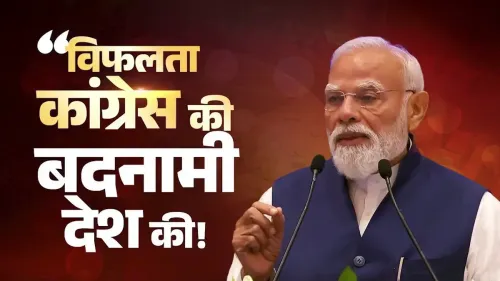
Union Parliamentary Affairs Minister Kiren Rijiju shared a quote from PM Narendra Modi on X, asking why decades under Congress saw less progress than 12 years of NDA rule. The post, tagged #LongestServingElectedPMModi, sharpens the BJP's core economic contrast ahead of parliamentary debates on growth data.
Key Takeaways
Union Parliamentary Affairs Minister Kiren Rijiju posted on June 10, 2026 , amplifying a quote from PM Narendra Modi on X.
The quote contrasts development achieved in 12 years of NDA rule against 'decades' of Congress governance.
Modi's words frame the difference as the gap between the 'Congress growth rate' and the 'NDA growth rate.' The post carries the hashtag #LongestServingElectedPMModi , marking Modi's record as India's longest-serving elected Prime Minister.
The BJP has consistently used this Congress-vs-NDA growth narrative in parliamentary sessions and election campaigns since 2014 .
Upcoming quarterly GDP data and the Economic Survey are expected to fuel further debate on these competing growth claims.
Union Parliamentary Affairs Minister Kiren Rijiju on Wednesday, June 10, 2026, shared a quote attributed to Prime Minister Narendra Modi on X, contrasting economic progress under the National Democratic Alliance (NDA) with the pace of development during decades of Congress rule, using the hashtag #LongestServingElectedPMModi.
Context
The post quotes Prime Minister Modi as asking: 'सवाल ये है कि अगर 12 साल में इतना कुछ हो सकता है तो फिर दशकों तक क्यों नहीं हुआ?' — translated as, 'The question is: if so much could be achieved in 12 years, why did it not happen for decades?' The quote then frames the contrast as the difference between the 'Congress growth rate' and the 'NDA growth rate.'
Rijiju's post amplifies the Prime Minister's framing directly, positioning the remark as a pointed rhetorical challenge to the opposition's record on economic governance. The accompanying hashtag highlights Modi's status as the longest-serving elected Prime Minister of India.
Policy Backdrop
The NDA government, in power since May 2014, has consistently drawn comparisons between its tenure and the preceding UPA period (2004–2014) led by the Indian National Congress, particularly on metrics such as GDP growth, infrastructure creation, and policy reforms. Key milestones cited by the NDA include the rollout of the Goods and Services Tax (GST) in July 2017, which unified India's indirect tax structure, and a sustained push on infrastructure spending.
The Congress, for its part, points to the 1991 economic liberalisation under Prime Minister P.V. Narasimha Rao as the foundational reform that dismantled the licence raj and opened India to foreign investment — framing that legacy as the bedrock on which subsequent growth was built. This back-and-forth has become a recurring feature of Indian parliamentary and electoral discourse.
Stakeholders and Impact
The messaging targets Indian voters and economic commentators ahead of parliamentary sessions where budget debates and economic surveys are expected to renew scrutiny of growth data. Senior BJP leaders sharing such quotes from the Prime Minister serves to reinforce the party's central economic narrative across social media platforms.
For economic analysts, the framing raises questions about the methodology of comparing growth rates across different global economic cycles, commodity price environments, and base effects — though the post itself does not cite specific figures.
What's Next
Quarterly GDP releases by the Ministry of Statistics and the upcoming Economic Survey will be closely watched as data points that both the NDA and opposition will deploy in parliamentary debates. The hashtag campaign around Modi's tenure milestone suggests the BJP intends to sustain this comparative narrative through the current political cycle, with senior ministers like Rijiju playing an active amplification role on social media.
Point of View
Ensuring a quote reaches beyond Modi's own feed into party-aligned audiences. The 'Congress growth rate vs NDA growth rate' framing is not new — it has been the BJP's most durable economic talking point since 2014 — but its deployment under the #LongestServingElectedPMModi banner signals an effort to tie Modi's longevity in office directly to a tangible development argument. The absence of specific figures in the post is deliberate: the rhetorical question format invites emotional resonance over statistical scrutiny. As the next parliamentary session approaches, expect this narrative to sharpen into data-backed claims when the Economic Survey and GDP prints provide fresh ammunition for both sides.
NationPress
24 Sept 2026
Frequently Asked Questions
What did Kiren Rijiju post on X on June 10 2026?
Kiren Rijiju shared a quote from Prime Minister Narendra Modi contrasting the development achieved in 12 years of NDA rule with the slower pace seen over decades of Congress governance, using the hashtag #LongestServingElectedPMModi.
What does 'Congress growth rate vs NDA growth rate' mean?
The phrase, attributed to PM Modi in Rijiju's post, is a rhetorical contrast arguing that India's pace of economic development and infrastructure creation accelerated significantly under the NDA after 2014 compared to the preceding decades dominated by Congress-led governments.
Why is Modi called the longest-serving elected Prime Minister of India?
Narendra Modi has served consecutive terms as Prime Minister since May 2014, making him the longest-serving elected Prime Minister in India's history, surpassing the tenures of other elected PMs — a milestone the BJP has highlighted with the hashtag #LongestServingElectedPMModi.
What is the NDA's economic record compared to Congress?
The NDA government has pointed to GDP growth, infrastructure spending, the GST rollout in 2017, and various welfare schemes as markers of accelerated development since 2014, while the Congress cites the 1991 liberalisation reforms as the foundational economic transformation of modern India.
What economic data will be watched after this post?
Quarterly GDP releases by the Ministry of Statistics and the upcoming Economic Survey are the key data points that both the ruling NDA and the opposition Congress are expected to use in parliamentary debates to support their respective growth narratives.