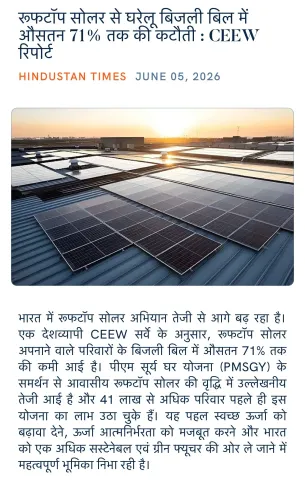
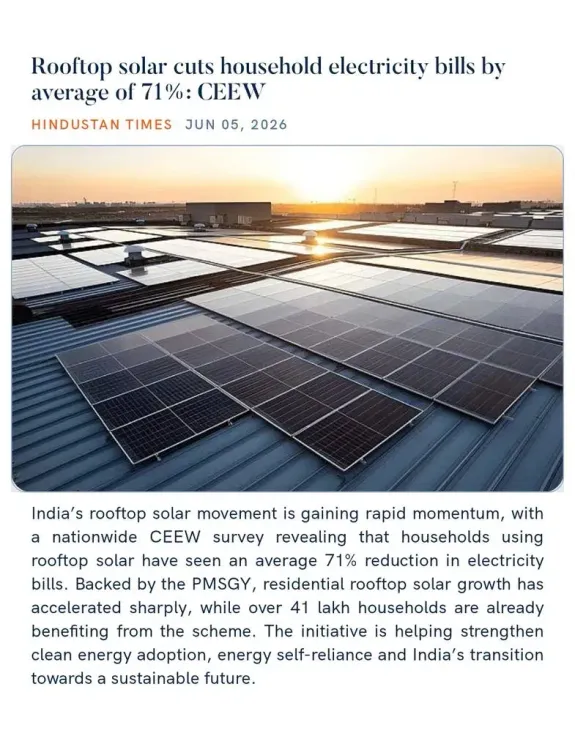
Joshi Highlights CEEW Study: Rooftop Solar Cuts Bills by 71%
Synopsis
Union Minister Pralhad Joshi on World Environment Day amplified a CEEW finding that rooftop solar cuts household electricity bills by an average of 71 per cent, lending independent research weight to the government's PM Surya Ghar Muft Bijli Yojana targeting one crore residential installations.
Key Takeaways
CEEW research cited by Minister Pralhad Joshi finds rooftop solar reduces household electricity bills by an average of 71 per cent .
The minister shared the finding on World Environment Day, June 5, 2026 via the NaMo App.
The PM Surya Ghar Muft Bijli Yojana , launched in 2024 with a Rs 75,021 crore outlay, targets rooftop solar on one crore households .
India's rooftop solar capacity has grown to over 15 GW by 2025 , up from a few hundred MW in 2014.
The scheme promises up to 300 units of free electricity per month through central financial assistance and net-metering.
India aims for 500 GW non-fossil fuel capacity by 2030 and net-zero emissions by 2070 .
Union Consumer Affairs and New and Renewable Energy Minister Pralhad Joshi on Friday, June 5, 2026 shared a study by the Council on Energy, Environment and Water (CEEW) finding that rooftop solar installations cut household electricity bills by an average of 71 per cent, amplifying the data point via the NaMo App on the occasion of World Environment Day.
Context
The CEEW finding, cited by the minister, points to significant financial relief for households that have adopted rooftop solar systems. A 71 per cent average reduction in electricity bills represents a substantial saving for Indian families, particularly those in states with high per-unit tariffs. The minister's decision to amplify the study signals the government's intent to use independent research to build public confidence in residential solar adoption.
The post comes on World Environment Day, a date the Union government has consistently used to highlight India's renewable energy milestones and climate commitments.
Policy Backdrop
The data point directly supports the government's flagship PM Surya Ghar Muft Bijli Yojana, notified in 2024 with a budgetary outlay of Rs 75,021 crore. The scheme targets rooftop solar installations on one crore households and promises up to 300 units of free electricity per month through central financial assistance and net-metering arrangements.
India's rooftop solar capacity has grown from a few hundred megawatts in 2014 to over 15 GW by 2025, driven by successive policy interventions including the Jawaharlal Nehru National Solar Mission (launched 2010) and a revised target of 40 GW rooftop solar announced under the National Solar Mission in 2015. Independent research bodies such as CEEW have been regularly cited by ministries to substantiate bill-saving claims and justify continued budgetary support for the sector.
Stakeholders and Impact
For electricity consumers, particularly middle-income and lower-middle-income households, a near-three-quarter reduction in monthly bills can translate into thousands of rupees in annual savings. The benefit is compounded in states where electricity tariffs have risen sharply in recent years. Distribution companies (DISCOMs), which carry significant subsidy burdens, also stand to gain as net-metering arrangements reduce peak-hour grid demand.
The CEEW, a New Delhi-based independent think tank specialising in energy, environment and water policy, is widely regarded as a credible source for such analyses. Its findings carry weight with both policymakers and state electricity regulatory commissions deliberating on net-metering and banking regulations.
What's Next
Attention will now turn to state-level progress reports on PM Surya Ghar Muft Bijli Yojana installations, particularly whether uptake is tracking the one-crore-household target. Any revisions to net-metering or solar banking regulations by state electricity regulatory commissions could significantly affect the bill-saving arithmetic that studies like CEEW's are based on.
With India's 500 GW non-fossil fuel capacity target by 2030 and a net-zero 2070 commitment on the horizon, the government is likely to continue leveraging independent data to sustain political and public momentum behind residential solar — making the CEEW figure a recurring talking point in policy communications.
Point of View
Minister Joshi is doing something deliberate: outsourcing credibility to an independent think tank rather than citing government data alone, a tactic that insulates the claim from partisan dismissal. The 71 per cent savings figure, if it gains traction, could meaningfully accelerate enrolments under PM Surya Ghar Muft Bijli Yojana by reframing rooftop solar as a personal finance decision rather than an ideological one. This fits a broader BJP communications pattern of anchoring welfare schemes in measurable household-level outcomes — electricity bills, cooking gas prices, tap water connections — to build a direct voter-benefit narrative ahead of state elections. The risk is that state-level installation bottlenecks and net-metering disputes could undercut the promise if headline figures are not matched by on-ground delivery.
NationPress
20 Oct 2026
Frequently Asked Questions
How much can rooftop solar reduce my electricity bill in India?
According to a CEEW study cited by Union Minister Pralhad Joshi, rooftop solar installations cut household electricity bills by an average of 71 per cent. Actual savings depend on system size, local tariffs, and sunlight availability.
What is PM Surya Ghar Muft Bijli Yojana?
PM Surya Ghar Muft Bijli Yojana is a central government scheme launched in 2024 with a Rs 75,021 crore outlay to install rooftop solar systems on one crore households, offering up to 300 units of free electricity per month through financial assistance and net-metering.
What is CEEW and why does its research matter?
CEEW, the Council on Energy, Environment and Water, is an independent New Delhi-based think tank that publishes policy research on energy and environment. Its studies are widely cited by government ministries and state regulators to inform solar and clean energy policy.
How much rooftop solar capacity does India have?
India's rooftop solar capacity crossed 15 GW by 2025, growing from just a few hundred megawatts in 2014, driven by national missions, central financial assistance, and net-metering regulations.
What is India's renewable energy target by 2030?
India has set a target of 500 GW of non-fossil fuel electricity capacity by 2030 as part of its nationally determined contributions, alongside a long-term net-zero emissions goal by 2070.