Amit Shah: 121 Hectares in Siliguri Corridor Given to BSF

Synopsis
Union Home Minister Amit Shah announced the allocation of 121 hectares of land in West Bengal's Siliguri Corridor — India's strategic 'Chicken's Neck' — to the Border Security Force, in a move to bolster security infrastructure linking the mainland to the eight northeastern states.
Key Takeaways
121 hectares of land in the Siliguri Corridor , West Bengal , has been allocated to the Border Security Force (BSF) .
The announcement was made by Union Home Minister Amit Shah on 28 May 2026 .
The Siliguri Corridor is a narrow 22-km strip — India's only land link to the eight northeastern states — bordered by Nepal , Bangladesh , Bhutan , and near the Chinese border in Sikkim .
The allocation is part of a broader central government push to expand BSF infrastructure along the India-Bangladesh and India-Nepal borders under the Act East framework.
Further BSF infrastructure tenders and land notifications in Darjeeling and Jalpaiguri districts are expected to follow.
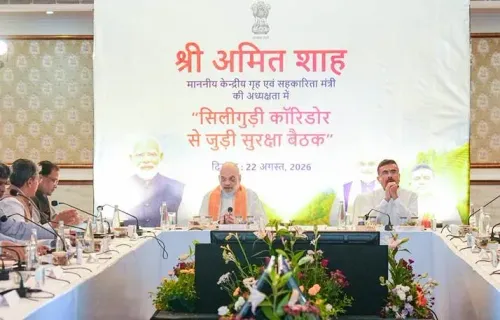
Union Home Minister Amit Shah announced on Thursday, 28 May 2026 that 121 hectares of land in the strategically vital Siliguri Corridor in West Bengal has been allocated to the Border Security Force (BSF), marking a significant step in strengthening India's border security infrastructure in the northeast.
Context
The post, shared by Amit Shah on X, states: 'Bengal mein Siliguri Corridor ki 121 hectare bhoomi BSF ko di.' ('In Bengal, 121 hectares of land in the Siliguri Corridor has been given to the BSF.'). The announcement signals a formal land transfer to the central paramilitary force responsible for guarding India's borders with Bangladesh and Nepal.
The Siliguri Corridor — also known as the 'Chicken's Neck' — is a narrow strip of land, roughly 22 kilometres wide, that connects mainland India to the eight northeastern states. It is flanked by Nepal to the north, Bangladesh to the south, Bhutan to the northeast, and lies in proximity to the Chinese border in Sikkim, making it one of India's most sensitive geopolitical chokepoints.
Policy Backdrop
Concerns over the corridor's vulnerability date back to the 1962 Sino-Indian war, after which successive central governments treated the strip as a priority area requiring dedicated security infrastructure. The BSF, raised in 1965, has long been the primary force deployed along this frontier.
In recent years, the central government has steadily expanded land and infrastructure support to border-guarding forces across the northeast — encompassing fencing projects, road construction, and the stationing of additional BSF battalions along the India-Bangladesh and India-Nepal borders. This land allocation in the Siliguri Corridor fits squarely within that broader push for enhanced border management under the Act East framework.
Stakeholders and Impact
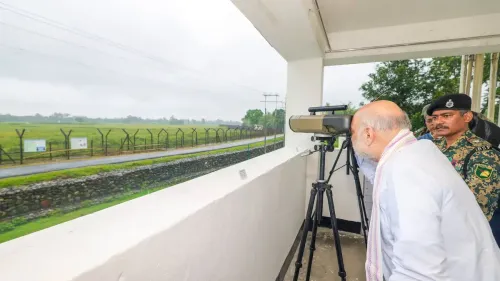
The BSF stands to gain critical operational space in one of the most strategically consequential corridors in South Asia. Additional land in the Siliguri Corridor could support the construction of forward operating bases, surveillance infrastructure, and rapid-response facilities that improve the force's ability to monitor cross-border movement.
The northeastern states — whose only land link to the rest of India runs through this corridor — are among the most directly affected stakeholders. Any improvement in security infrastructure here has cascading implications for the region's connectivity, trade, and internal stability. West Bengal, which administers the corridor districts of Darjeeling and Jalpaiguri, is a key party in the land-transfer process.
What's Next
Observers will watch for follow-on land notifications or infrastructure tenders from the BSF in Darjeeling and Jalpaiguri districts, as well as parliamentary scrutiny of corridor security during the upcoming monsoon session. The allocation could also prompt questions about the pace of fencing and road-building projects along the India-Bangladesh border in West Bengal.
With the Siliguri Corridor remaining a focal point of India's northeastern security calculus, this land transfer is likely to be the first in a series of infrastructure moves aimed at consolidating the BSF's operational footprint in the region.
Point of View
Amit Shah reinforces his image as the political architect of India's internal and border security apparatus. The move also carries a political dimension in West Bengal, where Centre-state relations over land and paramilitary deployment have historically been contentious. Taken together with ongoing fencing and road projects, this allocation suggests a systematic, long-term effort to harden the northeast's only land corridor against multiple threat vectors.
NationPress
11 Oct 2026
Frequently Asked Questions
What is the Siliguri Corridor and why is it important?
The Siliguri Corridor, often called the 'Chicken's Neck', is a narrow strip of land in West Bengal — roughly 22 km wide — that is India's only land link to its eight northeastern states. It is bordered by Nepal, Bangladesh, and Bhutan, and lies close to the Chinese border in Sikkim, making it one of the most strategically sensitive zones in South Asia.
How much land has been given to BSF in the Siliguri Corridor?
Union Home Minister Amit Shah announced that 121 hectares of land in the Siliguri Corridor in West Bengal has been allocated to the Border Security Force.
What will the BSF use the Siliguri Corridor land for?
The land is expected to support BSF operational infrastructure such as forward bases, surveillance posts, and rapid-response facilities to improve monitoring of cross-border movement along the India-Bangladesh and India-Nepal borders.
Why is the Siliguri Corridor considered a security vulnerability?
Since the 1962 Sino-Indian war, the corridor's extreme narrowness has made it a strategic chokepoint — any disruption there could sever India's land access to the entire northeast. Its proximity to four international borders amplifies the security challenge.
Which districts in West Bengal fall within or near the Siliguri Corridor?
The Siliguri Corridor primarily spans the Darjeeling and Jalpaiguri districts of West Bengal, which are the key administrative zones for any land or infrastructure decisions related to the corridor.