SHANTI Act 2025: NITI Aayog stakeholders deliberate on 3 key pillars

Synopsis
NITI Aayog's first major stakeholder consultation on the SHANTI Act 2025 mapped out the legislative, financial, and manufacturing architecture needed to open India's nuclear sector to private players — a structural shift decades in the making — as the country races toward a 100 GW nuclear capacity target by 2047.
Key Takeaways
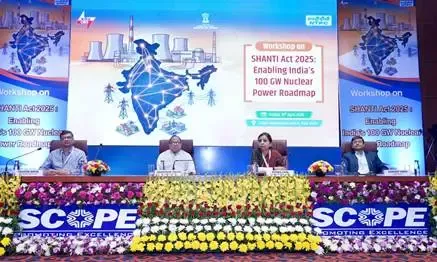
NITI Aayog held a stakeholder consultation on 11 July to deliberate on the implementation of the SHANTI Act 2025 .
Discussions were structured around three pillars : Legislative and Regulatory Framework; Finance, Insurance and Public Perception; and Manufacturing, Operations and Capacity Building.
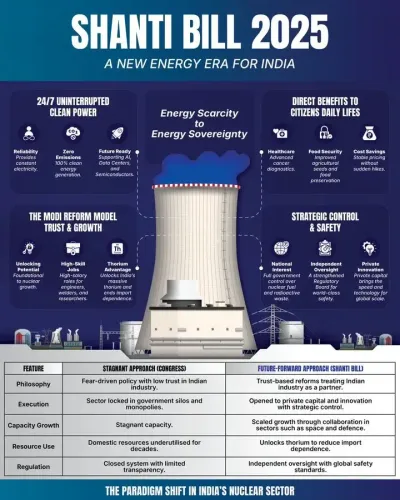
The Act enables private and joint venture participation in India's nuclear sector to bridge resource gaps and shorten project timelines.
India's nuclear energy target stands at 100 GW capacity by 2047 , aligned with its clean energy and self-reliance goals.
The consultation was chaired by Prof.
Abhay Karandikar (Member, NITI Aayog) and included senior officials from the Ministry of Power, CEA, NTPC, DAE, and AERB.
NITI Aayog on Saturday, 11 July convened a high-level stakeholder consultation on the implementation of the SHANTI Act 2025, bringing together policymakers, industry leaders, and domain experts to deliberate on the Act's operational framework across three critical pillars. The consultation is a significant step toward translating India's landmark nuclear energy legislation into a workable on-ground framework.
Three Pillars of the Implementation Framework
The technical discussions were structured around three foundational areas. The first, Legislative and Regulatory Framework, focused on the Act's draft rules, regulations, and related Foreign Direct Investment (FDI) policy provisions. Experts examined statutory compliance mechanisms and outlined how foreign capital can be mobilised while safeguarding domestic interests.
The second pillar, Finance, Insurance and Public Perception, saw stakeholders examine financial mechanisms and risk-mitigation frameworks essential to the Act's rollout. Discussions covered appropriate insurance arrangements for long-term nuclear projects and strategies to build public awareness, community trust, and broader social acceptance of nuclear energy infrastructure.
The third pillar, Manufacturing, Operations and Capacity Building, centred on the operationalisation phase. Emphasis was placed on strengthening domestic manufacturing capabilities, ensuring operational readiness, and developing a skilled workforce to sustain India's nuclear ecosystem. Stakeholders also deliberated on supply chain resilience and dedicated capacity-building programmes to support industrial scaling.
Key Participants
The consultation was chaired by Professor Abhay Karandikar, Member, NITI Aayog. Other prominent participants included Pankaj Agrawal (Secretary, Ministry of Power); Ghanshyam Prasad (Chairperson, Central Electricity Authority); Gurdeep Singh (CMD, NTPC Ltd.); Dr. Anshu Bharadwaj (Programme Director, NITI Aayog); Rajnath Ram (Adviser, NITI Aayog); Dr. Garima Sharma (Head, SSSD, Department of Atomic Energy); and Hari Kumar (Distinguished Scientist and Director, Atomic Energy Regulatory Board).
What the SHANTI Act 2025 Aims to Achieve
The SHANTI Act 2025 is designed to achieve self-reliance in India's nuclear sector and advance the country's 2047 clean energy goals. The legislation enables responsible private sector and joint venture participation to bridge resource constraints and shorten project gestation periods. Its central target is a 100 GW nuclear capacity by 2047, without compromising national security or public interest.
This comes amid India's broader push to decarbonise its energy mix, with nuclear energy increasingly seen as a reliable baseload complement to intermittent renewables. The SHANTI Act marks one of the most significant structural shifts in India's nuclear policy in decades, opening a sector long reserved for state actors to carefully regulated private participation.
What Comes Next
The inputs gathered from this consultation are expected to inform the finalisation of the Act's draft rules and regulations. With the 100 GW nuclear target by 2047 requiring a steep ramp-up in capacity, timely operationalisation of the framework — including FDI norms, insurance structures, and workforce pipelines — will be critical to keeping the programme on track.
Point of View
But for who was in the room — power ministry officials, NTPC's CMD, atomic energy regulators, and NITI Aayog advisers together signals that this is a whole-of-government effort, not a policy paper. The real test, however, lies in the FDI provisions: India has long struggled to attract credible foreign nuclear investment without diluting safeguards, and the draft rules will need to thread that needle carefully. The 100 GW target by 2047 is ambitious to the point of being aspirational — India's current installed nuclear capacity is under 8 GW, meaning a more than twelvefold increase in roughly two decades. Without a credible pipeline of projects, cleared sites, and a workforce strategy that moves faster than the consultation calendar, the target risks becoming another headline number detached from execution reality.
NationPress
10 Oct 2026
Frequently Asked Questions
What is the SHANTI Act 2025?
The SHANTI Act 2025 is a landmark Indian legislation designed to achieve self-reliance in the nuclear sector and advance the country's 2047 clean energy goals. It enables responsible private sector and joint venture participation in nuclear energy projects, aiming to bridge resource constraints and help India reach a 100 GW nuclear capacity by 2047.
What did the NITI Aayog consultation on the SHANTI Act cover?
The consultation, held on 11 July, deliberated on three critical pillars: the Legislative and Regulatory Framework (including FDI policy and draft rules), Finance, Insurance and Public Perception (financial mechanisms, risk mitigation, and public trust), and Manufacturing, Operations and Capacity Building (domestic manufacturing, workforce development, and supply chain resilience).
Who chaired the SHANTI Act stakeholder consultation?
The consultation was chaired by Professor Abhay Karandikar, Member of NITI Aayog. Senior officials from the Ministry of Power, Central Electricity Authority, NTPC, the Department of Atomic Energy, and the Atomic Energy Regulatory Board also participated.
Why does the SHANTI Act allow private sector participation in nuclear energy?
The Act opens the nuclear sector to private and joint venture players to bridge resource constraints, shorten project gestation periods, and accelerate capacity addition. India's 100 GW nuclear target by 2047 requires a scale of investment and execution that the public sector alone cannot sustain at the required pace.
What is India's nuclear energy target under the SHANTI Act?
India aims to achieve 100 GW of nuclear capacity by 2047, aligned with its broader clean energy and energy self-reliance goals. The SHANTI Act provides the legislative framework to mobilise private capital and expertise toward this target without compromising national security or public interest.