Sitharaman Highlights 56X Defence Export Growth Under Modi Govt
Synopsis
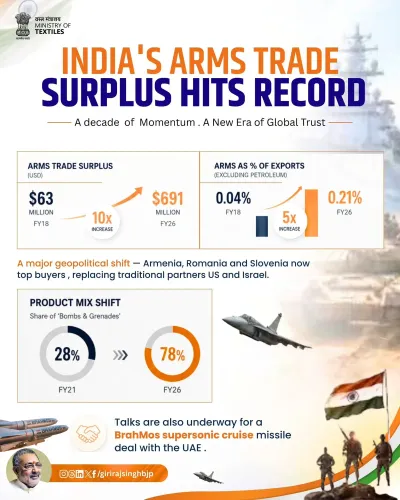
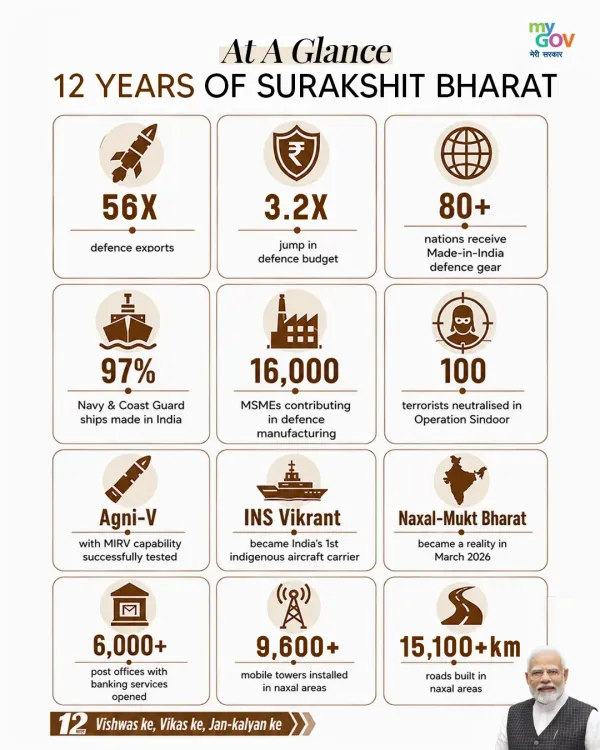
Finance Minister Nirmala Sitharaman marked 12 years of the Modi government by citing a 56-times rise in India's defence exports and the reach of Made-in-India military equipment to over 80 nations, underscoring the NDA's push for strategic self-reliance.
Key Takeaways
Union Finance Minister Nirmala Sitharaman posted on June 17, 2026 to mark 12 years of the Modi-led NDA government under the hashtag #12YearsOfSurakshitBharat .
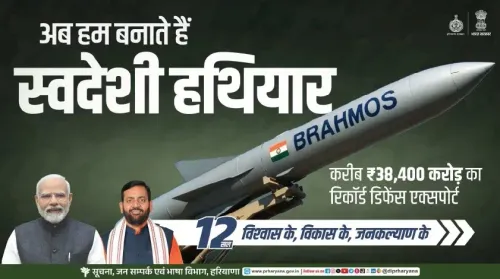
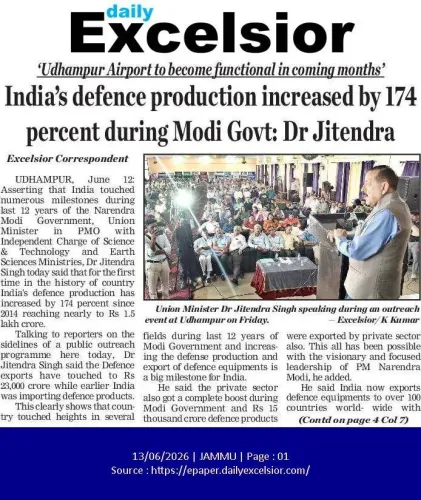
India's defence exports have grown 56 times since the NDA came to power in 2014, according to the minister's post.
Made-in-India defence equipment now reaches more than 80 countries across Africa, Asia, and Latin America.
Key policy enablers include the revised Defence Procurement Procedure (2016, 2020) and the Atmanirbhar Bharat initiative launched in May 2020.
Both public-sector defence firms and private manufacturers have benefited, deepening India's industrial and strategic ties with partner nations.
Updated defence export figures for 2025-26 and upcoming defence expos are expected to be the next milestones to watch.
Union Finance Minister Nirmala Sitharaman on Wednesday, June 17, 2026, highlighted India's defence export transformation under the Narendra Modi-led NDA government, citing a 56-times growth in defence exports and Made-in-India military equipment now reaching more than 80 nations worldwide.
Context
Sitharaman's post, shared under the hashtag #12YearsOfSurakshitBharat (12 Years of a Secure India), marks the 12th anniversary of the Modi government's tenure and frames the defence export surge as a central achievement of that period. The minister described the figures as reflecting 'India's rise in security, innovation and self-reliance.'
The post comes as the ruling BJP-led coalition marks over a decade in power, with several senior ministers taking to social media to catalogue flagship policy outcomes across sectors.
Policy Backdrop
India's defence export story is rooted in a series of structural reforms initiated after 2014. The Defence Procurement Procedure was overhauled in 2016 to prioritise indigenous systems, and revised again in 2020 to ease private-sector participation alongside Defence Public Sector Undertakings (DPSUs).
The broader Atmanirbhar Bharat (Self-Reliant India) initiative, launched in May 2020, set explicit targets for domestic defence manufacturing and a phased reduction of import dependence. The government also liberalised Foreign Direct Investment norms in defence and streamlined export licensing to enable Indian firms to compete in global markets.
Before these reforms, India's defence exports were negligible. The government has since cultivated buyer relationships across Africa, Asia, and Latin America, positioning Indian-made platforms, ammunition, and equipment as cost-competitive alternatives in developing-world defence markets.
Stakeholders and Impact
The primary beneficiaries of the export push include both public-sector giants such as Hindustan Aeronautics Limited (HAL) and Bharat Electronics Limited (BEL), and a growing ecosystem of private defence manufacturers that have entered the sector following policy liberalisation.
For recipient nations — spread across more than 80 countries — procurement of Indian defence equipment often comes bundled with financing arrangements, training, and maintenance support, deepening bilateral strategic ties. Analysts note that defence exports have become an instrument of India's broader foreign policy, reinforcing relationships in its extended neighbourhood and beyond.
Domestic industry stakeholders, including small and medium enterprises supplying components to prime contractors, have also expanded capacity as export orders have grown, creating employment and industrial depth in states with defence manufacturing clusters.
What's Next
The government is expected to release updated annual defence export figures for 2025-26 in the coming months, which will indicate whether the upward trajectory has been sustained. Upcoming editions of Aero India and other major defence expos in 2026-27 are likely to serve as platforms for showcasing new indigenous products and signing fresh export agreements.
Policymakers are also expected to expand the negative import list — which mandates domestic sourcing for an increasing range of defence items — further stimulating local manufacturing and potentially broadening the export basket available to partner nations.
Point of View
With defence exports serving as a flagship metric of the Atmanirbhar Bharat narrative. The 56X figure, if borne out by official data, represents one of the most dramatic sectoral turnarounds in India's post-liberalisation economic history and is being leveraged to signal both strategic autonomy and industrial competitiveness. By framing defence exports as an index of 'security, innovation and self-reliance,' the government is consciously linking economic nationalism with foreign policy credibility. The emphasis on 80-plus recipient nations also signals India's ambitions as a net security provider in the Global South, a posture that has strategic implications well beyond the defence industry itself.
NationPress
19 Sept 2026
Frequently Asked Questions
How much have India's defence exports grown under Modi?
Finance Minister Nirmala Sitharaman cited a 56-times (56X) growth in India's defence exports under the Modi-led NDA government, which came to power in May 2014.
How many countries buy Made-in-India defence equipment?
According to Sitharaman's post, Made-in-India defence equipment now reaches more than 80 nations , spanning Africa, Asia, and Latin America.
What is Atmanirbhar Bharat in defence?
Atmanirbhar Bharat (Self-Reliant India) is an initiative launched in May 2020 that includes specific targets for domestic defence manufacturing and reducing India's dependence on weapons imports.
What policy changes boosted India's defence exports?
The Defence Procurement Procedure was revised in 2016 and again in 2020 to favour indigenous systems and ease private-sector participation, while FDI norms and export licensing were also liberalised.
What is #12YearsOfSurakshitBharat?
#12YearsOfSurakshitBharat — meaning '12 Years of a Secure India' — is a hashtag used by BJP leaders in June 2026 to mark 12 years of the Narendra Modi-led NDA government and highlight its security and defence achievements.